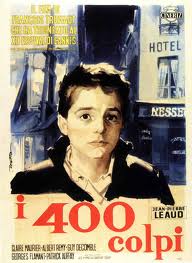
 Greetings again from the darkness. Cited as one of the films that begot the French New Wave, this one cuts straight to the nerve if you were ever misunderstood or felt isolated as a kid (and who wasn’t?). Knowing that it’s a semi-autobiographical presentation from director Francois Truffaut makes it all the more poignant. Truffaut was a troubled youth and (like many of us) used his love of cinema as an escape, and to provide hope for his future. His mentor, the famous film theorist Andre Bazim, died just before this (Truffaut’s first) film was released … it bears a dedication to Bazim.
Jean-Pierre Leaud plays 12 year old Antoine Doinel, a boy who just can’t get a break at home or school. Labeled a troublemaker (the film title translates “to raise hell” or “to live a wild life”) by a lazy, cruel teacher, and treated as a lost cause and unwanted burden by his tight-sweater-wearing mother (Claire Maurier, over 80 and still acting today) and stepfather (Albert Remy). Antoine’s days are spent reading Balzac, watching movies, and dreaming of escape. A couple of unfortunate incidents spiral out of control and he ends up first in jail, and then in an “observation center” for troubled kids.
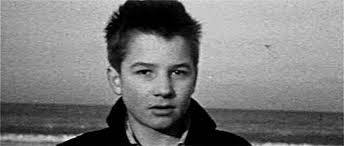 The beauty of the filmmaking is evident in most every shot … and there are some amazing extended takes. The overhead scene of the PE teacher “losing” students as they jog through the city is humorous and insightful. The puppet scene in the park is an extraordinary long take of kids’ innocent and mesmerized faces, and the extended shot of Antoine running through the countryside is a cinematic first. Above all of that is the famous ending shot – a zoom in to freeze frame of the young boy caught between land and sea (past and present).
Truffaut and Leaud teamed up for four more projects featuring the same character, Antoine Doinel. In 1962’s Antoine and Colette, he finds first love. 1968 brings Stolen Kisses and true love. 1970’s Bed & Board has Antoine getting married, and finally 1979’s Love on the Run brings divorce and life after a failed marriage. Other than the “7 Up” series, I can’t recall a movie character being tracked in real time for two decades in multiple films.
The French New Wave also included directors such as Jean-Luc Godard, Claude Chabrol, and Jacques Remy (who appears as a policemen in this movie). These filmmakers used realism to tell their stories just after the time when Hollywood was using icons such as James Dean and Marlon Brando to express rebellious youth. This makes for an interesting comparison and fun analysis. Whatever your preference, Truffaut’s first feature is clearly an exciting development for cinematic history.
**NOTE: Francois Truffaut was a huge Alfred Hitchcock fan, and published a book “Hitchcock, Truffaut” in which he interviewed Hitchcock on each of his films, in order.
**NOTE: Francois Truffaut periodically acted in films (including a cameo in The 400 Blows). His most famous role was when Steven Spielberg (a huge Truffaut fan) cast him in Close Encounters of the Third Kind.
watch a trailer (not the original trailer):


 Posted by David Ferguson


 Movie Reviews from the Dark