SXSW 2021 Day 3
 This was my third and final day of movies at this year’s South By Southwest (SXSW) virtual festival. I’ve watched and reviewed 16 movies in 60 hours, and remarkably, there wasn’t one clunker in the bunch.
Day 3 for me included a documentary, a comedy, two dramas, and a horror film. Here’s a recap:
WITHOUT GETTING KILLED OR CAUGHT (documentary)
 Jerry Jeff Walker made the lyrics famous: “If I can just get off of this L.A. freeway without getting killed or caught”, but it was Guy Clark who wrote ‘em. Co-directors Tamara Saviano and Paul Whitfield put together a profile of legendary songwriter Clark, but it’s also an intimate look at an era, the challenges of the music industry, Clark’s enigmatic wife Susanna, and at their friendship with the great Townes Van Zandt.
The film is based on Susanna’s diaries and the biography written by co-director Saviano entitled, “Without Getting Killed or Caught: The Life and Music of Guy Clark”. Most documentaries that focus on a musician spend the vast majority of time on the songs, but this is something quite different. Sure, the music is crucial to the story, but this is the saga of struggling artists and poets, and the unconventional and complicated relationships they formed. It’s more of a psychological character study than a tribute to the beautiful music.
Background on Guy and Susanna go back to each of their childhoods. We see family photos and videos, and learn Guy was brought up west Texas tough, while Susanna had a large family. Brought together by tragedy, their 40+ year relationship was built on art and a free-wheeling nature not uncommon to the times. Guy became best friends with songwriter Townes Van Zandt, and an unconventional triumvirate was the result when Townes and Susanna became spiritual soul mates.
Vince Gill, Steve Earle, and Rodney Crowell fill in some details of those early years, and more importantly provide perspective on the commitment to a specific type of songwriting that Guy held precious. There are also clips of interviews with Townes, and we learn just how difficult it was for Guy to achieve success. It came much easier for Susanna, who wrote #1 hit songs AND was an accomplished artist – her painting served as the cover of Willie Nelson’s “Stardust” album.
Of course, Guy Clark ultimately achieved both admiration and success with his songs. Jerry Jeff put him on the map, but Grammy awards came later, as did lifetime achievement awards and best-selling albums. The film includes much of Susanna’s time with “TR”, which is what she called the tape recorder, so we eavesdrop on many conversations – both personal and musical. Clips of Guy’s appearances on Austin City Limits in 1977, 1981, and 1989 are a pleasure, but the later years are a bit more difficult. The most challenging part of the story is knowing that Susanna remained bedridden after Townes’ death in 1997. Guy passed a few years later: “Texas is callin’, callin’ me home.” With narration from Sissy Spacek (as Susanna), the film is a personal journey that we are privileged to take.
SWAN SONG (drama)
 It’s never too late. We’ve all heard the phrase, but is it accurate … at least mostly? Writer-director Todd Stephens met the real life Pat Pitsenbarger in a small town gay bar, and he turned that person into this engaging story by casting the great Udo Kier in the lead. When we first meet Pat, he’s living a life of daily drudgery in a nursing home. He’s a curmudgeon whose hobbies are folding (perfectly) the paper napkins he takes from the cafeteria, and sneaking a smoke when no one is looking. We also see how tenderly he treats an incapacitated neighbor. It’s not the last time we see his two sides.
Pat was once a renowned hairdresser in Sandusky, Ohio. When he is informed that a long-time former (wealthy) client has passed away, and her dying wish was for Pat to do her hair for the funeral, he sneaks out of the home and begins a road trip down memory lane. Despite Pat spending the time on foot, the film has the feel of a true road trip movie as he crosses paths with many folks – some new and some with ties to his previous life. One of his first stops is the graveyard to visit his life partner who died of AIDS. We realize Pat still grieves.
There is a hilarious stop at a convenience store as he tries to knock off the items on his shopping list for the project. Since he has no money, Pat depends on the kindness of others … and his own sticky fingers. As he makes his way through town, some folks remember him, while others remind him of how long he’s been gone and how much has changed. His house and business may be gone, but his memories remain.
Two folks from his past generate tremendous scenes. Pat confronts Dee Dee Dale (a reserved Jennifer Coolidge) who gets to tell her side of the story of their unpleasant business split so many years ago. Even better is a “conversation” in the park with his old friend Eunice (a superb Ira Hawkins). The two old friends toast the bygone days of their gay club, while also acknowledging the new world of the gay community. It’s a touching sequence.
But the most surprising portion of the film occurs at the funeral home, where Pat imagines a final chat with that recently deceased client, Rita Parker-Sloan. What a pleasant surprise (actually shock!) to see Linda Evans back on screen. She is terrific in her brief appearance and we’ve really missed her over the last 23 years. But this film belongs to Udo Kier, and he kills. Pat is known as “The Liberace of Sandusky” and Kier embraces all that entails. This is a sentimental story punctuated by a spirited performance – and a Shirley Bassey song!
HOW IT ENDS (comedy)
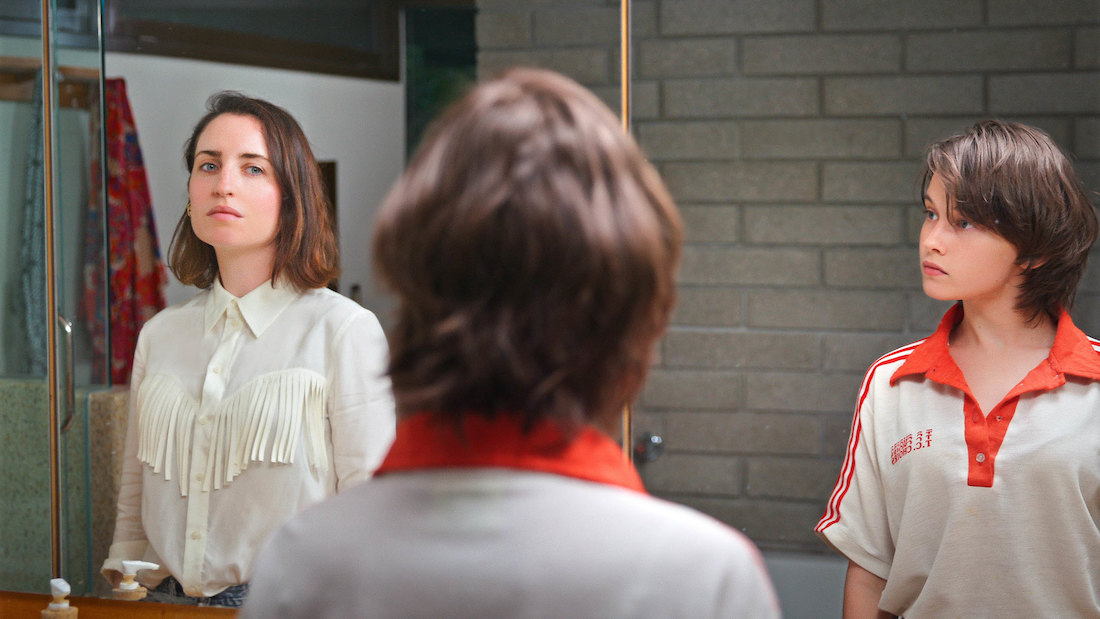
 We get glimpses of the meteor that’s speeding on a collision course with Earth, but no character ever points it out. In fact, most emit a chill vibe that corresponds to that of the film. The only exception is Liza. Played by Zoe Lister-Jones, Liza simply wants to get trashed and let the world end overnight … well after she finishes off her morning pancakes (at least a dozen) and glass of wine. Liza’s only problem is Young Liza (Cailee Spaeny), her metaphysical younger self who pressures Liza to attend the Apocalypse Party being thrown by Mandy (Whitney Cummings).
In addition to attending the party, Young Liza persuades Liza to spend the day confronting her regrets. This includes meeting up separately with her divorced parents (Brad Whitford and Helen Hunt), as well as a former best friend (Olivia Wilde), and past boyfriends, including her one true love (Logan Marshall-Green). In fact, this trip down Regret Road provides a steady stream of stereotypical California flakes. This means none of the soul-searching ever goes very deep, but playing spot-the-funny-person is a win-win. None of the interactions seem to last more than 2-4 minutes, but it’s a blast seeing how many familiar faces pop up during Liza and Young Liza’s day of walking. I won’t name the others here so that you can enjoy each moment – some more than others.
The film is co-written and co-directed by Zoe Lister-Jones and Daryl Wein, and it’s one of the more entertaining ‘pandemic’ films so far. For me, the constant roll of quick vignettes never got old, but you should know that as good as the performances are from Lister-Jones and Spaeny, the soul-searching and self-discovery only skims the surface. Still, a chill End of the World party seems perfect, even if a 1980’s relic agreed to be a punchline.
VIOLET (drama)
 Justine Bateman’s first feature film as writer-director acts an education for men and a wake-up call for women. And it’s welcome and effective on both fronts. Olivia Munn (“The Newsroom”) stars as Violet, a film industry executive whose self-doubts and lack of confidence prevent her from every really feeling happiness. Her inner voice – she calls it “the committee” feeds her bad ju-ju and keeps her obsessed with safe decisions, rather than dynamic ones … both personally and professionally.
As an example, her inner voice (Justin Theroux) pushes her to date an older, boring film executive for the sake of her career, rather than her screenwriting life-long friend Red (Luke Bracey) who clearly thinks more highly of Violet than she does herself. Violet’s boss (Dennis Boutsikaris) purposefully belittles her which causes some of her staff to also show little respect. Violet does have some supporters who recognize the talent and strength within her, but of course, it’s Violet who must come to terms with the disconnect between achieving happiness and the way she makes choices.
We see flashbacks to Violet’s childhood and understand how the seeds of self-doubt were planted. The supporting cast is excellent and very deep, though some (Bonnie Bedelia for one) only appear briefly. Filmmaker Bateman uses on screen script to let us know what’s going on in Violet’s mind as it battles with her “committee”. It’s a trick that serves the purpose well. Some may recall the “Seinfeld” episode where George does “the opposite”. Well that sentiment serves Violet well and puts her on the road to recovery … and to silencing that darn committee. A terrific first feature from Ms. Bateman, and kudos for the closing credits which put the crew on camera.
VIOLATION (drama/horror)
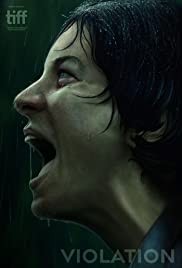 Not just another rape-revenge thriller, this film from co-writers and co-directors Dusty Manicinelli and Madeleine Sims-Fewer is one of the most brutal and unforgiving films I’ve seen in a while. Emotional pain, regret, bitterness, and compromise worm through every scene and every character.
It begins as a cabin in the woods story. Miriam (co-director Sims-Fewer) and Caleb (Obi Abili) have a strained relationship that appears headed towards a breaking point. They are meeting up with Miriam’s sister Greta (Anna Maguire) and her husband Dylan (Jesse LaVercombe) at his family cabin. There is an underlying tension that prevents the four from every being at ease with each other, though we only get bits and pieces at a time. To further force our concentration, the story is told in non-linear fashion, making it important to focus on hairstyles and details.
One evening by the campfire turns into a turning point in the film and acts as the before and after point. A primal and brutally violent sequence takes up close to half of the film, and it’s unlike anything I’ve previously seen on screen. The practical effects are next level, and Ms. Sims-Fewer is absolutely terrific throughout. A chilling use of music accompanies an odd combination of wolf-rabbit-psychopath, and the filmmakers use shots of nature as connective tissue in a world where sometimes we are the wolf and sometimes the rabbit. Certainly not a film for mass audiences, but it will surely find an appreciative following.
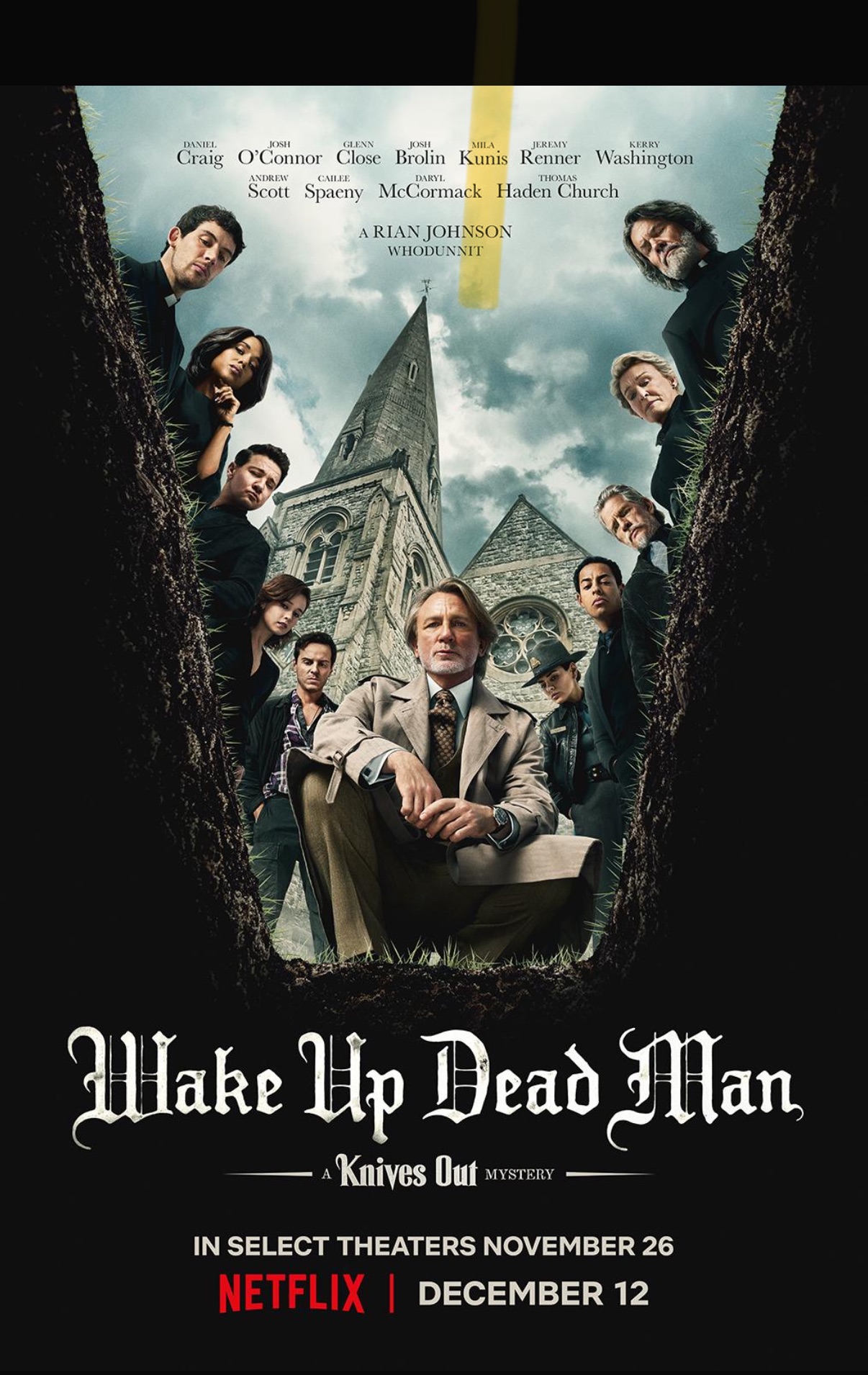 Greetings again from the darkness. The phrase ‘Third time’s the charm’ loses impact when the first two times were also charmed. Such is the case for writer-director Rian Johnson and his ‘Knives Out’ trilogy (so far). The filmmaker has really tapped into the joy of whodunits for those of us who are big fans of the genre. This third one has a darker tone and feel than the first two, but many of the elements remain in place – including a stellar ensemble of well-known actors, some whom only appear briefly.


 Posted by David Ferguson
  Greetings again from the darkness. It was less than 18 months ago when Baz Luhrman’s Oscar nominated ELVIS hit theaters and we were admiring Austin Butler’s performance. Where that movie was glitzy and loud and centered on Elvis and Col Tom Parker, this current film from writer-director Sofia Coppola (Oscar winner for LOST IN TRANSLATION, 2003) offers a quieter, more intimate glimpse at the relationship between Elvis and Priscilla through her eyes.
 Movie Reviews from the Dark