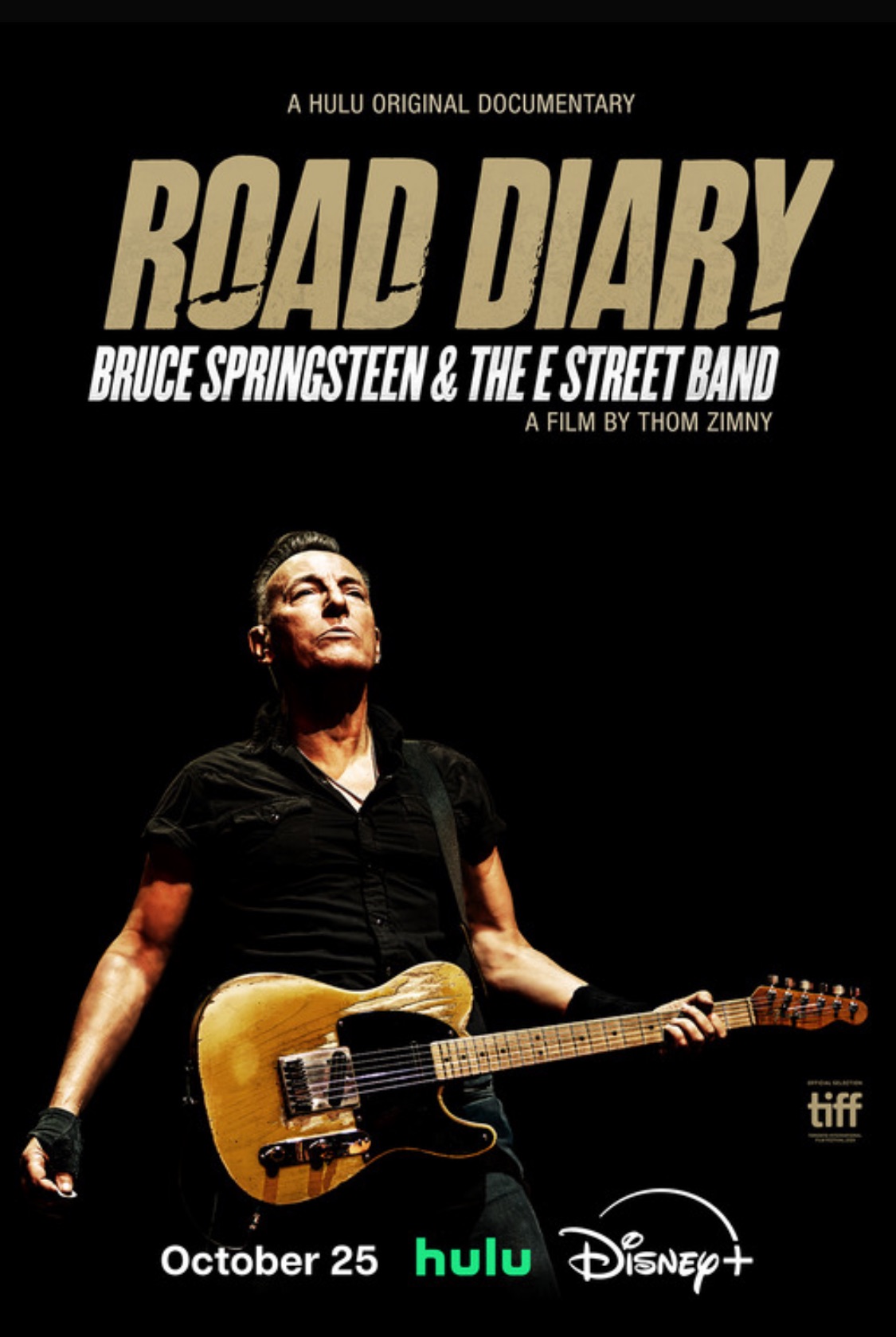
ROAD DIARY: BRUCE SPRINGSTEEN AND THE E STREET BAND (2024, doc)

October 24, 2024

Greetings again from the darkness (on the edge of town). What keeps a band together for decades? It could be the shared love of music … although many bands have split up with members continuing on in solo careers. It could be a love of performing … but again, a band isn’t needed for that. It could be friendship or family … lifelong friends Paul and John couldn’t save The Beatles, and a brotherly feud broke up Creedence Clearwater Revival. Certainly “luck” plays a role … too many deaths to count have caused the demise of bands through the years. Although no clear answer exists, it’s likely a blend of all the above combined with a certain spiritual bonding. Nowhere is that more evident than with the E Street Band. Of course, the band has a dynamic leader in (the once shy) Bruce Springsteen, but it’s obvious these musicians like and respect each other, and very much value what they have built together.

Having been a Springsteen fan since the early 1970’s, I can’t possibly be overly objective towards Thom Zimny’s documentary, so you’ve been warned. Zimny released THE BEACH BOYS documentary earlies this year, and he has a long-standing affiliation with Springsteen on music videos and other documentaries, including LETTER TO YOU (2020) and WESTERN STARS (2019). This latest is centered on the band’s 2023 tour, their first in six years and first since the pandemic. However, rather than a traditional concert flick, Zimny takes us behind the scenes for the band’s reunion, early rehearsals, and process while on the road. Most insightful are the musings from the individual band members, while Bruce’s narration provides some structure to the film.

Bruce kicks us off by recalling that as a kid, he dreamed of playing music in front of screaming fans. It’s hard to imagine his dreams were ever as big as the reality he’s living. What inspired this documentary was his promise that when the pandemic ended, he’d throw “a big party”. That’s what led to the E Street Band’s reunion for their first tour in six years. We learn bits and pieces of history as it pertains to how the band came together, and though the rehearsal time is short, Bruce explains his goals are to “shake the dust off the band” and establish the playlist for the tour. While it’s only hinted at a few times, it seems clear that his run on Broadway influenced the vision he had for this tour.

Opening night in Tampa is as exciting for the band as it is for the fans. A recurring theme for this film is the crowd shots – often close-ups of fans and their emotional reaction (tears flow freely). We can’t help but view this as spiritual for so many – the Church of E Street, if you will. Bruce is crystal clear in his desire to tell a story with the show; a story long-time manager Jon Landau describes as ‘living life now’. The show pays tribute to bandmembers lost – Clarence Clemons and Danny Federici, and Bruce’s wife and bandmate Patty Scialfa briefly discusses the health scare that has her cautiously participating in shows whenever possible.

One of the highlights is the anticipation of the tour arriving in Barcelona. Whatever you’ve heard about the crowds in Europe, what we witness goes even beyond. These fans remind me so much of those early days as they express their pure appreciation and raw emotion driven by the music. Another aspect that becomes obvious as the tour progresses is that, despite being a huge band on stage, the E Street Band is remarkably talented and incredibly tight musically. This entertainment spectacle is first and foremost a musical gem, and Steve Van Zandt (as Musical Director) probably doesn’t receive the recognition he deserves from the fans for his attention to musical details.

The segment on the cover of “Nightshift” is particularly telling on how things come together for both the music and the stage presentation. It’s noted that the song has turned into a ‘showstopper’ on tour and the film makes it obvious why. Insights from band members throughout the film infer a blended magic with influences of Jazz, R & B, Soul, and Jazz, and the music provides the proof. Piano work from Professor Roy Bittan and sax work from Clarence’s nephew Jake cover multiple styles, and when the band cuts loose, rock music has rarely been better. The film leaves us with a bit of uncertainty. Alone on stage with his acoustic guitar, Bruce (now 75 years old) sings “Last Man Standing” (noting the recent passing of George Theiss leaves Bruce as the only survivor of his original band, The Castiles). As narrator he refers to “yesterdays and goodbyes”, and then proclaims he’ll continue “until the wheels come off.” If it’s his goodbye, the legacy spans over 50 years. If the wheels stay on, we’ll chomp at the bit to see what the Boss brings us next.

Premieres on Hulu and Disney+ on October 25, 2024

WATCH THE TRAILER


BRUCE SPRINGSTEEN & THE E STREET BAND: THE LEGENDARY 1979 NO NUKES CONCERTS (2021, doc)

November 8, 2021

Greetings again from the darkness (on the edge of town). The old adage goes, “Music soothes the savage beast”. But what if it’s the savage beast playing the music? Let’s go back more than 40 years to 1979. In March, the Three Mile Island nuclear plant accident occurred, sending shockwaves through the U.S. An activist group of musicians led by Jackson Browne, Graham Nash, Bonnie Raitt and others founded MUSE (Musicians United for Safe Energy) and scheduled concerts for awareness. The concerts were better known as “No Nukes”, and were followed up by a best-selling album and videos. Performing at two of the Madison Square Garden concerts in September were Bruce Springsteen and E Street Band. All these years later, Springsteen has re-mastered the original footage and packaged it as a remarkable and breathtaking 90 minute concert film that is a must-see for any Bruce fans of yesterday or today.
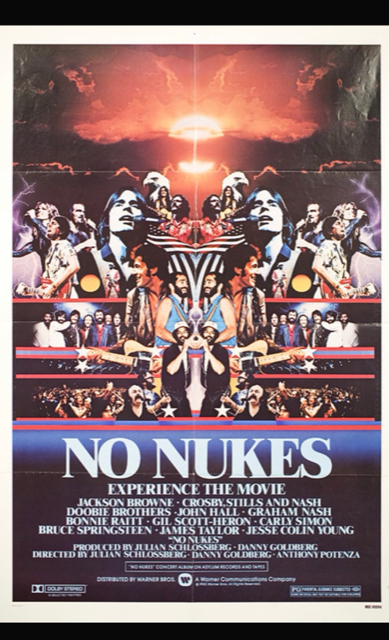
Lest you think I am an objective reviewer on this one, you should know that I caught Bruce and the E Street Band on December 7, 1978, near the end of their last tour prior to the No Nukes shows. That night in Austin remains the closest I’ve ever come to a religious experience – musically speaking. Those special memories came flooding back as I watched this 90 minute film. The raw power, sheer energy, and pure joy emanating from the stage is truly something to behold … oh, and the music was incredible.

This is much less a documentary than a concert film, but it’s certainly a different level than what we typically see in a concert film. The cinematographer, Haskell Wexler, had already won two Oscars for WHO’S AFRAID OF VIRGINIA WOOLF? (1966) and BOUND FOR GLORY (1976) and had been nominated for ONE FLEW OVER THE CUCKOO’S NEST (1975). I counted six cameras, but it’s possible fewer cameras were used and instead moved around between the two nights of shows that are blended here.

Keep in mind this was filmed two years before MTV was founded, so even his biggest fans hadn’t seen much film or video of Springsteen to this point. His reputation was built on legendary live performances, and his two most recent albums “Born To Run” and “Darkness on the Edge of Town”. This was also pre-Patty Scialfa and pre-Nils Lofgren. The music is straight-ahead, driving rock ‘n roll – five years before Bruce lapsed into “Dancing in the Dark” and became a global superstar, rather than a cult phenomenon. To this point, he had not been viewed as an activist, so his participation in the No Nukes concerts was a jackpot for the organizers, but also a turning point for Springsteen as a spokesperson on social issues (and politics).

Below is the 13 song playlist, and since this is a blend of the two nights, the easiest way to spot the difference is by Clarence’s outfit: one night he’s wearing a red suit, and the other night he’s wearing a white one. What you also notice is the athleticism and stamina of Bruce and Clarence as they bound around the stage – including the back amps to occasionally play for those seated behind the stage.

  1. Prove it All Night – (hard rock opener, setting the tone)
  2. Badlands – breakneck tempo (dedication to No Nukes volunteers)
  3. Promised Land – the third straight song from “Darkness”
  4. The River – (Bruce’s sister in the audience, written for her)
  5. Sherry Darling – (second song from “The River”, released a year later)
  6. Thunder Road – (this kicks off a string of fan favorites)
  7. Jungleland – (Roy, Steve, Clarence shine)
  8. Rosalita – (Bruce introduces the band)
  9. Born to Run – (the anthem)
  10. Stay – (Jackson Brown, Tom Petty, Rosemary Butler on stage)
  11. Detroit Medley – Devil with a Blue Dress, Good Golly Miss Molly, CC Rider, Jenny Jenny
  12. Quarter to 3 – (the Gary US Bonds hit)
  13. Rave On – the Buddy Holly cover plays over the credits

It was May of 1974 when music critic Jon Landau wrote, “I saw Rock and Roll’s future and its name is Bruce Springsteen”. Landau’s words proved prophetic (and he went on to become Bruce’s longtime manager). Very few performers have ever connected to a live audience the way Springsteen did in those days. Sure, there’s some comedic shtick on stage: “That’s all I can stand …”, before he screams, “I’m just a prisoner … of Rock n Roll”. The fact is, many of us were prisoners of Bruce Springsteen and E Street Band, and this film is the best opportunity for others to understand.  

AVAILABLE FOR DIGITAL PURCHASE ON NOVEMBER 16 AND DIGITAL RENTAL ON NOVEMBER 23


JUNGLELAND (2020)

November 9, 2020

 Greetings again from the darkness. We’ve rarely seen more improvement from an actor than what we’ve witnessed on screen from Charlie Hunnam in his nearly 25 year career. His work was particularly strong in James Gray’s LOST CITY OF Z (2017), and he builds on that here as the older brother filled with dreams of a better life. Writer-director Max Winkler (FLOWER, 2017, and son of Henry) co-wrote the script with Theodore Bressman and David Branson Smith (INGRID GOES WEST, 2017), and while it has a ‘seen this before’ vibe, we remain engaged throughout.

Hunnam stars as Stanley, the visionary who manages the underground boxing career of his brother Lion (Jack O’Connell, UNBROKEN, 2014). Lion is quiet and reserved, while Stanley thinks talking is the key to life. We don’t get the full back story on the brothers, but enough to know that Stanley has made an endless stream of bad decisions that have left the brothers squatting in a deserted foreclosed house in Massachusetts that requires them to sneak in and out of windows for access. Preaching a belief in “fate”, Stanley gushes about their future, which he envisions as a beautiful house in California and tailored Italian clothes.

In a scene that we assume has occurred numerous times, Stanley finds himself unable to pay the $2000 he owes his crime boss Pepper, played by Jonathan Majors. Rather than kill Stanley, Pepper offers him the kind of deal that seems too good to be true. All the Kaminsky brothers have to do is drive Sky (Jessica Barden) across the country to Reno, where they are to deliver her to Yates (John Cullum). At this point, we only know enough about Yates to understand that he’s not an upstanding citizen. If the brothers manage to execute this “simple” task, Pepper will ensure that Lion is added to the list of fighters of “Jungleland”, a bare-knuckles, no-holds-barred fight in San Francisco where the Grand Prize is $100,000. Stanley sees this as a much better alternative than being killed, and Lion agrees to go along with the plan.

What follows is a road trip with the Kaminsky brothers, their Whippet dog Ash, and Sky, the mysterious young lady whose minimal dialogue masks intentions that don’t necessarily mesh with the mission of trip. On the road, Stanley makes a few more less-than-brilliant decisions, while Lion and Sky bond … or do they? Regardless, things get challenging and obstacles appear everywhere. Once Yates appears, it’s a joy to behold 90 year old Jack Cullum (“Northern Exposure”) as he tears into the role of tough guy.

Mr. Winkler’s film actually has very little fighting in it, especially when compared to Gavin O’Connor’s outstanding 2011 film, WARRIOR. Instead, this is about brotherly love and the ties that bind (although so was O’Connor’s film). Surprisingly, the soundtrack features Bruce Springsteen singing “Dream Baby Dream”, and we do learn how to dress a knife wound with duct tape.

watch the trailer


BLINDED BY THE LIGHT (2019)

August 14, 2019

 Greetings again from the darkness. Last year we had Queen via BOHEMIAN RHAPSODY, and so far this year we’ve had Elton John with ROCKETMAN and The Beatles with YESTERDAY. Thanks to writer-director Gurinder Chadha (BEND IT LIKE BECKHAM), our latest musical genius to receive the cinematic treatment is The Boss … New Jersey’s own Bruce Springsteen. While this one is not a biopic of Bruce, it is based on the memoir (“Greetings from Bury Park”) of British journalist Sarfraz Manzoor, who co-wrote the script with Ms. Chadha and Paul Mayeda Berges.

Viveik Kalra stars as Javed, a Pakistani Brit living in Luton during the economic downturn of Margaret Thatcher’s run as Prime Minister. It’s 1987 and Javed faces racism and the struggles of a first generation Pakistan family pursuing their American dreams. He is a wanna-be writer who creates recession-era poems and politically-charged song lyrics for his best friend’s pop-synth band. At home, his hyper-stressed father (Kulvinder Ghir) pushes to keep his ideals on track for the family – a vision which does not allow Javed to pursue a writing career.

Javed finds a supportive teacher in Ms. Clay (Hayley Atwell), and things really change for him thanks to his energetic Sikh buddy Roops (Aaron Phagura) who introduces him to the music of Springsteen. Viveik Kalra is a relative newcomer, having only previously appeared in the TV mini-series “Next of Kin”. He shines in this role, and never more than when he conveys the near-religious experience of being touched by music the first time. The more he listens to Springsteen, the more he relates. The music helps him find his voice as a writer, and equally importantly, his place in society.

Another relative newcomer to the big screen is the terrific Nell Williams, who plays activist and rebellious Eliza. She also happens to be the love interest for Javed, and the two are quite fun to watch together. It’s a bit of a shame that the roles weren’t expanded more for both Ms. Williams and Mr. Phagura. Both characters could have contributed more to the story. Dean Charles-Chapman plays Matt, Javed’s long-time musician friend, and Rob Brydon has a comical appearance as Matt’s dad – one who appreciates Springsteen as much as Javed.

The film weaves in the cultural challenges of Javed and his family, as well as some of the Pakistan traditions and the accompanying pressures. Filmmaker Chadha doesn’t deliver a musical per se, but there are definitely some musical moments, including full production numbers that have us singing along. A few too many Jewish Springsteen jokes are included, and some may find the film a bit too light-hearted, but it’s crafted for mass appeal while blasting some classics from the theatre speakers: Promised Land, Badlands, Thunder Road, Darkness on the Edge of Town, Born to Run, Because the Night, Prove it All Night, and yes, even “Hungry Heart”. These songs are the inspiration for the movie, just as they were for Mr. Manzoor. Sure, there are some silly moments, but mostly it’s an entertaining and inspirational message movie wrapped in BRUUUUUCE!

watch the trailer:


ASBURY PARK: RIOT, REDEMPTION, ROCK N ROLL (2019, doc)

May 23, 2019

 Greetings again from the darkness. Ask most people what they think of when you mention Asbury Park, New Jersey, and the vast majority would answer Bruce Springsteen. In today’s global music climate, it’s rare for a musician to be so closely associated with a city or geographic area. Perhaps only Elvis and Memphis eclipses The Boss and Jersey. However it’s important to note that this documentary from director Tom Jones (no, not that one) is not the story of Bruce, but rather a historic tale of a divided city whose music defined a generation.

New Jersey radio personality Big Joe Henry narrates the film, and we learn Asbury Park was founded in 1871, and became a town literally divided by railroad tracks (not the proverbial kind). The East side was populated with well-off citizens and tourists, while the West side was comprised of working class and minorities. Though only 1 square mile in size, the city’s division and segregation was clear and beyond question. Of course, the one aspect those tracks couldn’t stop was the music.

What happened in the 1960’s was a blend of jazz, soul, R&B, rock and blues. Music acted as a uniter in the evenings after the daytime maintained the line of demarcation. We hear the stories from the local musicians who thrived during the era: Steven Van Zandt, Southside Johnny Lyon, David Sancious, Max Weinberg, Garry Talent, Vini “Mad Dog” Lopez, and Edward Carter among others. To top it off, we get New Jersey’s own Bruce Springsteen casually lounging on a chair (well-lighted, mind you) within the walls of the infamous Upstage Club, deserted for more than 40 years, but looking pretty much the same as it did when a young Bruce and all of the previously named musicians played there.

July 4, 1970, changed everything for Asbury Park. Race riots, police, destruction, and fire. The city went through some dark times. Urban blight prevailed on the west side, and to this day it has not recovered. On the other side of the tracks, the east side has bounced back with music, the boardwalk and resorts leading the way. The Empress Hotel features The Paradise Club, a favorite establishment for the gay community … a community that has been behind much of the town’s resurgence.

It’s quite fascinating to have these local musicians recalling their own memories, and how the artistic freedom provided by The Upstage allowed their music to blossom. Asbury Park is described as “the Liverpool of America”, and through these passionate interviews, we get a taste of how. Not much actual music is included in the film, though near the end, we see clips of Springsteen joining Steve Van Zandt on stage with some young students from the local Lake House Music Academy. The film is co-sponsored by Jersey Mike’s and Halo X media, with much of the proceeds going to youth music programs. The only way this could have ended better would have been Bruce playing Ten Years After’s “I’m Going Home” … for 30 minutes.

watch the trailer:


ALL THINGS MUST PASS (2015, doc)

November 6, 2015

all things must pass Greetings again from the darkness. I do not envy those experiencing their childhood in this modern era. Sure, they have far superior electronics and hundreds more TV channels, but they also have very little independence (most can’t even walk alone to a friend’s house or a park) and they likely will never experience the pure joy of perusing the stacks at Tower Records (or any other record store) for hours … experiencing the thrill of discovering a new artist or style of music that rips into their soul. OK, I admittedly suffer from a touch of “old man” syndrome, but filmmaker Colin Hanks (yes, the actor and son of Tom) has delivered both a cozy trip down memory lane and a stark accounting of good times and bad at Tower Records.

With humble beginnings as little more than a lark, Tower Records began when Russ Solomon’s dad decided to sell used 45 rpm singles in his cramped Sacramento drug store. He bought the singles for 3 cents and sold them for 10 cents. Within a few years, Russ purchased the record business from his dad, and proceeded to run it as only a rebellious kid from the 1960’s could. From 1960 through 2000, the business grew each year. It expanded the number of stores (peaking at 192 worldwide) and constantly adjusted to the musical tastes and the delivery method – 45’s, LP’s, cassettes, CD’s, etc.

Using some terrific photographs and video clips, accompanied by spot on music selections, director Hanks brilliantly and generously allows the actual players to tell the story. The expected celebrity drops are present, and even the words of David Geffen, Dave Grohl, Bruce Springsteen and Sir Elton John carry emotion. However, far and away the most impact comes from extended interviews with the unconventional and charismatic Tower Records founder Russ Solomon and his devoted and forthright employee team. Their sincere recollections provide the roadmap through the phenomenal growth, as well as the devastating end in 2006. We understand how these stores became so much more than retail outlets … they were cultural hotspots for at least two generations. We also learn some things we probably shouldn’t … like the definition of “hand truck fuel”, and the reason Russ installed hot lighting in the listening booths.

Mr. Hanks surprises with his ability to balance nostalgia and the harsh realities of the downfall of an iconic cultural business. The film captures the key role Tower Records, while also pointing out that the crash was due to more than just Napster and digital music delivery. An interesting case study for business majors highlights the importance of vision vs debt. For more insight from Colin Hanks, check out the interview from film critic Chase Whale: http://www.hammertonail.com/reviews/documentary/a-conversation-with-colin-hanks-all-things-must-pass/

“No Music. No Life”. The motto of Tower Records was somehow inspirational, and fit perfectly for stores that featured mammoth album artwork on their store fronts, their own “Pulse” magazine, and staff that couldn’t fathom life without music … much less wearing a suit and tie to work. This was truly “a chain of independent stores”, and trust me when I tell you that hanging out at Tower Records was more fun than having hundreds of cable channels.

watch the trailer:


20 FEET FROM STARDOM (2013)

July 1, 2013

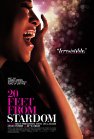
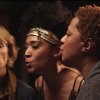
20 feet1 Greetings again from the darkness. “And the colored girls go do doo doo, do doo …”. The controversial lyrics from Lou Reed’sWalk on the Wild Side” kick off this exceptional documentary about the oft-ignored back-up singers who have played (and continue to play) a huge role in some of the biggest songs of all-time. You may not know their names, but you have undoubtedly sung along with them while driving or taking a shower.

Director Morgan Neville has a credit list filled with music shorts and documentaries. One of my personal favorites of his is “The American Masters” on Muddy Waters. I recalled that while watching this one because Neville does a nice job of connecting the dots from Gospel, Blues and Soul to the roots of Rock and Roll. The main women featured here all admit to being daughters of preachers, and fine-tuning their ability to harmonize during their youth while singing in the church choir.

20 feet5 Most of the interview time and insight comes from Darlene Love, Lisa Fischer, and Merry Clayton. You may not recognize the names or faces, but you will surely recognize the voices. Ms. Love has been elected to the Rock and Roll Hall of Fame, and may be best known thanks to her annual appearance on the David Letterman Show at Christmas. Ms. Fischer is the most frequent worker today of the three as she tours with Chris Botti, Sting and The Rolling Stones. However, the heart-stopping climax of the film belongs to Merry Clayton, as we are treated to her isolated vocals from the master on her infamous performance on the single “Gimme Shelter“. Hearing her raw voice blast out “Rape. Murder. It’s just a shot away” is both exhilarating and gut-wrenching. To hear her tell the story is mesmerizing. One of my favorite movie moments ever.

20 feet2 While we see and hear the personal stories filled with frustration and regrets, we also see an inherent love of music and the appreciation for their particular gift. We also hear from Tata Vega, Dr. Mabel John (a former Raelette for Ray Charles), and Claudia Lennear. With many similar stories of their quest for solo careers, we get the contemporary version with Judith Hill, a twenty-something working back-up today as she strives for a solo career. The parallels are obvious with her older peers.

Another excellent feature of the film comes in the form of interviews from the likes of Bruce Springsteen, Sting, Stevie Wonder, Lou Adler, Chris Botti, and Mick Jagger. We also see some studio shots featuring Phil Spector (once the hottest music producer, now incarcerated), and concert footage of Talking Heads, Ray Charles, The Rolling Stones, and the Concert for 20 feet3Bangladesh. It’s especially fitting to see Luther Vandross as a back-up singer to David Bowie‘s “Young Americans“, and to hear from Sheryl Crow, who worked as Michael Jackson’s back-up/lead female. These are the examples of the back-ups who successfully made the walk.

My only minor quibble with the film is structural, not content. Neville has an over-whelming task of addressing each of the individual stories, while also relating it to the nasty and unfair music business, the Civil Rights movement, the development of Rock and Roll, and the role that “talent” plays in what Springsteen terms the “complicated” walk from back-up to lead singer (the titular 20 feet). The segment focusing on Merry Clayton’s role in Lynyrd Skynyrd’s “Sweet Home Alabama” is especially poignant. Overall this film is fascinating and entertaining, and makes a great companion piece to Standing in the Shadows of Motown (2002) and Muscle Shoals (2013).  Whether or not you are a fan of documentaries, this is a film to be enjoyed by all.

watch the trailer:

http://www.youtube.com/watch?v=tWyUJcA8Zfo