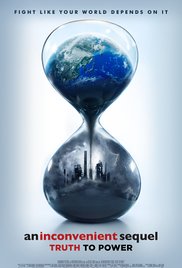
 Greetings again from the darkness. Eleven years ago, former Vice President Al Gore teamed up with filmmaker Davis Guggenheim to deliver a significant and startling wake-up call in the form of the documentary AN INCONVENIENT TRUTH. Not only was this the first introduction to the science of “global warming” for many, it also won an Oscar for Mr. Guggenheim and contributed to Mr. Gore winning the Nobel Peace Prize.
Co-directors Bonni Cohen (THE RAPE OF EUROPA) and Jon Shenk (LOST BOYS OF SUDAN) seem conflicted on the purpose of this sequel. Is this a frightening eye-opener on the climate-related changes over this past decade, or is it an attempt to return the spotlight to a faded rock star? The film provides evidence of both.
The film kicks off with a reminder of how powerful the original documentary was and how it started an avalanche of deniers … even re-playing Glenn Beck’s comparison of Al Gore to Joseph Goebbels as being weak sources of truth. Mr. Gore is on screen almost the entire run time. He is a self-described “recovering politician”, yet we see him acting very much like an esteemed politician: presenting on stage, shaking hands with the adoring crowds, posing for selfies, giving speeches, appearing on talk shows, and coming across as a highly-polished public figure reciting well-rehearsed lines.
As we would expect, the film is at its best when it focuses not on the celebrity and commitment of Mr. Gore, but rather on the statistics and documentation of these earth-changing developments. Some of the featured videos are surreal: the 2016 Greenland glaciers “exploding” due to warm temperatures, the flooded streets of Miami Beach from rising tides, and the aftermath of the Philippines typhoon are particularly impactful. There is even a connection made between the severe drought and the Syrian Civil War in creating an especially inhumane living environment. A Gore trip to Georgetown, Texas and his visit with its Republican mayor is effective in making the point that political platforms should have no bearing on our doing the right things for our planet. There simply aren’t enough of these moments.
A central focal point is the 2015 UN Climate Conference in Paris, and cameras are rolling when terrorism causes fear for the safety of 150 heads of state, and necessitates a delay in the proceedings. We are privy to some of the behind-the-scenes negotiations that include Solar City agreeing to “gift” technology to India in an attempt to have that country join the accord and reduce from 400 the number of planned new coal plants. Of course as we now know, the historic Paris Climate Accord has since been compromised with the pull out of the United States after the recent election.
Is the purpose of the film to keep climate change believers motivated, or are the filmmakers (and Gore) attempting to educate those who might still be won over? With so much attention to Mr. Gore’s ongoing efforts (and an attempt to solidify his legacy), it often plays like a pep talk rather than a fact-based documentary.
There is no questioning the man’s passion, though his screen presence over two hours is hampered by his reserved manner. He states clearly that he is “not confused about what the right thing to do is”, and even compares his mission to the Civil Rights movement. Gore labels the lack of global process as a “personal failure on my part”, while simultaneously claiming the Democracy crisis has affected the attention given to the climate crisis. His frequent proclamations that “we are close” seem to be in conflict with the many setbacks. Are we close? The film seems to offer little proof.
watch the trailer:


 Posted by David Ferguson
 Movie Reviews from the Dark