Greetings again from the darkness. As one who readily admits to unabated cringing at most romantic-comedies, it’s with a certain burst of pride that I acknowledge that this one from first time writer-director Matthew Shear is actually quite entertaining, and possesses a minimal cringe factor. There are likely a couple of reasons for this. First, Mr. Shear, who also stars in the film, has clearly been influenced by his time acting on filmmaker Noah Baumbach’s sets, and the second reason would be the most welcome presence of Amanda Peet in her first big screen role in 10 years.
We first meet Sam (Matthew Shear) as he’s being fired from his job, and soon after as he’s having a panic attack in a coffee shop. We recognize Sam’s overall lack of confidence, even before he heads to his appointment with a psychiatrist (Judd Hirsch). It’s there where the receptionist (Andrea Martin) suggests he consider babysitting for her three granddaughters. Sam initially views this nanny/manny position as temporary, but of course, it ends up being an extended gig. In fact, the story is loosely divided into the seasons of the year.
Sam is instantly attracted to Dianne (Amanda Peet), the mother of the three girls. Dianne is attempting to revive her acting career (it’s an age thing) while also managing a teetering marriage to musician David (Alessandro Nivola). David announces he’s headed out on an extended tour in Australia, making Sam’s manny position all the more crucial to Dianne … providing the time and proximity for the two to get better acquainted. Their initial bonding comes courtesy of granola.
Touches like the granola and the realization that the story doesn’t go down the predictable road are what set this one apart from the slew of mush in this genre. Mental health and the meds-of-the-day are part of the landscape, as are antisemitism and ageism. There is even a ‘Lake Bell’ crack and a grumpy grandpa. We do get the obligatory disastrous family dinner, but even that is handled with a spin. The ensemble cast is exceptional. In addition to Judd Hirsch and Andrea Martin, we are also treated to Bob Balaban, Jessica Harper, Holland Taylor and Zosia Mamet. Each is terrific, but let’s leave no doubt … this is Amanda Peet’s moment to shine (again), and she seizes it. As a winner of the SXSW Narrative Feature Audience Award, Matthew Shear’s film proves anxiety and NYC angst can play wide. The film may be as much character study as it is rom-com, but I’m sticking to my ‘minimal cringe’ description as a compliment.
Greetings again from the darkness. Few things in the cinematic world are more instantly recognizable than a Wes Anderson movie. In fact, historically speaking, perhaps only Jacques Tati comes as close to having a signature style easily spotted by viewers (unless you want to count Tom Cruise sprinting or Julia Roberts cackling). This is Mr. Anderson’s 10th feature film in 25 years, and I now rate 5 of these very highly, though all 10 have a certain appeal. This latest, co-written by Anderson with frequent collaborators Roman Coppola, Hugo Guinness, and Jason Schwartzman, could be considered his most ambitious to date … and likely the most ‘Wes Anderson’ of all.
Billed as a love letter to journalists, it becomes crystal clear, that by this, Anderson means the esteemed stable of writers from the early days of “The New Yorker”. In fact, Anderson structures the film as if it were following the path of a magazine being published. We are informed upfront that this edition features “an obituary, a travel guide, and 3 feature articles”. An episodic format is not unusual for films, yet Anderson never does anything by the book. Each piece takes place in its own time period, and there appears to be little connection or crossover among key characters. Still, somehow he makes this work by ensuring each piece stands on its own and is filled with unusual characters and those patented, fabulous Anderson visuals.
The obituary is that of Arthur Howitzer Jr (a deadpan Bill Murray), the founder and publisher of “The French Dispatch” magazine, a spin-off from The Liberty Kansas Evening Sun … a move from a small town in Midwestern United States to a charming small town in France (hilariously and fittingly) named Ennui-sur-Blasé. Howitzer adores his writers, and the only guidance he offers them is, “Just try to make it sound like you wrote it that way on purpose”. He also has a “No Crying” sign posted in his office, likely as much as a reminder to himself as a rule for the staff.
Our travel guide section is fortunately quite brief since it involves Owen Wilson as a bicycle tour guide showing us around the town – the “Local Color”- of Ennui-sur-Blasé. This takes us to the first feature story, and the best of the lot. Tilda Swinton excels (doesn’t she always?) as a writer and art expert giving a colorful lecture entitled “The Concrete Masterpiece”. She tells the story of Moses Rosenthaler (Benecio del Toro), a genius modern artist serving a life sentence for murder, and as she lectures, we see it play out. While incarcerated, Moses continues to work and his muse is a prison guard named Simone, played exceptionally well by Lea Seydoux. Her nude posing for him leads to his signature modern art piece, which attracts the attention of an ambitious art dealer played by Adrien Brody.
“Revisions to a Manifesto” is the next feature, and it involves a young activist named Zeffirelli (Timothee Chalamet). He’s a chess expert, quite moody and has a questionable quest. He’s being covered by writer Lucinda Krementz (Frances McDormand), who is unable to maintain objectivity, and inserts herself right into the story, amongst other things. The segment pays tribute to the activism of the 1960’s and is filmed mostly in black and white.
The third feature, “The Private Dining Room of the Police Commissioner” involves writer Roebuck Wright (Jeffrey Wright) telling his story while a guest on Liev Schreiber’s Talk Show in the 1970’s. Roebuck is obviously inspired by James Baldwin, and he famously recalls every line he’s ever written. The story he recites involves a legendary chef played by Steve Park.
Actors mentioned so far are just the headliners, and Anderson has packed the film with his usual troupe, as well as dozens of others – some you’ll recognize, and some you won’t. There are at least seven Oscar winners involved: Christoph Waltz, Fisher Stevens, and Angelica Huston (as narrator), in addition to the aforementioned Swinton, McDormand, del Toro, and Brody. Numerous Oscar nominations and awards are included in the group of other familiar faces like Willem Dafoe, Saoirse Ronan, Edward Norton, Lois Smith, Henry Winkler Bob Balaban, Elisabeth Moss, and Mathieu Amalric.
Other frequent Anderson collaborators who deliver standout work include Production Designer Adam Stockhausen, Cinematographer Robert Yeoman, Editor Andrew Weisblum, and composer Alexandre Desplat. The film looks and sounds remarkable, and somehow it doesn’t feel like it’s moving fast – although we can barely keep pace. The film can be compared to ordering a flight at your local distillery. Each flavor is tasty, but they may not add up to a full drink.
Wes Anderson has delivered another stylish, fun film to watch, and one that is endlessly entertaining. It may not have as many moments of laughter as some of his previous films, yet there are still plenty of sight gags, insider references, and light-heartedness bathed in nostalgia – even if it’s not quite as whimsical. Shot in the French town of Angouleme, the visuals are as impressive as any you’ll find, serving up a collage of time, caricatures, color, and topics.
Opening nationwide in theaters on October 29, 2021
Greetings again from the darkness. Despite my fascination and quasi-obsession with movies, the Science Fiction genre has never really appealed to me. Sure, there have been a few dozen exceptions over the years (and it depends how you categorize certain movies), but it’s the non-classics in the genre that just never seem to connect with my love of film. So when Steven Spielberg states that he doesn’t consider his beloved CLOSE ENCOUNTER OF THE THIRD KIND(CE3K) to be a “sci-fi” film, you won’t see me get offended, or even offer a contrary argument. Of course, the difference is that Mr. Spielberg makes his claim based on his belief of life “out there”, while I simply have no desire to defend the category label.
For its 40th anniversary, the film is making the rounds in selected theatres, and the big screen is a must for this gem. Released in the same year and just a few months after George Lucas’ groundbreaking STAR WARS, Spielberg’s follow-up to JAWSconfirmed his status as a revolutionary filmmaker, and cemented 1977 as one of the finest movie years of all-time (including ANNIE HALL, SATURDAY NIGHT FEVER, A BRIDGE TOO FAR, JULIA). CE3K would become the first of 7 Best Director Oscar nominations for Spielberg (inexplicably only one win to date).
Spielberg is credited as the writer, though many contributors are “uncredited”: Hal Barwood (now known for video games), Jerry Belson (Emmy winner for “The Odd Couple” and his work with Tracey Ullman), and John Hill (QUIGLEY DOWN UNDER), and Matthew Robbins (CRIMSON PEAK). Paul Schrader and Walter Hill also contributed to the script, making this the veritable vegetable soup of screenplays. The film came at a time when Columbia Pictures was struggling, so in order to remain under budget, Spielberg had to make some compromises on the final version. In a highly unusual development in the movie industry, Spielberg was able to revise, re-edit, and add new scenes to a 1980 re-release of the film – realizing his original vision.
Richard Dreyfuss stars as Roy Neary, a blue collar family man from Muncie, Indiana. With an acting career spanning more than 50 years (many recognize his baby face in THE GRADUATEas he offers to call the cops), it was AMERICAN GRAFFITIthat caused his career to take off, leading to JAWS in 1975, and his stellar 1977 with both CE3K and THE GOODBYE GIRL. He later overcame a severe drug habit to star in such crowd favorites as WHAT ABOUT BOB?,MR. HOLLAND’S OPUSand “Madoff”. His wife Ronnie in CE3K is played by Teri Garr, whose acting career also covers more than 50 years, including small roles in five different Elvis movies in the 1960’s and her best known roles in YOUNG FRANKENSTEINand TOOTSIE (for which she received a Best Supporting Actress Oscar nomination). In recent years, she has had to turn her energy and attention to health issues.
Melinda Dillon stars as Jillian, mother to young Barry (Cary Guffey) who is abducted by the aliens. Ms. Dillon received her first (of two) Oscar nomination for her work in the film, and is still seen annually breaking a leg lamp in the holiday favorite A CHRISTMAS STORY, although she retired from acting ten years ago. Young Mr. Guffey is now 45 years old and hasn’t acted since 1985. Director Stanley Kubrick considered him for the role of Danny in THE SHINING, but ultimately decided on Danny Lloyd, another youngster who decided against remaining in showbiz.
Francois Truffaut was an Oscar nominated director known for kicking off the French New Wave of Cinema with his all-time classics THE 400 BLOWSand JULES AND JIM, and it was quite surprising to see him cast in the role of UFO expert Claude Lecombe. It’s likely that cinephile Spielberg loved the idea of working with a peer whose work he so admired. Truffaut is a significant screen presence despite his challenges with the English language (which led to “dialogue cheat sheets” throughout filming). Bob Balaban, so familiar to “Seinfeld” fans, plays the translator, while Justin Dreyfuss (Richard’s real life nephew) is the noisy and obnoxious son during the hectic family scene. Roberts Blossom is the one in the film who admits to spotting Bigfoot, and is best known as Kevin’s neighbor in HOME ALONE and the braced-up car seller in CHRISTINE. He was also a well-respected poet before passing away in 2011. Other familiar faces include Lance Henrikson (ALIENS), George DiCenzo (BACK TO THE FUTURE), Carl Weathers (ROCKY), CY YOUNG (OK, more a name than a face), Bill Thurman (Coach Popper from THE LAST PICTURE SHOW), and gas mask salesman Gene Rader, who hails from Paris, Texas.
Desert discoveries are a key here, and offer more insight into Spielberg’s attention to history. The “lost” plane is a tribute to real life Flight 19 which disappeared in 1945, and The Cotopaxi was a real cargo ship that sunk … both becoming part of Bermuda Triangle lore. Devil’s Tower in Wyoming is also significant here, and it’s Spielberg’s nod to John Ford’s frequent use of Monument Valley in his westerns. Spielberg has admitted to watching Ford’s THE SEARCHERSdozens of times while filming CE3K. Another tribute comes in the form of a wind-up monkey with cymbals. It was previously seen in REBEL WITHOUT A CAUSE, and can also be viewed as a precursor to the infamous clown in POLTERGEIST.
Spielberg acknowledges being inspired by President Nixon and the Watergate scandal. He wondered what else the government might be hiding from us. Remarkably, he gets his point across with a total absence of modern day cynicism. As opposed to what we usually see these days, the military isn’t trying to bomb the mothership and citizens aren’t retreating in a panic to bunkers. Instead, the military is working to keep the public safe (albeit through some sneaky strategy), the scientists are approaching communication through a protocol steeped in research and data gathering, and Dreyfuss and Dillon are trying to figure out why they were “chosen”. Spielberg delivers sweetness and warmth rather than a show of power and might. It’s such a pleasant viewing experience to watch people we like and to whom we can relate.
Some points of interest related to the film include a cameo from famed UFOologist J Allen Hynek, who is seen smoking a pipe as the abductees are released from the mothership. Mr. Hynek actually created the phrases Close Encounters of the First, Second, and Third Kinds. ABC news anchor Howard K Smith is seen since CBS would not grant permission for Walter Cronkite to appear. The film’s stunning visual effects come courtesy of Douglas Trumball, who also collaborated with Stanley Kubrick on 2001: A SPACE ODYSSEY. Of course, the Visual Effects Oscar that year went to STAR WARS, and that speaks to the contrast between the films. STAR WARSis clearly a special effects movie, while CE3K is much more of a character study … a study of human emotions.
As for other Oscar categories, the film was nominated for 9 total, with the only win going to Cinematographer Vilmos Zsigmond, though it was also awarded a Special Achievement Oscar for Sound Effects Editing. Spielberg was nominated, but Woody Allen won Best Director for ANNIE HALL, and Richard Dreyfuss actually won the Best Actor Oscar that year for THE GOODBYE GIRL. The great John Williams was of course nominated for his iconic 5 note melody (following up his immortal JAWS theme), and he instead won the Oscar that year for … repeat after me … STAR WARS. A quirky note on the music – the “voice” of the mothership was a tuba, not an instrument that typically gets much publicity.
While Stanley Kubrick opted not to show aliens in 2001: A SPACE ODYSSEY, this film not only puts the aliens front and center, it reminds us to keep an open mind to those unfamiliar to us … a lesson that is still important today. The film was named to the National Film Registry in 2007, and seeing it on the big screen allows for the full impact of awe and wonderment. It’s rated PG and can be enjoyed by most ages. Spielberg only asks that you leave the cynicism at home.
Greetings again from the darkness. Movies based on real life are often some of my favorites, but that doesn’t let them off the hook in needing to be well made. The real life story of the Monuments Men provides both pride and heartbreak. The Allied group tracked down and rescued so much Nazi-stolen artwork, while at the same time being so short-staffed that they resorted to picking and choosing what parts of history and culture to save.
For much of 2013, this movie was mentioned as a possible Oscar contender. When the release date was delayed and director George Clooney admitted he was struggling with the film’s “tone” – a balance of comedic and dramatic and historic elements – all the warning flags shot up. This final version would certainly have benefited from script improvement, though the cast is so strong and the mission so true, that the film is still enjoyable enough. Director Clooney and co-writer Grant Heslov have adapted the source material from Robert M Edsel, but Clooney can’t resist stamping the movie with his smirk appeal, despite capturing the look of the era.
The actual Monument Men spend very little time together, so it’s tough to call this an ensemble piece. Bill Murray and Bob Balaban have their own subtle comedy routine going, while John Goodman and Jean Dujardin enjoy a jeep ride. Matt Damon and Cate Blanchett add a dose of gratuitous love interest where it’s not needed, and Hugh Bonneville strikes the heroic pose of redemption. Director Clooney ensures that actor Clooney and his buddy Damon get the most screen time and close-ups, detracting from what the real story should be … the men who saved art and culture.
Michelangelo’s Madonna of Bruges and Hubert van Eyck’s Ghent Altarpiece are supposedly the centerpieces of this group’s mission, but the film really is just an amalgam of individual scenes that leave the viewer working frantically to tie all the pieces together. Shouldn’t that be the filmmaker’s job? The question gets asked a couple of times, “Is art worth a human life?”. That critical theme could have been the core of a far superior movie … one not in such desperate need of suspense rather than more punchlines.
Very few war projects have successfully blended comedy and drama. A few that come to mind are Kelly’s Heroes, The Dirty Dozenand TV’s “Hogan’s Heroes“. It’s a tricky line to walk, even with a great cast. So while this one has sufficient entertainment value for a February release, I would rather recommend two others that deal with this same subject matter: The Rape of Europa(2007, documentary) and The Train(1964, directed by John Frankenheimer, starring Burt Lancaster).
**NOTE: the phrase “women love a man in uniform” was well established prior to anyone seeing John Goodman don the Army green.
**NOTE: the actor playing an elderly Frank Stokes (Clooney’s character) viewing the Madonna near the end of the movie is actually George Clooney’s real life father.
SEE THIS MOVIE IF: it’s February and you just need a pleasant movie break
SKIP THIS MOVIE IF: you are seeking for an in-depth look at the fascinating folks behind this fascinating story
Greetings again from the darkness. Not many people think like Wes Anderson. That’s probably a good thing in real life. It’s definitely a good thing for movies. He is a creative and distinct filmmaker, though not one with mass appeal. My two personal favorites of his are The Royal Tenenbaumsand Rushmore. His previous film, Fantastic Mr Fox, was a solid hit and critically lauded. Now he delivers one that will probably only click with his core fans. It’s a thing of beauty … if you keep in mind that beauty is in the eye of the beholder.
Set on the fictional New Penzance Island off the coast of New England in 1965, the movie opens with terrific visuals of the Bishop family’s lighthouse/home. Our tour is conducted as if the home were a dollhouse, and our eyes struggle to keep up with the detailed decor. We are struck by the color palette of tans, greens and splashes of red. This will continue throughout the movie.
The story centers around two 12 year old misfits: Sam and Suzy. Sam is an orphan and outcast in his Khaki Scouts troop, and Suzy is misunderstood and ignored by her selfish parents, who communicate with a bullhorn and through legalese at bedtime (they are both lawyers). Sam and Suzy are attracted to each other’s misery and decide to run away together (yes, they are on an island). This ignites a flurry of activity on this quiet island and showcases two first time actors with remarkable screen presence: Jared Gilman (Sam) and Kara Hayward (Suzy).
The “grown-ups” on the island include Suzy’s parents played by Bill Murray (a Wes Anderson regular) and Frances McDormand. The island police chief is played Bruce Willis, who we soon figure out is also a social outcast. The Scoutmaster is played by Edward Norton with a regimented weirdness that will have you laughing in confoundment. For such serious topics, Mr. Anderson and co-writer Roman Coppola provide us many comedic moments – both through dialogue and site gags.
During the search, other colorful supporting characters get involved. Social Services is pursuing Sam. Tilda Swinton plays Social Services. In one of the few gags I’ll give away, Swinton’s character only introduces herself as Social Services. This is a gut punch to a system that is often under-staffed and forgetful of it’s true mission. We also get Jason Schwartzman as a very helpful, though slightly seedy, Cousin Ben. Harvey Keitel plays the senior Scoutmaster who is unhappy with Norton for losing a scout. Bob Balaban makes periodic appearances as a narrator … either for a documentary or for the movie, depending on the moment’s need.
The script does a wonderful job of capturing how the 12 year old brain works. Some of the scenes with Sam and Suzy are almost like looking a photo album … exactly the way our childhood memory works. Flashes of moments. The Alexandre Desplat score is heavy on percussion, but it works well with the minimalistic look of the film. It’s also interesting to note that this is one of the few movies where it makes sense to have a soundtrack with Benjamin Britten, Hank Williams and Mozart! If you go to this one, keep your eyes open and moving, and your ears receptive. The payoff is worth it.
SEE THIS MOVIE IF: you are a devoted fan of Wes Anderson OR you are ready for an example of what makes indie films so intriguing to those of us who crave them
SKIP THIS MOVIE IF: your movie preferences lean towards straightforward entertainment rather than off-beat dialogue from disturbed characters
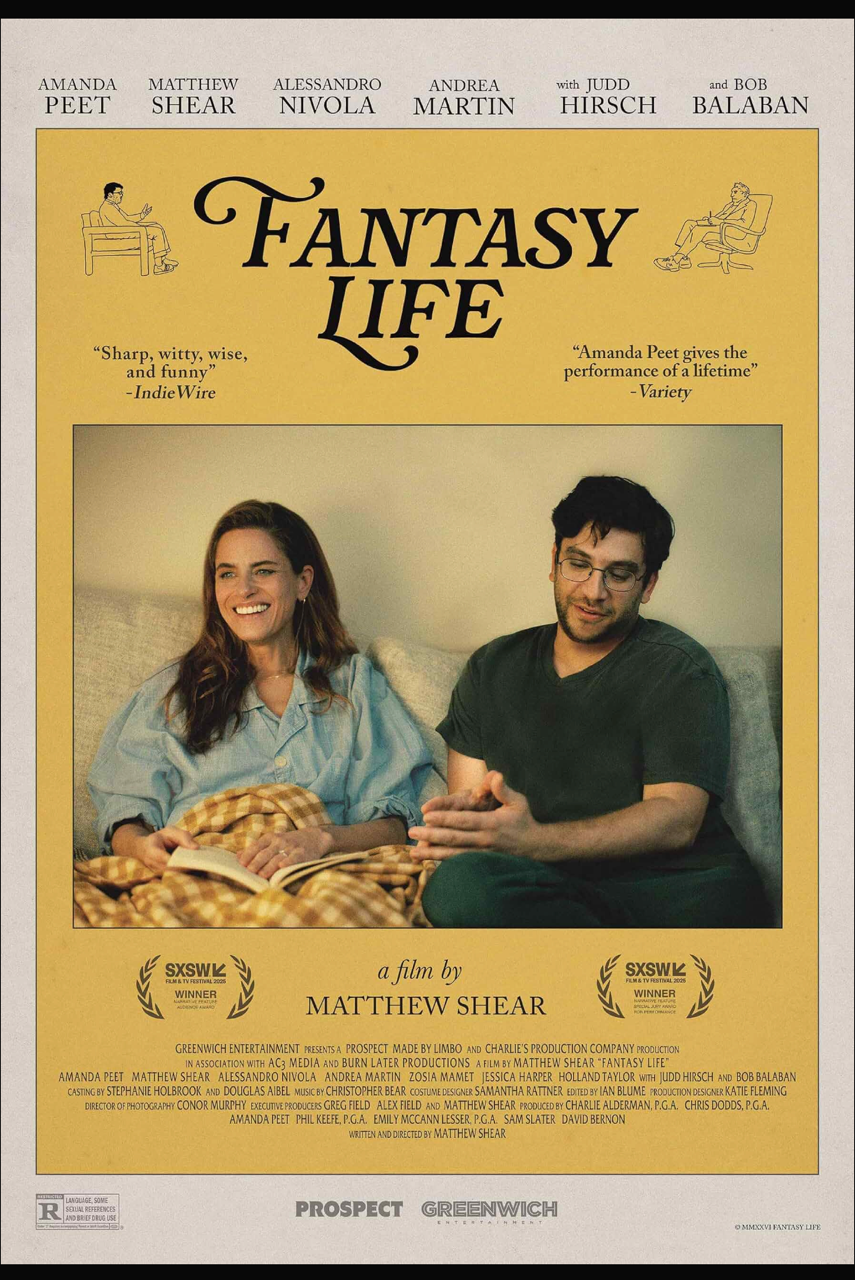 Greetings again from the darkness. As one who readily admits to unabated cringing at most romantic-comedies, it’s with a certain burst of pride that I acknowledge that this one from first time writer-director Matthew Shear is actually quite entertaining, and possesses a minimal cringe factor. There are likely a couple of reasons for this. First, Mr. Shear, who also stars in the film, has clearly been influenced by his time acting on filmmaker Noah Baumbach’s sets, and the second reason would be the most welcome presence of Amanda Peet in her first big screen role in 10 years.


 Posted by David Ferguson
  Greetings again from the darkness. Few things in the cinematic world are more instantly recognizable than a Wes Anderson movie. In fact, historically speaking, perhaps only Jacques Tati comes as close to having a signature style easily spotted by viewers (unless you want to count Tom Cruise sprinting or Julia Roberts cackling). This is Mr. Anderson’s 10th feature film in 25 years, and I now rate 5 of these very highly, though all 10 have a certain appeal. This latest, co-written by Anderson with frequent collaborators Roman Coppola, Hugo Guinness, and Jason Schwartzman, could be considered his most ambitious to date … and likely the most ‘Wes Anderson’ of all.





 Movie Reviews from the Dark