THE PACT (2022)

February 10, 2022

Greetings again from the darkness. It’s a bit embarrassing to admit, but prior to this movie, I was unfamiliar with Birthe Neumann. Most of her 50-year career has been spent in Denmark projects (film, TV, stage), but her screen presence here is such that I feel compelled to seek out some of her early work in order to catch up on what now feels like a gap in my movie watching. Ms. Neumann stars as writer Karen Blixen (pen name Isak Dinesen), who published her 1937 memoir, “Out of Africa”. The adapted book became a Best Picture Oscar winner starring Meryl Streep and Robert Redford. A couple of years later (1987) the film adapted from Blixen’s story “Babette’s Feast” won the Oscar for Best Foreign Language film.

Director Bille August (PELLE THE CONQUEROR, 1987) and screenwriter Christian Torpe bring Thorkild Bjornvid’s memoir to the screen. You might ask why then the opening paragraph was not about Mr. Bjornvid, a noted Danish writer and poet. The answer is derived from the fact that while the process of writing doesn’t translate well to the big screen, complicated relationships definitely do … and the bond between Blixen and Bjornvid (played here by Simon Benebjerg) was about as complicated and convoluted as one can get. Ms. Blixen was somewhat of an isolated literary icon when she first met the 30ish Bjornvid in 1948. What followed can only be described as a Faustian deal where she promised to make him a great writer if he followed her every direction to a “T”. She says to him, “Have faith and I will protect you.” The stipulations included moving into her compound and being apart from his wife Grete (Nanna Skarrup Voss) and child for long stretches.

Of course, we all dream of having someone bankroll our hobby so that we may leisurely pursue our passions. This was more than that. Blixen was living with the long-term effects of her syphilis and the loss of her friend/lover/companion (detailed in her memoir). Her bitterness filled her with contempt for anything other than the sole pursuit of artistic passions, and Ms. Neumann’s performance is so authentic we are taken aback at times (just like Bjornvid). We know the price to pay for such a deal is sure to be high. Soon enough, Bjornvid becomes infatuated with Benedicte Jensen (Asta Kamma August, the daughter of the director), the wife of Neumann’s friend Knud (Anders Heinrichsen) and the temptation is too strong.

The situation and the film raise many questions. Should one follow their gift, regardless of the cost to others? Is selling the soul a fair price for reaching greatness? Is risk and pain and sacrifice necessary to reach one’s artistic peak? It’s painful to watch the young poet surrender to his elderly patron, but it’s fascinating to see how Karen Blixen spurs the writer to improvement. How far would you go to achieve your dreams?

Opening in NYC on February 11, 2022 and expanding on February 18, 2022

WATCH THE TRAILER


DIFF 2019 Day 4

April 15, 2019

2019 Dallas International Film Festival – Day 4

 Greetings again from the darkness.  Scheduling conflicts meant I only had two films on the agenda for Sunday. With one of the films being an epic Danish film that pushed 3 hours in run time, I still managed to sit for more of the day than anyone should. The other film was a reimagining of Shakespeare’s “Hamlet”, so chuckles were expected to be few and far between.


Here is my recap of the two films watched on Day 4:


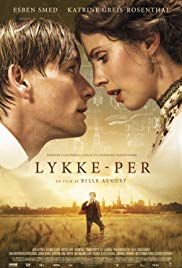
A FORTUNATE MAN (Lykke-Per)

 Turning the classic novel from Henrik Pontoppidan into a film project likely seemed nearly insurmountable; however director Bille August (PELLE THE CONQUEROR, 1987) was the perfect choice to handle the adapted screenplay written by his son Aders Frithiof August. Pontoppidan won the 1917 Nobel Prize for literature, and this novel offers a fascinating lead character and much commentary on class division and religious differences.

Esben Smed stars as Peter Andreas Sidenius, a young man from Jutland who, when we first meet him, as just received his acceptance letter to The College of Advanced Technology in Copenhagen to study engineering. Peter was raised in a pious Christian community by a respected clergyman father. Peter’s rebellion is viewed as a move against God by his father. As Peter begins his studies, we can think of him as a less compliant George Bailey from IT’S A WONDERFUL LIFE. He’s a forward thinker who dreams of converting wind and water to energy to transform Denmark into an international power.

Once he crosses paths with the wealthy Jewish Salomon family, Per (as he now calls himself) at first appears as a smart fish-out-of-water, and slowly learns the nuances of high society. There is a great line about his ‘changing lanes’ as his attraction shifts from bubbly daughter Nanny (Julie Christiansen) to the more thoughtful and socially-conscious older daughter Jakobe (a terrific Katrine Greis-Rosenthal). His affiliation with the family leads to a realistic opportunity to see his energy dreams become a reality.

This is a period drama taking place sometime around 1900, and we quickly learn that Daddy issues and pride can affect one from any era. Though he has physically escaped the abusive, repressive father he had, Per is so convinced of his own genius that he simply can’t lower himself to traditional structure – whether it be social, familial or economic.

As with contemporary times, when arrogance meets arrogance, power prevails. Returning to his home roots humbles Per for a moment, and he is constantly haunted by a reappearing pocket watch tied to the previously mentioned Daddy issues. We see his childhood scars never heal and we hear ‘fortune favors fools’, and watch as pride brings the downfall of a man who continues to search for his true self rather than finding joy in life. It’s a beautifully shot film with terrific costumes and sets, and a wonderful lead performance (even if the film runs a bit long).


OPHELIA

 Well here we are more than 400 years later, and artists are still finding new ways in which to explore and adapt the writings of William Shakespeare. Some of these attempts are quite serious, others offer a bit more whimsy, and still others are quite creative. Director Claire McCarthy is working from Emmy winning writer Semi Chellas’ (“Mad Men”) adaptation of Lisa Klein’s 2006 Young Adult novel. The general structure is “Hamlet”, but the perspective is through the eyes of Ophelia (with some dramatic effect of course).

“You may think you know my story”. Those are the first words we hear … and we think to ourselves, “yes, we do.” But we don’t really know this story. Daisy Ridley stars as Ophelia, whose spunk as a young girl leads her to being chosen for Queen Gertrude’s court of ladies-in-waiting. Not being of noble blood, Ophelia is on outcast, but her reading skills put her in the Queen’s favor … especially for those bedtime stories that aren’t exactly scripture. Two-time Oscar nominee Naomi Watts plays Gertrude, as well as a second role that carries much weight in this reimagining.

Clive Owen plays Claudius – bad guy, bad wig, bad personality. Tom Felton plays Ophelia’s brother Laertes, Devon Terrell is Horatio, and George MacKay (CAPTAIN FANTASTIC, 2016) portrays Hamlet. This Prince of Denmark is missing the familiar self-doubts he was cloaked in by the Bard, and is quite a romantic who doesn’t quite share the close bond his mother feels towards him. There is a Rosencrantz and Guildenstern sighting, but of course, most of the focus remains on Ophelia – who is a strong and independent thinker, yet dutiful in her responsibilities to the Queen. Her “crazy” scene is actually quite strategic.

Screened at Sundance last year, the film now has distribution through IFC, and the Americanized dialogue should make it accessible to younger viewers … though some of the most familiar lines will be good for a chuckle from those in the know. Elsinore Castle looks terrific and the costumes are first rate … both crucial to period pieces. Unfortunately, outside of Ms. Ridley and Ms. Watts, the cast just doesn’t bring enough to pull off a new version. I found it difficult to avoid comparison to Franco Zefferelli’s ROMEO AND JULIET (1968), and we are reminded that it’s a foolish man (Prince or not) who chooses vengeance over love. Those familiar with “Hamlet” will see this differently than those who aren’t, but it’s certainly watchable for both sides of the castle.