THE FIRE INSIDE (2024)

December 24, 2024

Greetings again from the darkness. Claressa Shields’ story is inspirational, and yet it’s so much more than that. She’s an extraordinary person with a remarkable story. She doesn’t just inspire young girls to pursue sports, she motivates us all to pursue our dreams with passion and tenacity. It’s only fitting that the first feature film directed by renowned cinematographer Rachel Morrison centers on a barrier-breaking woman. Ms. Morrison was the first woman to receive a Best Cinematography Oscar nomination for her work on MUDBOUND (2017). The screenplay was written by Oscar winner Barry Jenkins (MOONLIGHT, 2016), and he’s also a producer on the film.

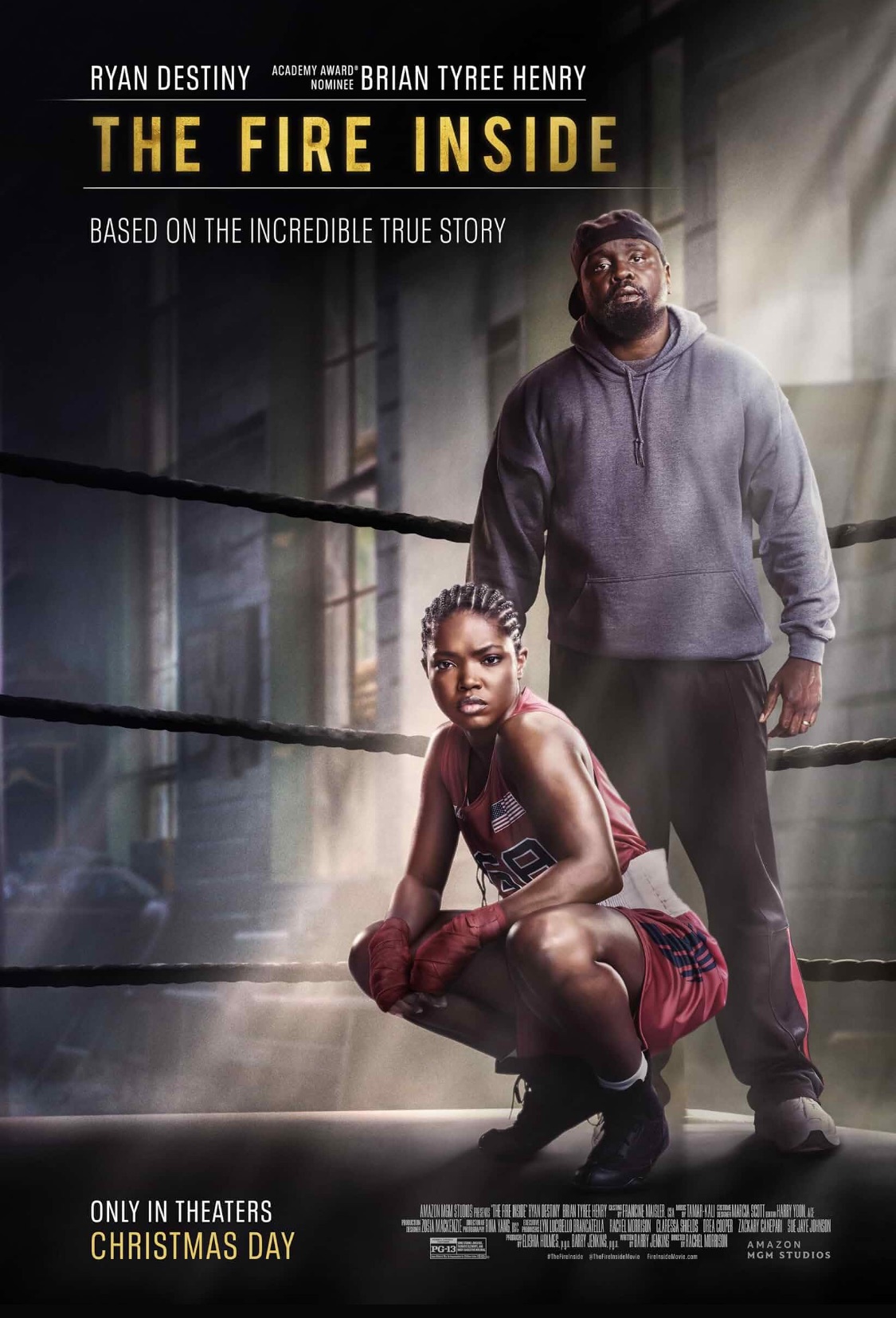
We first see young Claressa as she’s running through her downtrodden hometown of Flint, Michigan to reach the boxing gym … the same gym where volunteer trainer Jason Crutchfield (a terrific Brian Tyree Henry, BULLET TRAIN, 2022) tells her he doesn’t train girls, and later admits, he’s “never thought about girls boxing.” Of course, Jason not only ends up working with Claressa, he also becomes a full-bore role model as her trainer/coach/mentor. Young versions of Claressa are played by Jazmin Headley and Kylee D Allen, and it’s Ryan Destiny (musician-actress-model) who we come to follow as Claressa “T-Rex” Shields, so nicknamed due to her short arms. Destiny is outstanding in the role.

Being a young girl wanting to learn boxing is not Claressa’s only challenge. She grows up very poor, often scraping for food. Her mother doesn’t seem particularly interested in being a mother, and ends up kicking the strong-willed girl out of the house. We learn Claressa even experienced sexual abuse as a child. The film doesn’t glorify or skip over the hard parts of her life, focusing instead on how she remained committed to her dream as she overcame hurdles. This Claressa defines “grit”, an often-overused description.

Jason and his wife invite Claressa into their home, and her training goes next level. We do get the mandatory training montage (thanks, Rocky!), and we see her advance through the stages of matches until, at age 16, she qualifies for the 2012 Olympics in London. By this time, her dad is out of prison and her little sister is pregnant, yet none of that, or even the odd Olympic coaching regulations, can stop her mission. As interesting and fascinating as this quest for a gold medal has been, it’s what Morrison and Jenkins (and Claressa) do after London that is most impressive.

The all-too-familiar struggle of female athletes to secure endorsements becomes a nightmare for Claressa. The emphasis on aesthetics overrides excellence in athletics. She’s told that sponsors are looking for marketability – what a woman looks like out of the ring is every bit as important. The frustration of not being able to cash in motivates Claressa to fight for women’s Olympic equality, a worthy and successful cause. Oh, and yes, she continues training and the closing credits show clips of her at the 2016 Olympics, winning her second gold medal. As I stated, she’s more than an inspiration.

Opens in theaters on December 25, 2024

WATCH THE TRAILER


IF BEALE STREET COULD TALK (2018)

December 23, 2018

 Greetings again from the darkness. Humiliation and disgust register when we acknowledge that James Baldwin’s 1974 book is as relevant today as it was when published. Though the book hardly lends itself to a big screen presentation, writer-director Barry Jenkins (Best Adapted Screenplay Oscar winner for last year’s Best Picture winner MOONLIGHT) brings his cinematic artistry and deft touch to a story that is a touching love story wrapped in a tale of social injustice.

Filmmaker Jenkins has succeeded in delivering the rare film that is filled with both tender, warm, smile-inducing moments and moments of absolute frustration that fill us with outrage. It’s a beautiful film with a sweet story of love between two soul mates, and it’s also a story of race, class, and Harlem in the 70’s. The film begins with a Baldwin quote informing us that “Beale Street” is born from black roots – it’s not geographical, but rather cultural. He’s certainly not referring to today’s tourist destination in Memphis.

Tish (terrific newcomer Kiki Lane) and Fonny (Stephan James, played Jesse Owens in RACE) have been best friends since early childhood. They are now ages 19 and 22 respectively, and that friendship has blossomed into romantic attraction. Their fairy tale love story is shattered when a racist cop (Ed Skrein) falsely accuses Fonny of rape, and Fonny goes to prison. And if that’s not enough, we witness the scene where Tish and her family invite Fonny’s family over to announce she is carrying his baby. Fonny’s judgmental and religious zealot of a mother reacts with indignation and is beyond cruel to Tish. It’s one of the most emotionally explosive scenes of any movie all year. Regina King gives a powerhouse performance as Tish’s mom, and she goes toe-to-toe with Fonny’s mom played by Aunjunae Ellis (Yula Mae from THE HELP). Fonny’s dad (Michael Beach, AQUAMAN) and Tish’s dad (Colman Domingo, SELMA) are stunned by the situation, and wisely take their discussions to the corner bar.

That incredible scene of families clashing is offset by the tenderness and soulfulness of the scenes showing Fonny and Tish together … whether on the neighborhood streets, in their apartment, or talking with a glass barrier between them. As the timeline gets bounced around, we see Fonny and his old buddy Daniel (Byron Tyree Henry) in one exceptional scene, and we also see the bond between Fonny and his café manager friend played by Diego Luna. The depth of these scenes is difficult to relay, and the film acts as both a character study and social commentary relevant to today’s issues. There is so much precision and attention to detail in the story-telling and acting. The color palettes transition depending on the mood of the scene, as does the music – the strings used by composer Nicholas Britell are very much a part of the Tish-Fonny love story, and the brassy jazz music cover the rest.

We get to know Fonny as an artist and charming young man smitten with Tish, who is a gentle and angelic soul. We see his changes while in prison, and we see how others react to her (based on their race, gender and age) as she works the perfume counter at a department story. Baldwin’s writing is spot on as Tish (in her role as narrator) says “I hope that nobody has ever had to look at anybody they love through glass.”

Director Jenkins has delivered a special movie that is brilliantly constructed. It’s a story of love and family and the impact of racism without any of the preachiness we often get. Cinematographer James Laxton expertly captures the tone changes, and having the actors periodically look directly into the camera (at the viewer) proves quite powerful. This is romanticism vs. reality, and speaks to the power and beauty of love … and the strength to carry through even in an unjust situation brought on by a fractured society. It’s a beautiful film.

watch the trailer:


MOONLIGHT (2016)

November 27, 2016

moonlight Greetings again from the darkness. It’s uncertain whether writer/director Barry Jenkins has developed the story from Tarell McCraney in order to highlight stereotypes, explain stereotypes, or both. The interpretation is up to the viewer, but what’s clear is that the film is one of the most sensitive portraits we’ve seen of growing up young, black, and sexually confused, while being mostly neglected by a drug-addicted mother.

Told in standard triptych structure, the film chronicles 3 stages in the life of a young male, with the chapters titled Little – Chiron – Black, for the names he is known by at each stage. As a 9 year old boy, “Little” (a nickname due to his small stature) is a wide-eyed near-mute who gets bullied and called names by the bigger boys. It’s at this stage where he is taken under the wing of local drug dealer Juan (Mahershala Ali), who offers a “safe place” to sleep and eat, with the bonus of swimming lessons accentuated by life lessons from Juan and his understanding girlfriend Teresa (Janelle Monae). It’s a poignant and painful moment when Little connects the dots between his mother (Naomie Harris) and Juan.

As a high school adolescent, Chiron is now a nervous, totally-withdrawn kid who simply doesn’t fit in – and doesn’t understand why. His high-crime Miami neighborhood is even more dangerous for him now as the schoolyard bullying is often accompanied by violent behavior. His surrogate father figure Juan is no longer in the picture, but Teresa is still there for him – always at the ready with a meal, clean sheets, and a spoonful of wisdom.

In the final chapter, we catch up with a hardened “Black” (another nickname) 10 years after high school followed by a stint in prison. He has moved from his Miami roots, and it’s at this stage where we fully understand the influence of a role model on a boy who has few. When he reconnects with childhood buddy Kevin, we see the shredded remnants of young “Little” still present in the older, experienced “Black”. This circle of life is understandable, while at the same time being nearly unbearable.

In addition to Mr. Ali and Ms. Monea (both who are excellent in the upcoming Hidden Figures), and the standout work of Ms. Harris, the six actors who play Chiron and Kevin through the years are fascinating to watch. Alex Hibbert perfectly captures the confused “Little”. Ashton Sanders plays the awkward, dreading-each-day Chiron; and Trevante Rhodes (former University of Texas athlete) plays the adult “Black” with a quiet uneasiness that resonates on screen. The 3 Kevin actors are Jaden Piner, Jharell Jerome, and Andre Holland (a standout as the adult Kevin).

Beautifully filmed in all three segments by cinematographer James Laxton, the film reiterates the importance of role models, especially in the life of those whose path seems pre-ordained by circumstance. The harsh realities of drug addiction, absentee parents, schoolyard bullying, and the almost inevitable stint behind bars are contrasted with a plate of fries, the chef’s special from an old friend, and the soothing effects of sand and sea. Encouraging our kids to be true to themselves is a lesson that can fall on deaf ears when surviving the moment is first and foremost. This incredibly sensitive film is likely either a necessary reminder or an eye-opening education … depending on your own situation.

watch the trailer: