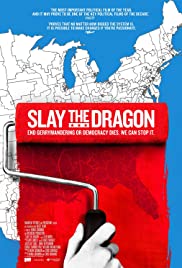
 Greetings again from the darkness. It’s no wonder our faith in democracy is waning. The list of reasons and the targets to point fingers are both numerous. Heck, one of the last-standing Presidential hopefuls has spent most of his life believing and preaching that there is a better way. This documentary from co-directors Chris Durrance and Barak Goodman ensures gerrymandering remains on the list of reasons. They weave together three stories from Michigan, North Carolina, and Wisconsin to demonstrate how a party can invoke a strategy of gerrymandering, and what the long-term impact can mean.
We’ve long understood the basics of gerrymandering. It is when one political party works to carve up the voting districts in order to benefit one party or handicap the other. The film educates us on the fine art of “packing” and “cracking.” Packing involves concentrating the opposing party’s voters into a few districts, while cracking involves spreading out (diluting) that party’s voters amidst many districts. Both are designed to render opposition votes meaningless. We even learn how gerrymandering got its name … a link to Elbridge Gerry, a former Governor of Massachusetts and Vice President to James Madison.
The “star” of the Michigan segment is Kate Fahey, and we see how her 2016 Facebook post led her directly into political activism, and the formation of “Voters Not Politicians” (VNP). Because she is so energetic and engaging, it’s clear why the filmmakers devoted so much time to this segment. Ballot initiatives, petitions, speeches, interviews, the Michigan Supreme Court, and ultimately, voting day … this is her journey and we get to come along for the ride.
North Carolina and Wisconsin offer more details on the fights against gerrymandering, but neither of these stories go quite as in-depth, although we do follow the Wisconsin case all the way to the U.S. Supreme Court, where Justice Kennedy’s retirement changes everything. There is a very informative segment on the Republican’s national strategy after Obama was elected. Survival of the party was in jeopardy, and behind-the-scenes strategists like Chris Jankowski and Tom Hoeffler were specialists brought in to focus on the best approach to re-districting across the country … something called the Redmap Project.
There are a lot of moving parts included in the film by Durrance and Goodman: tracing the 2014 Flint water crises to the 2010 elections, insight into ALEC (American Legislative Exchange Council), discussions of Lobbyists writing bills, details on voter suppression, and input from journalists, radio talk show hosts, political consultants, and attorneys. David Daley, author of the 2016 book “Ratf**ked” comments throughout with his opinions on specific examples of gerrymandering. The grass roots movement to end gerrymandering in Michigan was fascinating to watch, and there is mention that both parties have used gerrymandering to their advantage over the years. The difference makers these days are Big Data and Big Tech … highly complex analytical tools that turn this into a science. “Independent committees” drawing district lines is offered as a solution, but if the last decade has taught us anything, it’s that most everyone has an agenda and true independent thinkers are a rare breed. Whether calling this an “assault on Democracy” is accurate or not, it seems quite obvious that there must be a better way … and a better way is needed.
watch the trailer:


 Posted by David Ferguson
 Movie Reviews from the Dark