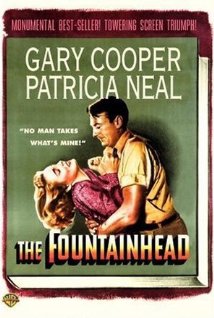
 Greetings again from the darkness. Russian-American writer/philosopher Ayn Rand is best known for her novels The Fountainhead and Atlas Shrugged. She is the founder of Objectivism (as opposed to collectivism) which has become the foundation for the Libertarian Party in the U.S. Both novels make for fascinating and thought-provoking reading, and numerous other writings and interviews featuring Ms. Rand will question your beliefs and today’s society. Unfortunately, her words and thoughts have just not translated well to the silver screen.
Ms. Rand was hired to adapt her own novel for this film version, and her stubbornness led to the two main weaknesses: the casting of Gary Cooper and the too long and too convoluted final courtroom speech. Cooper, a Hollywood legend and already a four time Oscar nominee by this time, was simply too old to play the idealistic architect Howard Roark. His stilted acting, such an advantage to High Noon a few years later, really bogged down many scenes in this one.
Newcomer Patricia Neal (22 years old) was cast and she brings much needed energy to the story, though her inexperience shows in a couple of crucial moments. Contrast her performance here with her Oscar winning performance in Hud (1963), where she was in complete command. Sadly, Ms. Neal had a series of strokes in the mid-1960’s and her recovery caused her to turn down the iconic role of Mrs. Robinson in The Graduate (1967).
Other support work in the movie is quite effective. Raymond Massey (so great in East of Eden) is terrific in the William Randolph Hearst-inspired role of powerful newspaper publisher, and Robert Douglas is expertly conniving as the self-centered villain and architecture critic. King Vidor, a 5 time Oscar nominee as director, does his best to overcome the challenges provided by Cooper and Ms. Rand’s script, and for the most part, the film is interesting and enjoyable enough to watch. It’s a bit frustrating to think what might have been.
Howard Roark’s final courtroom speech/closing was at the time the longest soliloquy yet seen on a movie screen. Supposedly, Mr. Cooper didn’t really understand it and his delivery makes that pretty easy to believe. Refusing to compromise on one’s beliefs and talent, and the theory that all we have are our convictions and integrity is simple enough to understand. The arguments ensue when the collectivists state that society depends on the creations of man, and these creations are owed to society, and the most talented of us should serve others. The film’s method of making this point probably won over very few people with it’s theme: “To want nothing. To expect nothing. To depend on nothing.”
watch the trailer:
http://www.youtube.com/watch?v=swOxKu80JpU


 Posted by David Ferguson

 Movie Reviews from the Dark