 Greetings again from the darkness. I don’t recall a more unusual opening seven or eight minutes for a film (even including Terrence Malick). Slightly disorienting fragments of scenes from odd angles are made more obscure through nearly indistinguishable dialogue. The surreal images form a dreamlike montage of a playground, a sale on color TV’s, Martin Luther King’s speech, and more. A few more minutes pass before we get an actual look at Elwood, whose story we are about to follow.
The Pulitzer Prize-winning 2019 novel by Colson Whitehead is adapted for the screen by writer-director RaMell Ross and co-writer Joslyn Barnes. Though the story and characters are a work of fiction, the Nickel Academy is based on the Dozier School, a Florida panhandle-based reform school that operated for 111 years prior to unmarked graves being discovered.
Elwood (Ethan Herisse) is an intelligent high schooler being raised by his wise and hardworking grandmother Hattie (Aunjanue Ellis-Taylor, KING RICHARD, 2021). His teacher is so convinced of Ethan’s potential that he guides him towards a local college that accepts black students and offers scholarships. It doesn’t take us long to gain an affinity for Elwood and realize he has a promising future. Well, that’s right up to the moment he mindlessly accepts a ride in a stolen car. The police treat him as an accomplice, and poof, he’s in a patrol car headed to reform school. The contrast between the environments for white kids at Nickel Academy versus black kids is startling.
Elwood and Turner (Brandon Wilson, THE WAY BACK, 2020) form an unlikely friendship. Turner, who has no family, is from Houston and has a big city viewpoint of societal racism compared to Elwood’s mostly hopeful nature. Two sides of a coin one might say. Director Ross references the classic film THE DEFIANT ONES (1958) a few times – noting the differences between the Sidney Poitier and Tony Curtis characters. Another creative choice from Ross is the alternating timeframes as the story is told. Of course, there is young Elwood (Ethan Cole Sharp) and reform school Elwood (Herisse), and we find ourselves intrigued by ‘adult’ Elwood (Daveed Diggs). Ross shows mostly the back of his head as he starts his own business – Ace Moving Company – and works through relationship issues.
Still, most of the film’s story occurs while Elwood and Turner negotiate each day through the abuse and mistreatment … and fear of the sweatbox. It’s through their eyes that we ‘see’ what they say. This distinctive camera work from cinematographer Jomo Fray would likely be distracting in most films, but here, it works to plop us right into an environment we’d likely never experience on our own. Supporting work comes from Hamish Linklater as the home’s director and Fred Hechinger as a foreman who cuts the boys some slack. It’s Linklater’s character who methodically lays out the steps for the boys to achieve release. It’s only with time that they discover these steps are nothing but a pipe dream.
It’s a long movie with some heartbreaking moments. It’s also one that frequent movie goers will recognize as a true work of art. As adult Elwood follows the excavation of the Nickel Academy site, the impact of a place that laid the foundation of animosity becomes quite clear. There are lessons to be learned from history, if only we take heed.


 Posted by David Ferguson
 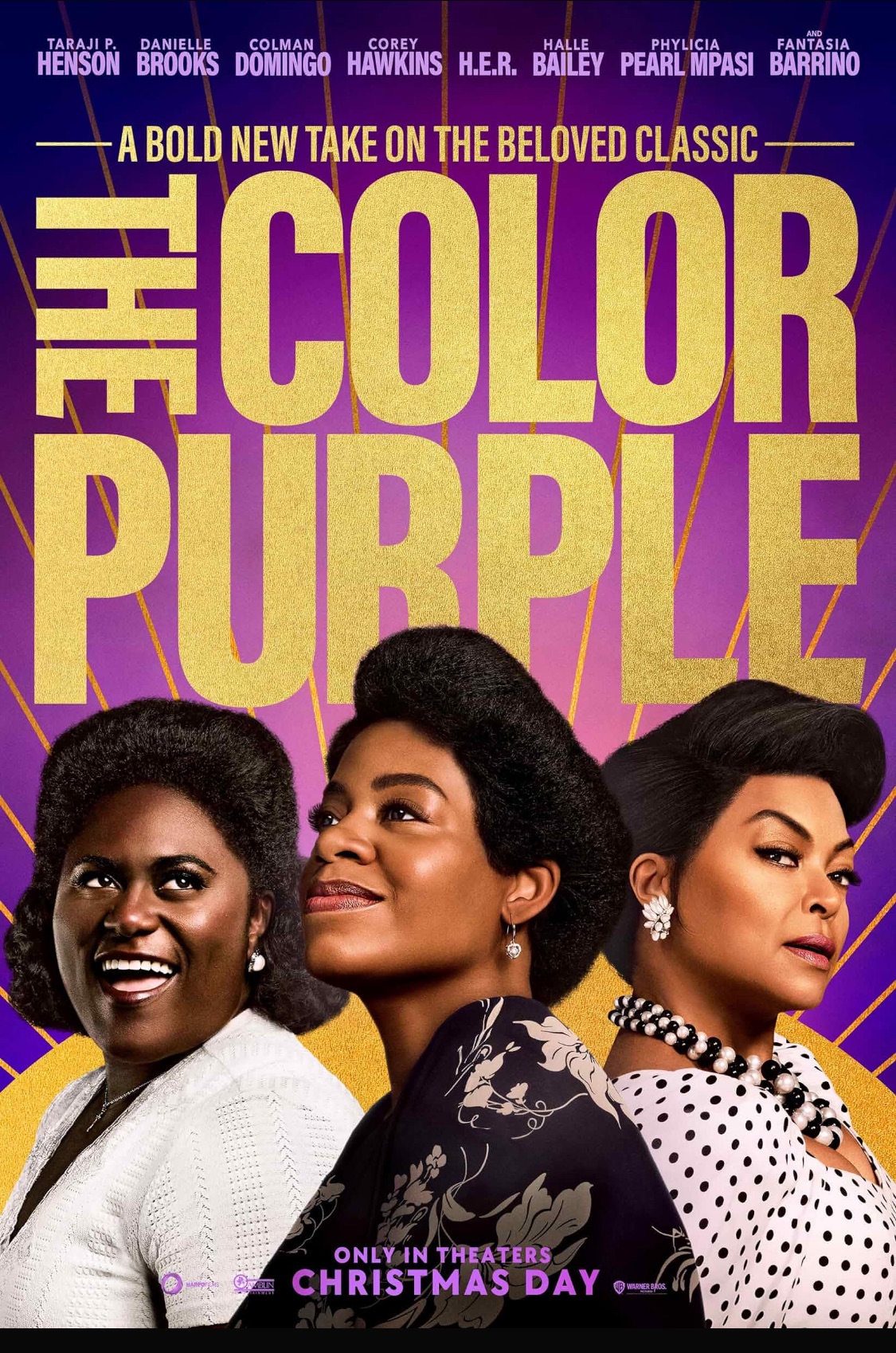 Greetings again from the darkness. It all began with Alice Walker’s 1982 novel, for which she was awarded a Pulitzer Prize. Shortly thereafter, Steven Spielberg turned it into the movie event of 1985, with a memorable cast including Whoopi Goldberg, Danny Glover, and yes, Oprah Winfrey. The film received eleven Oscar nominations, yet was shut out in all categories. Jumping ahead 20 years (2005), Marsha Norman created a musical stage book that turned into a smash hit on Broadway, receiving eleven Tony nominations. It was 2015 when the musical revival hit the stage, re-establishing the story as part of the fabric of the entertainment world. Along the way, Ms. Walker’s book had been frequently banned and censored, and the adaptations were sure to pick and choose what to cover and how to do so. Here we are forty-one years after the book’s publication, and director Blitz Bazawule (Beyonce’s BLACK IS KING, 2020) delivers a moving and bold film version (screenplay by Marcus Gardley) based on the musicals, the novel, and the original film.
 Movie Reviews from the Dark