A HERO (2021, Iran)

January 4, 2022

Greetings again from the darkness. “Oh, what a tangled web we weave, when first we practice to deceive.” That line from a Sir Walter Raleigh poem hit me early, and stuck with me through this latest superb film from Iranian writer-director Asghar Farhadi. Having won me over a decade ago with A SEPARATION (2011), and again 5 years ago with THE SALESMAN (2016), Farhadi excels at pushing our buttons on the complexities of human nature.

Rahim (Amir Jadidi) receives a two day leave from debtor’s prison, and has reason for optimism. He has a legitimate plan to make good on his debt and gain his release. A taxi drops him at the tomb of Xerxes where his sister’s brother Hossein (Alireza Jahandideh) is working on the preservation. Rahim, a low-key guy with an easy smile, asks Hossein for help in brokering a deal with Bahram (Mohsen Tanabandeh), the man who paid off the loan shark on Rahim’s behalf, and filed the complaint that sent him to jail.

The divorced Rahim meets up with his secret lover, Farkhondeh (Sahar Goldust), to cash out the 17 gold coins she recently found. Unfortunately, the exchange rate is less than expected, and worse than that for Rahim, Bahram refuses to accept the partial payment in conjunction with a promissory note. This leads to the aforementioned ‘tangled web’ and allows filmmaker Farhadi to do what he does best … cause us to question everything.

The web involves Rahim, Bahram, the jailer, and a local charity that gets involved for what is initially termed the actions of ‘a hero’. But that’s just the tip of who gets dragged in, and that includes Rahim’s son, who has a significant speech impediment. So what happens? Well, without giving anything away, we learn there’s a fine line between a lie and the truth, and between a heroic act and manipulation. In fact, Farhadi has us questioning what it means to be a hero. What impact does media attention have? Is it heroic to do the right thing? What if that thing also helps you?  What role do the reasons for your actions play?

Rahim faces a steady stream of moral forks in the road. Which path to take at any given time has ramifications on him, his situation, and countless others. As the fibs pile up, soon others are lying to help you or telling stories to hurt you. There is so much grey area here, we can’t be certain whether black and white even exists. Farhadi’s film seems like a simple story about a simple man, but neither the story nor the man are simple. It’s not about the money, but the money reveals character. Reputation and integrity are on the line. We may first root for Rahim and jeer Bahram, but upon reflection, we likely shift our support. This is Iran’s submission to the Academy, and it’s a good one.

In theaters January 7, 2022 and streaming on Amazon Prime January 21, 2021

WATCH THE TRAILER


EVERYBODY KNOWS (2019, Todos lo saben)

February 21, 2019

 Greetings again from the darkness. Sometimes we just click with the work of a particular filmmaker, and such is the case with Iranian-born Asghar Farhadi. From ABOUT ELLY (2009) to his two Oscar wins for Foreign Language films, the instant classic A SEPARATION (2011) and THE SALESMAN (2016), Mr. Farhadi has proven himself to be a terrific and distinct story teller. As an added bonus in this latest film, he works with cinematographer (and frequent Pedro Almodovar collaborator) Jose Luis Alcaine to take his visuals to a new level.

There is a playful and warm and familiar set-up before the switch is flipped. Laura (Penelope Cruz) has been living in Argentina with her husband Alejandro, teenage daughter Irene (Carla Campra) and young son Diego (Ivan Chavero), and has returned to her hometown outside of Madrid for her younger sister Ana’s (Inma Cuesta, THE BRIDE) wedding. Laura’s husband Alejandro did not make the trip, and that plays a role deeper in the story. Hugs and kisses are exchanged amongst some of the most attractive people you’ll see on screen as family and friends are reunited … including Laura and local vineyard owner Paco (Javier Bardem), who share a romantic history from years ago. We quickly learn that Laura’s daughter Irene is a bit rebellious and free-spirited as she re-establishes her connection with Paco’s lovestruck nephew.

Slowly, we are introduced to other friends and family members, including Paco’s wife Bea (Barbara Lennie). These introductions are vital, not for the raucous and music filled wedding reception, but for what happens after. Having put her to bed earlier, Laura comes back to find daughter Irene missing and the only clues are newspaper clippings from a local child kidnapping years past. A most festive evening has been jolted into panic and dread. Soon Laura receives an untraceable text (I guess that’s how it’s done these days) asking for a huge ransom. It’s at this point, where secrets previously kept begin to surface.

The Farhadi trademark kicks in about this time. Although Laura is understandably distraught and disoriented, it’s clear the story is less about the crime and more about the interactions of the characters – resentments, the weight of long held grudges, and more of those dark secrets that begin to find the light. Everyone is a suspect, including Laura’s husband Alejandro (Ricardo Darin, THE SECRET IN THEIR EYES) who shows up convinced God will protect his daughter. The worst traits of human nature are on full display as quick assumptions are drawn. There are lots of pieces to this puzzle and it’s dizzying fun keeping track.

Trust within the family and amongst friends is at the core of the story, and Mr. Farhadi makes solving the crime secondary to the actions and reactions of these folks who have known each other for so long. Melodrama abounds (in a good way) and there are some wonderful visuals, including drone photography from the wedding reception, and an opening sequence featuring the church bell tower and clock. This is the 5th film collaboration between real life couple Cruz and Bardem (the most recent being the disappointing LOVING PABLO), and both are exceptional here. Ms. Cruz offers up a gut-wrenching performance and Mr. Bardem is a joy to watch as he struggles with emotions too complex to verbalize. This is Mr. Farhardi’s first Spanish language film, but it’s clear his subject matter and characters are universally recognized.

watch the trailer:


THE SALESMAN (Forushande, 2016, Iran)

February 25, 2017

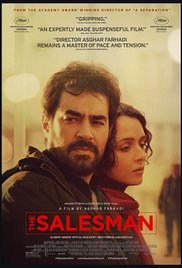
salesman Greetings again from the darkness. Iranian writer/director Asghar Farhadi won the Best Foreign Language Film Oscar for his 2011 A Separation, and with his latest (also Oscar nominated), he proves yet again that his unique approach to family/domestic dramas might best be described as simmering suspense artistry. He certainly knows how to tell a story and structure a film for maximum impact.

Shahab Hosseini (A Separation) and Taraneh Alidoosti (About Elly) star as Emad and Rana, a normal and seemingly happily married couple. One morning, some heavy equipment jeopardizes the stability of their apartment building and they escape to the streets. Husband and wife are both performing in a community theatre production of Arthur Miller’s “Death of a Salesman” and at that evening’s rehearsal, one of their castmates, Babak (Babak Karimi) offers the couple the use of a rooftop apartment … he has recently evicted the tenant.

Of course, this bit of luck comes with some baggage … specifically, the baggage and belongings of the previous tenant who (unseen to viewers) keeps telling Babak she will return for her stuff. Meanwhile, the neighbors inform Emad and Rana that the previous tenant and her “many acquaintances” (paying clients, if you get my drift) will not be missed. This history comes into play when one evening a home invasion leaves Rana dazed, injured and being treated at a local hospital. This sets off the cultural commentary about the roles and power of Iranian men vs women, as well as a psychological study of wounded pride, a need for revenge, and a scarred psyche who wishes to be neither alone nor coddled.

The strained marital relationship has some interesting parallels with the scenes depicted in the Miller play, and there are also a few key moments in the build-up … moments of subtlety for the discerning viewer. Foreshadowing occurs in a seemingly humorous moment when one of Emad’s students asks during class, “How does a man become a cow?”, and Emad answers “Gradually.” A throwaway line is never really that in a Farhadi script.

Most of the film centers on how Emad and Rana react to the traumatic event, and for the first two-thirds, it’s Emad’s movements that we follow. However, during the extraordinary final act, Rana becomes the focus and there is a tremendous performance from Farid Sajjadi Hosseini as an older gent in a key role. So much raw human nature is on display here – pride, revenge, forgiveness, trust, weakness, etc. It’s the type of film that has much going on even during the parts that might seem slow on the surface. Farhadi is an exceptional filmmaker, and evidently, he will just continue to prove it so.

watch the trailer:


A SEPARATION (Jodaeiye Nader az Simin, Iran)

February 5, 2012

 Greetings again from the darkness. This one finally made it to Dallas and it’s now clear why it is not only the Oscar favorite for Best Foreign Language Film, but also received a Best Original Screenplay nomination. It’s truly that good … and powerful … and thought provoking. I caught myself changing my mind more than once on some of the issues these characters faced.

The film opens with Nader and Simin (Peyman Moadi and Leila Hatami) in front of a judge to determine if they will be granted a divorce. Simin wants to take their daughter Termeh (Sarina Farhadi, the director’s daughter) to study abroad. Nader doesn’t disagree with the plan, only the timing. He refuses to leave his Dad, who suffers from Alzheimer’s, alone in Iran. In a poignant moment, Nader points out that while his dad may not know him, he still certainly knows his dad. This is the first of a recurring theme throughout … there are numerous ways to look at every issue.

When Simin moves in with her mother, Nader hires Razieh (Sareh Bayat) to be his dad’s caregiver. After a few days, Nader and Razieh have a heated argument and he pushes her out of the apartment. Next thing he knows, she is in the hospital after a miscarriage. She and her husband (Shahab Hosseini) file a claim saying Nader pushed her down the stairs causing the miscarriage. The core of the story is the actions of the key characters during the inquisition process by the judge/inspector. Nothing seems clear cut, and each character’s recall and statements vary from moment to moment.

 A key point is that these are all basically good and moral people. Muslim believers in various stages. None would purposefully sin, yet each is trying to protect something or someone. The script is fascinating in its detail and subtlety. It moves like real life rather than a movie trying to get crammed into a 2 hour window. Written and directed by Asghar Farhadi, the film deserves all accolades and acclaim. Let’s hope it finds an audience in the U.S. We could certainly use more stories and films like this. My reasoning for keeping my comments short here is that I believe this movie is most effective when one can watch this movie with few pre-conceived notions. Let your mind follow its own path.

SEE THIS MOVIE IF: if you want to see one of the best films of 2011 OR you would like an example of superb  and complex screenwriting

SKIP THIS MOVIE: if you prefer movies that don’t require you to engage the decision-making part of your brain (this one keeps you working!)

watch the trailer: