THE CRITIC (2024)

September 12, 2024

Greetings again from the darkness. After the lukewarm reception at last year’s Toronto Film Festival, and complaints about the ending, director Anand Tucker (SHOPGIRL 2005, HILLARY AND JACKIE 1998) called the cast back for re-shoots. Oscar nominated writer Patrick Marber (NOTES ON A SCANDAL, 2006) adapted the 2015 novel, “Curtain Call”, by Anthony Quinn (a former film critic, not related to the two-time Oscar winner with the same name). Although I can’t comment on the original version, this one provides a bit of entertainment.

The famous saying, “Everyone is a critic”, holds true because everyone has an opinion (reminding us of yet another famous saying). However, this story takes place during a much different time. We are transported back to 1936 London where we find Jimmy Erskine (two-time Oscar nominee Sir Ian McKellen) is the powerful and feared theater critic for “The Daily Chronicle”. He’s arrogant and brusque, and super-talented with the twisting of words and turning of phrases. His reviews are eagerly awaited and can make or break a show or career – sometimes in a humiliating manner.

Erskine flaunts his ego like the cashmere scarf around his neck. He claims, for critics, “only the greats are remembered”, and he fully intends to be remembered. When the proprietor of the paper suddenly passes away, his stuffy son David Brooke (the always dependable Mark Strong) likes the idea of moving on from the old ways and creating a more contemporary publication. With 40 years of loyalty, Erskine is spared, despite his continued bashing of Brooke’s favorite stage actor, Nina Land (Gemma Arterton, TAMARA DREWE, 2010). Two things of consequence soon occur. First, Nina confronts Erskine to his face (a rare occurrence). Secondly, Erskine is fired after a public incident exposes the dark secrets of his life.

These two events lead Erskine to invoke a savage scheme of manipulation and deadly blackmail in hopes of regaining his job. This plan entices Nina to cut a deal with the proverbial devil. The film features a strong supporting cast, though most are unfortunately not given enough to do. Nina’s supportive mother is played by the always terrific Lesley Manville (Oscar nominated for PHANTOM THREAD, 2016); Alfred Enoch (the “Harry Potter” franchise) plays Tom Turner, Erskine’s live-in secretary; Nina’s lover Stephen is played by Ben Barnes (who has been off doing TV and music since 2014); Ramola Garai plays Stephen’s wife, while Beau Gadsdon and Claire Skinner also appear.

This is pre-WWII London and director Tucker offers nods to the times regarding homosexuality and racism, and even throws in a jab at fascism when Erskine bellows, “fascists come and go, but theater is forever.” Tucker also “treats” us to quite a sight: Sir Ian in the bathtub. This is certainly a story about ego and power, but also one of morality. Does talent afford privilege? Of course it did then, as it does now. But no amount of talent or ego should quash the good in people.

Opening in theaters on September 13, 2024

WATCH THE TRAILER


LAWRENCE OF ARABIA (1962) revisited

March 28, 2013

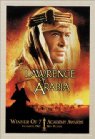
lawrence Greetings again from the darkness. It’s been over 50 years since the film’s initial release and more than 20 since I last viewed it on the big screen. When Cinemark announced it as part of the Classic Film Series, I circled the date on my calendar. While most movies are best viewed in a theatre setting, no other film absolutely demands such a setting.

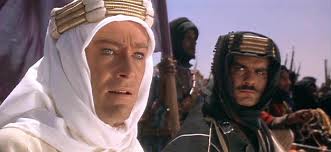
There are many elements that contribute to the well deserved “classic” label: David Lean‘s direction, Freddie Young‘s photography, the star-studded support cast, the historical significance, Maurice Jarre‘s iconic score, and of course, Peter O’Toole‘s standout and unusual performance. This is an action-adventure film with up close battle scenes filmed with no CGI aid. The famous shot of Omar Sharif‘s Sheriff Ali slowly making his initial appearance on the desert horizon is breathtaking on a 60 foot screen. Watching Lawrence’s victory dance on top of the train is majestic in the theatre, and the big screen provides the necessary ominous feeling as the Arabs slowly navigate the blowing sands of the Nefud Desert culminating in an amazing single shot of the attack on Aqaba.

lawrence2 T.E. Lawrence was a fascinating man, though there has been much debate about the film and his legend. Lawrence’s own writings in “Seven Pillars of Wisdom” provided many details used by screenwriters Robert Bolt and Michael Wilson, as well as the writings of American photo-journalist Lowell Thomas … depicted in the film as Jackson Bentley (Arthur Kennedy). The real life Thomas was looking for a hero and likely sensationalized his story of Lawrence, but most believe the foundation is fairly accurate.  As if to offer an upfront disclosure, Lean begins the film with notice that no one really knew the man.

While the story of T.E. Lawrence is incredibly interesting, the story in the film is somehow just part of the experience. Director David Lean’s movie is a true experience for movie lovers. This was Mr. Lean’s middle film of an incredible streak of three … The Bridge on the River Kwai (1957) and Doctor Zhivago (1965) being the others. Lean insisted on filming on location, rather than in studio despite the nearly four hour run time, and the nearly insurmountable challenges faced when filming in the desert. This decision drove the cost up, but allowed for the stunning visuals that set it apart … and influenced so many future films, not the least of which were Star Wars2001: A Space Odyssey, and of course the Indiana Jones franchise.

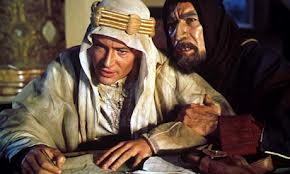
lawrence3In addition to O’Toole’s performance, it is quite exciting to see the dynamic Omar Sharif, the powerful Anthony Quinn (as Auda abu Tayi), the classy Alec Guiness (as Prince Faisal), the kinda creepy Jose Ferrer, the familiar Jack Hawkins and the slightly slimy Claude Rains. Missing from this list is any actress. The movie features exactly zero speaking roles for women … allowing for even more focus on the tendencies and mannerisms displayed by Lawrence.

Maybe the only two actors of the era who could have competed with this fabulous landscape were Peter O’Toole and Marlon Brando. Brando was actually first cast as Lawrence, but soon dropped out to star in Mutiny on the Bounty. O’Toole’s blue eyes and white robe create quite the contrast to the sandy desert. Speaking of contrast, the two times he admires his reflection in his knife are visual keys to his evolution from God complex to broken man. After attending the premiere, writer Noel Coward told O’Toole, “If you had been any prettier, the film would have been called Florence of Arabia.”

The movie received 10 Oscar nominations. It walked away with 7 wins including Best Picture, Director, Cinematogapher, and Score. O’Toole lost out to Gregory Peck (To Kill a Mockingbird). Mr. O’Toole has received 8 Best Actor nominations without ever winning (he does have an honarary Oscar). Watching this film (more than once) is a must for any movie lover. The opportunities to view it in a theatre setting are quite rare, so please seize the chance should it present itself. Your four hour commitment will be rewarded with a movie memory you’ll never lose.  And keep in mind, if the movie makes you feel small, “we can’t all be lion tamers“.

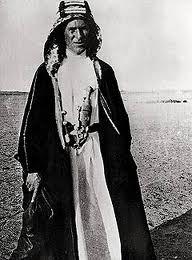
Here is a photo of the real T.E. Lawrence:

lawrence4