Blogathon “Adventure-a-thon”
 The blogathons administered by Cinematic Catharsis and RealWeegieMidget Reviews are always fun to participate in … and the entries from talented writers make for interesting and enlightening reading. Unfortunately, my movie review schedule often prevents me from dedicating the necessary time, so I’m always excited when my lull corresponds to their next collaborative blogathon.
This time the topic is “Adventure”, and since so many movies and TV shows fall into that category, the challenge was in selecting one that I not only left me in awe, but also hasn’t received the recognition it deserves (in my opinion). On this basis, my choice became:
THE LOST CITY OF Z (2016)
 It’s been almost ten years since this film from director James Gray was released, and I’ve recommended it many times to folks who were unfamiliar or unaware. The film is expertly photographed by cinematographer Darius Khandji (a two-time Oscar nominee) and is based on the book by the absurdly talented David Grann, whose books also include one of my personal favorites, “Killers of the Flower Moon”. The screen is filled with green and golden hues (similar to OUT OF AFRICA), providing a sense of realism and a touch of romanticism to the true adventures of the bold explorer, Percy Fawcett.
Charlie Hunnam (fresh off his “Sons of Anarchy” run) portrays military man and explorer Fawcett (often) through quiet strength and a doggedness to discover what is ahead. Helping us to understand this man’s heroic actions, director Gray divides the presentation into three areas: the stuffy, poorly lit backroom of London’s power brokers; the 1916 WWI front line where Fawcett’s courage is on full display; and the Amazon jungles where Fawcett strives for glory and redemption. No matter that we viewers would be satisfied with a film focusing only on those last two circumstances of action, Gray wisely recognizes that it’s the debates and conversations within the backrooms that motivate Fawcett to never give up the fight.
With a run time of 2 hours and 21 minutes, the film is quite long, yet it never seems so thanks to the three main Fawcett expeditions of focus. In 1906 the Royal Geographic Society enlisted Fawcett for a “mapping” journey to distinguish boundaries around Bolivia in what had become a commercially important area to the abundance of rubber. It’s on this adventure where Fawcett cracks wise about overcoming his “poor choice in ancestors”. He’s joined on this expedition by the great Franco Nero, and it’s also the one that lights Fawcett’s lifelong obsession with proving the existence of Z (Zed), an earlier advanced society.
1912 brings the second Amazonia expedition – the one in which renowned Antarctic explorer James Murray (played her by a snarling Angus Macfayden) joins Fawcett and his loyal and expert travel companion, Henry Costin (a terrific Robert Pattinson). The trip proceeds as one might expect when an ego-driven, unqualified yet wealthy passenger hitches a ride for glory alone. Murray’s history is well documented, and the film treats him just as we’d expect.
It’s the third trip (1925) that Fawcett makes with his son that will not only prove to be his last, it’s also the one that left unanswered questions which writer Grann felt compelled to research for his book. What possesses a man to hop into a wooden canoe on unchartered waters and trek through lands and jungles with no known back story? The spirit and mettle of such a man defines the legacy of Percy Fawcett. The film also offers us glimpses of life at home for Fawcett with his wife Nina (Sienna Miller), who flashes signs of early feminism. One of their kids is played by Tom Holland (giving us a future Spider-Man and future Batman – Pattinson in the same movie).
The film leaves an impact for many reasons: it looks stunning, Fawcett’s life was fascinating, the adventures are dangerous and breathtaking, we gain a sense of the courage required for such explorers. This was also the year of LA LA LAND – and the MOONLIGHT mess on stage – and James Gray’s film was overlooked for awards, but even all these years later, it still offers an movie-watching experience like few others.


 Posted by David Ferguson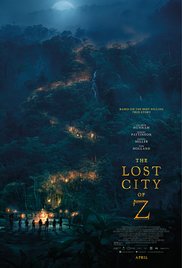
 Movie Reviews from the Dark