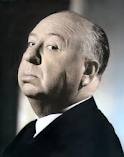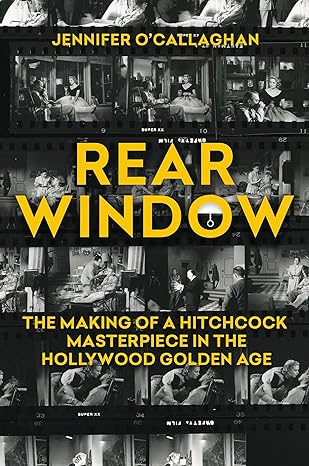
Book Review- “REAR WINDOW: THE MAKING OF A HITCHCOCK MASTERPIECE IN THE HOLLYWOOD GOLDEN AGE” by Jennifer O’Callaghan

September 28, 2025

Writing a book about a beloved movie is a tricky undertaking. Viewers who love the movie typically have their own memories and perspectives regarding what they saw on the big screen … why the film had such an emotional impact. On the other hand, anyone who hasn’t bothered to watch a movie that was released more than seventy years ago either has no interest in it, or isn’t likely to take the time to read a book to determine if they should watch it now. So, while the market for potential readers may not be massive, author Jennifer O’Callaghan is surely very aware that anyone reading her new “Rear Window” book is likely a raving fan of the movie and excited to learn as many ‘behind-the-scenes’ details as possible.

Yours truly is certainly one of those raving fans of REAR WINDOW (1954) and of its director, the legendary Master of Suspense, Alfred Hitchcock. Ms. O’Callaghan delivers all the scoop fans of the film could possibly want, yet after reflecting on the content, I believe it fair to state that the book’s title actually undersells what has been researched and reported here. Readers will benefit from numerous history lessons on Hollywood (not just the movie), as well as various personal profiles. In other words, cinephiles and classic film lovers will likely be as absorbed in these stories as I found myself.

Author O’Callaghan chooses an unusual structure for the book. While the timeline and stories bounce around, she always ties a particular detail or person to the film, REAR WINDOW. This results in something much broader than the “making of” projects that have become so prevalent these days. An argument could be made that Hitchcock’s wife, Alma, deserves a bit more attention, or that their daughter Patricia could have provided additional familial anecdotes (she has 2-3 quotes included); however, this is offset by the fascinating personal and professional elements – especially for stars Jimmy Stewart and Grace Kelly.

Of particular interest to this reader was the profile of the luminous Grace Kelly. Most of us are aware that she left Hollywood when she married Prince Rainier of Monaco, and we learn that although she embraced her duty to her new country, she also held on to the hope that she could someday return to acting … even going so far as considering the lead in Hitchcock’s MARNIE (1964), a role that ultimately went to Tippi Hedren, who also starred in THE BIRDS (1963). We learn that Grace left home after high school, determined to pursue an acting career. She was one of many famous tenants of the Barbizon Hotel for Women in New York, before heading to California for movie roles … her first being Henry Hathaway’s FOURTEEN HOURS (1951). Grace Kelly’s eleven movie career included three films with her favorite director, Alfred Hitchcock: DIAL M FOR MURDER (1954), REAR WINDOW (1954), and TO CATCH A THIEF (1955). Consistent throughout her film career was how highly her directors and lead actors spoke of her – adoration that was later shared by the citizens of Monaco.

This gives you a pretty good idea of the type of insight to expect from this book. Just know that the details provided also cover some of Hollywood’s power structure, and insight into the realization that what we saw on screen with Jimmy Stewart was basically the man he was when the cameras weren’t rolling. The comparison to Tom Hanks seems apropos. Stewart’s military service and influence are also outlined, and alone would have made him a hero and idol. Some of Hitchcock’s renowned ego is touched on, including a spat with one particular writer – an interesting reveal that won’t be spoiled here.

Of course, this is a book about one of the all-time great movies, REAR WINDOW, and author O’Callaghan never loses sight of that. The remarkable Greenwich Village apartment set is detailed, as are the supporting characters that make the film such an emotional deep dive. Details on the great Thelma Ritter (who plays wise-cracking Stella) are provided, and we get some inside info on Raymond Burr (the villain Lars Thorwald) and Wendell Corey (Detective Doyle). Just as interesting as those key characters is the breakdown of the other residents who have become so familiar to us: dancer Georgine Darcy (as Miss Torso), Judith Evelyn (as Miss Lonelyhearts), and Ross Bagdasarian, a real-world composer who also created “Alvin and Chipmunks” and the corresponding popular Christmas song.

 This may not be the book for casual movie fans, but for those who revel in the history of cinema and behind-the-scenes secrets, you’ll very much appreciate the bits of previously unknown facts, data, and trivia. It also works as a better understanding of how Alfred Hitchcock worked on his films, how he put them together, and his strategy during the era of The Hays Code and blacklists. Entertainment Journalist Jennifer O’Callaghan has researched and written a book that will surely be treasured by cinephiles and Hitchcock fans.

Available beginning September 30, 2025

Amazon Book Order


MY NAME IS ALFRED HITCHCOCK (2024, doc)

October 24, 2024

Greetings again from the darkness. It takes a cinephile and documentarian of Mark Cousins ability to pull off such a treat for other cinephiles, especially fans of “The Master of Suspense.” This felt like a two-hour geek-out that I wished would never end. Of course, the early title card that read “Written and Voiced by Alfred Hitchcock” tipped us that this would be no ordinary biopic. It’s been more than 40 years since Hitchcock died (1980 at age 80), and his career spanned 1925 through 1976. His oeuvre firmly established his place among the greatest filmmakers, featuring at least eight all-time classics.
Alistair McGowan provides the voice acting that so closely mimics that instantly recognizable Hitchcock oratory prowess, and Cousins infuses the necessary sly wit that we came to expect during Hitchcock’s TV work (unmentioned here). Perhaps no other filmmaker has had their film work so thoroughly analyzed over the year, and yet Cousins brilliantly adapts a new approach. He structures the analysis via 6 categories, and then proceeds to provide archival footage and film clips as ‘proof’ as ‘Hitch’ guides us through.

These categories include:

  1. Escape – the segment shows various characters in different stages of trying or needing to remove themselves from a particular situation, often danger. This is the longest segment and emphasizes Hitch’s use of ‘opening a door’ to welcome viewers inside the movie.
  2. Desire – pretty much the opposite of ‘escape’, this reinforces the power of lust, desire, and sex to motivate a character’s actions.
  3. Loneliness – this segment is a mashup of loneliness, solitude, and discomfort – kind of a catch-all category of those all alone in a moment.
  4. Time or Timing – the proverbial race against the clock is sometimes quite real for characters in suspense or mystery films. Cutting it a bit too close qualifies as well.
  5. Fulfillment – an unusual segment in that it mentions love and then focuses on the personal life of Alfred and his wife (and collaborator) Alma. Shown are their London townhouse, their country estate outside of London, and their U.S. home in Santa Cruz, California.
  6. Height – back to film analysis, we see the frequent use of going high with the camera and shooting down at the scene. It’s a useful lesson in how the camera is a tool for the director.

I have purposefully not included the film titles with clips utilized for each category so as not to spoil the surprises and dull the impact. You should know that the clips fit perfectly, making this a nice film technique education, as well as a different approach to viewing Hitchcock movies. I believe the only two other directors mentioned here are Bergman and Murnau, both of whom influenced Hitchcock – just as Hitchcock has influenced so many filmmakers since. Cousins does forego any mention of the questionable persona and actions that have been associated with Hitchcock over the years, and that’s likely because this documentary wants us zeroed in on techniques that make up Hitchcock films. It’s difficult to imagine any Hitchcock fan not finding this to be a hypnotic experience of learning and appreciation.

In select theaters in NYC and Los Angeles on October 25, 2024

WATCH THE TRAILER


HITCHCOCK cameos

April 18, 2013

hitch Anyone with an affection for Alfred Hitchcock movies is well aware of his proclivity for personal cameos … often just a quick glimpse of the great director.  He actually makes some type of appearance in 39 of his 52 movies, and the video below edits them together for a 5 minute look … starting with the 1927 silent films.  My personal favorites of these Hitch cameos have always been Lifeboat (1944), Strangers on a Train (1951), and The Birds (1963).


http://www.youtube.com/watch?v=_YbaOkiMiRQ


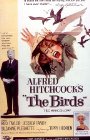
THE BIRDS (1963) revisited

September 20, 2012

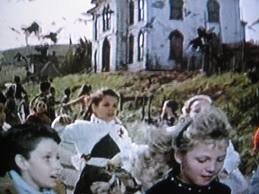
 Greetings again from the darkness. Sure, I have seen this film many times over the years, but just couldn’t miss the chance to see it on the big screen courtesy of Fathom Events and Cinemark. Many critics consider this to be Alfred Hitchcock‘s last great film, while a few dismiss it as a lark (get it?). Hitchcock is known for his sterling career of suspense films, though this one is really categorized as horror.

The writing pedigree is beyond reproach as it’s based on a story by Daphne du Maurier with a screenplay from Evan Hunter. Dame du Maurier is considered one of the best writers of the twentieth century, and you might recognize Mr. Hunter’s pen name – Ed McBain. He was quite famous for his detective stories (including the foundation for TV’s “Hill Street Blues”).

 There are really two parts to the film. The set-up involves some playful grown-up flirting between lawyer Mitch Brenner (Rod Taylor) and socialite Melanie Daniels (Tippi Hedren). The scene in the pet store is a treat to watch thanks to the banter between two attractive, intelligent, confident people. The tie-in with the love birds for Mitch’s sister (Veronica Cartwright) is simple, yet brilliant. The extreme playfulness takes Hedren to Bodega Bay, California via her sleek Astin Martin.

Hitchcock includes his common elements of feminine mystique as Mitch Brenner’s world revolves around his omnipresent mother (Jessica Tandy), his younger sister (Cartwright), his ex-lover (Suzanne Pleschette) and now a new love interest in Hedren. There are some terrific scenes between Tandy (26 years prior to Driving Miss Daisy) and Hedren, but my favorites are those with Hedren and Pleschette. Pleschette was an underrated actress and is best known for her role in TV’s “The Bob Newhart Show”. Watching her face as Hedren talks on the phone to Taylor is classic frustration from an ex-lover.

The second half of the film involves the terror of the bird attacks. Of course, the infamous scene of the kids running down the street being pecked by birds will make your skin crawl, and the scene where Hedren gets attacked in the bedroom is horrific and sends her into a breakdown. I really enjoy the scenes with the townspeople in the café. Some wonderful interchanges as they each tell bird stories. My favorite bird sequence in the film involves the empty playground equipment slowly taken over by birds as Hedren sits on the bench. Great stuff.

 Another interesting aspect of the film is the cast. Ms. Hedren (mother of Melanie Griffith) is still acting today (in her 80’s), though I have never considered her anywhere near the level of actress of other Hitchcock blondes: Grace Kelly, Ingrid Bergman, Kim Novak, Janet Leigh, Doris Day, etc. Rod Taylor is also in his 80’s now and was last seen on screen as Winston Churchill in Tarantino’s Inglourious Basterds. Jessica Tandy had a long career and is best known for Driving Miss Daisy, and Veronica Cartwright went on to star in such films as Alien and The Right Stuff). The supporting cast is filled with familiar faces including a very young Morgan Brittany (“Dallas”), Malcolm Atterbury (as the Deputy), Ruth McDevitt (as the pet store owner) and one of my favorite actor names, Doodles Weaver (Sigourney’s uncle).

As you watch the film, you will notice that there is no traditional score. Instead, we are treated to an assortment of bird effects which cue us in to the level of danger. Hitchcock was always a master of guiding the viewer right along the path he wanted. This film has some unusual pacing and a few wide shots that are quite rare for his films. To me, it proves that he was always experimenting, yet with an innate ability to know how the audience would react. A true craftsmen.

** NOTE: Hitchcock’s cameo occurs as Hedren walks into the pet store … he is seen walking out with his two dogs

here is a clip of the playground scene – that’s the school kids you hear singing.  Don’t watch this if you haven’t seen the movie:

http://www.youtube.com/watch?v=ydLJtKlVVZw&feature=related


NORTH BY NORTHWEST (1959) revisited

July 19, 2012

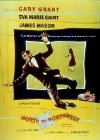
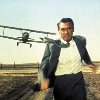
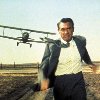
 Greetings again from the darkness. It seems apropos that Hollywood’s first stylish thriller with tongue planted firmly in cheek should come from director Alfred Hitchcock. We get two of the most iconic scenes in one film: Cary Grant being targeted by a crop duster, and the chase across the faces of Mt Rushmore. That combined with the stellar writing of famed screenwriter Ernest Lehman (West Side Story, The Sound of Music) provide one of the all-time most entertaining and beloved thrillers.

Cary Grant plays Roger O Thornhill (the O stands for nothing), a Madison Avenue Advertising hotshot who gets mixed up in a wild case of mistaken identity that involves the CIA and an unnamed foreign intelligence agency. Spies who nab the wrong guy … there’s something funny about that, as long as you aren’t “the guy”. The story is tied into the Cold War, but really the fun part of the film involves watching Thornhill maneuver his way through the maze with very little assistance. Well, Eve Kendall (played by Eva Marie Saint) says she is helping, but it doesn’t take long to figure out that she’s no innocent bystander … what blonde is ever innocent in a Hitchcock film? The bad guy is Vandamm, played with true menace by James Mason (whose wonderfully creepy voice always made him a terrific villain). His henchman is a young Martin Landau, whose mannerisms will have you raising an eyebrow throughout. While many rave about the scenes with Grant and Ms. Saint, my favorites involve Grant and Mason. Two suave masters going at each other with verbal sparring that stands up more than 50 years later.

 This was Hitchcock’s only film for MGM, and I would argue it is his most visually stylish … clothing, set decorations and the beautiful scenery and camera work. Also, he makes his cameo very early here … just missing a city bus as the doors close in his face.  And of course, one can’t help notice the poor gray suit that Grant wears through most of the film. It looks fabulous on him, even after he crawls out of the corn fields. Mr. Grant may be the most elegant actor to ever grace the silver screen. He moves like a dancer and has the face of model. This is a true movie star. I have often stated that he mastered the confounded grimace and the quick, sly smile and built a career.

Bernard Herrmann delivered yet another perfect score and Lehman’s risqué’ (for the times) dialogue is especially fun in the train’s dining car. Finally getting to see this one on the big screen gave me a whole new appreciation for the crop dusting scene and Mt Rushmore. The scale of both segments is pure Hitchcock art. On a final note, there are so many character actors whom you will recognize throughout the film. Many went on to long careers in the 60’s and 70’s and even beyond. A true classic from the master.

**Note: Jessie Royce Landis plays Cary Grant’s mother in the film … actually, she was only 7 years older than Grant.

watch the trailer:


TMI (5-27-12)

May 27, 2012

TMI (Today’s Movie Info)

5-27-12

 The Cinemark Theatre chain is running a Classic Film Series this summer.  One of the films in the series is the Alfred Hitchcock classic North By Northwest (from 1959)

The film stars Cary Grant, Eva Marie Saint and James Mason (as a bad guy).  With a little Hollywood magic (and Grant’s ever-youthful appearance), Grant’s mother is played by Jessie Royce Landis, who is actually only 7 years older than Grant. 

You’ll have to be quick to catch Hitchcock’s cameo in this one … it occurs during the opening credits at a bus stop.  You might also notice Edward Platt, who went on to TV fame as The Chief in “Get Smart“.  This was Hitchcock’s only movie for MGM.  The famous scenes taking place on Mt. Rushmore are actually filmed on a replica of the national monument.

Highly recommend catching this one on the big screen if you can …  both the crop duster chase scene and Mt Rushmore sequence are worth the price of admission.


TMI (4-25-12)

April 25, 2012

TMI (Today’s Movie Info)

Director Sacha Gervasi is currently filming a script based on the Stephen Rebello book Alfred Hitchcock and the Making of Psycho.  The first images of Anthony Hopkins as Hitchcock have been released:


Compare Hopkins to the real deal:


The film will also star Scarlett Johansson as Janet Leigh, Jessica Biel as Vera Miles and James D’Arcy as Anthony Perkins.  This is not intended to be a remake of Psycho, but rather a display of HOW the film was made.  It may turn out to be fantastic, but my initial reaction is …. hands off my Hitchcock! … so to speak.


TMI (3-29-12)

March 29, 2012

TMI (Today’s Movie Info)

Oscars trivia


Not including “no-show” winners, the record for the shortest acceptance speech is shared by William Holden (above)and renowned director Alfred Hitchcock (below). They both simply said, “Thank you.”


TMI (3-22-12)

March 22, 2012

TMI (Today’s Movie Info)

Hitchcock … defining happiness


TMI (2-1-12)

February 1, 2012

TMI (Today’s Movie Info)

February: Director’s Month

 ALFRED HITCHCOCK (1899-1980) directed more than 50 feature films in a career spanning six decades. He used very distinctive camera movement and pioneered a film editing style that created a new viewing experience.  He was married to Alma Reville from 1926 until his death.  She was his most valued behind-the-scenes collaborator on his films. If Alma didn’t like something, Hitch changed it.  Hitchcock was nominated five times for a Best Director Oscar, but remarkably never won. In fact, the only two Oscars won for his films were: Best Actress for Joan Fontaine in Suspicion (1941), and Best Song for “Whatever Will Be, Will Be (Que sera, sera)” from The Man Who Knew Too Much (1956).  One of his trademarks was a small cameo in most of his movies.  He overcame the challenge of Lifeboat (1944), which is filmed entirely on a small boat.  Watch closely and you’ll see Hitchcock in a newspaper advertisement for weight loss … he was both the “Before” and “After” picture.   His classic films include: Rebecca (1940), Lifeboat (1941), Suspicion (1941), Shadow of a Doubt (1943), Spellbound (1945), Notorious (1946), Strangers on a Train (1951), Dial M for Murder (1954), Rear Window (1954), To Catch a Thief (1955), Vertigo (1958), North By Northwest (1959), Psycho (1960), The Birds (1963)