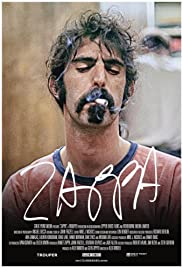
 Greetings again from the darkness. Frank Zappa’s music was never considered mainstream. His songs were rarely played on the radio. In his entire career, he charted one Top 40 song, and that was driven by his daughter. To some, he was known as a political activist and a spokesperson first, and a musician second. At times he was an enigma and a rebel or maverick, and he’s even described as trying not to write a hit song. Alex Winter may be best known as Bill in the “Bill and Ted” movies, and he’s also a successful documentary filmmaker (DEEP WEB, 2015). This time out he turns his focus on the career and life of Frank Zappa.
One of the first things we see is Frank Zappa taking us on a tour of his personal vault located at his Laurel Canyon home. It’s an enormous private collection that captures quite a bit of history from the 1960’s forward. Zappa points out some of his favorites including his jams with Eric Clapton in the basement and music with his friend Captain Beefheart (Don Van Vliet). These are original masters of Zappa’s work over the decades, and he was nothing if not prolific, releasing 62 albums during his career, and another 53 following his death in 1993.
Acting as bookends for the film are clips of Zappa’s 1991 live show in Prague, where he is helping celebrate the withdrawal of Russian troops. It’s also his last guitar performance on stage. An incredible amount of footage exists of Zappa pontificating on one subject or another, sometimes on television, sometimes in front of news cameras, and even in front of a Senate committee. His music and his life was usually focused on social commentary, opinions not always popular with the establishment.
It’s very interesting to hear Zappa talk about his early influences, particularly how he never outgrew his love for editing – something that began with the 8mm films at his childhood homes. He didn’t begin playing music until his early teenage years, and it was orchestral before rock. He always considered himself a composer, and what a prolific writer he was. It’s an unusual film in that it not only tracks the timeline of his career, but we are privileged to hear Zappa’s opinions directly from him thanks to the unending recordings and archival footage available.
Mr. Winter includes much more than Zappa. We hear from musicians that made up the Mothers of Invention, including Steve Vai, Bunk Gardner, Ian Underwood, and an emotional Ruth Underwood. We also hear from renowned Rock n Roll groupie Pamela Des Barres, and Frank’s wife Gail. It’s noted that Zappa disbanded the Mothers of Invention in 1969, and there were many iterations that played afterwards. Some of the prominent names included violinist Jean Luc Ponty, and Howard Kaylan and Marc Volman of The Turtles fame. There is even a terrific clip of John Lennon and Yoko Ono performing on stage with Zappa and his band … shocking for anyone not familiar with Yoko’s infamous primal screams.
One of the best stories included is how Zappa’s biggest hit came to be. A note from his young daughter, Moon Unit, introducing herself to her frequently absent father led to a collaboration on the single “Valley Girl”, which cracked the Top 40. There are also stories on his dreaded hosting of “Saturday Night Live”, as well as pieces on the Kronos Quartet, London Symphony Orchestra, and Ensemble Modern performing his music. In 1979, Zappa became the first musician to go completely independent with his own label, and this is only a few years after he was seriously injured by being attacked on stage.
Some may recall Zappa’s appearance in front of the Senate committee in regards to the drive to include Parental warning labels on published music. Zappa viewed this as nothing more than censorship, and he was one of the few musicians to fight the battle against the opponents led by the wife of White House Chief of Staff James Baker. Zappa was certainly a man of principles, and had no time for those who weren’t. It was pancreatic cancer that took his life, but a life well lived it was. His time as a symbol of freedom in Czechoslovakia is proof that he never shied away from standing up for what he believed in. So like his music or not – he surely didn’t care. But he respected those who cared for society and freedom. Filmmaker Winter does a nice job with a two hour run time, when the material exists for a 4 part series.


 Posted by David Ferguson
 Movie Reviews from the Dark