***This is an entry into my “Revisited” series where I re-watch a classic movie and then write about it (SPOILERS included) – not with a traditional review, but rather a general discussion of the movie, those involved, and its impact or influence.
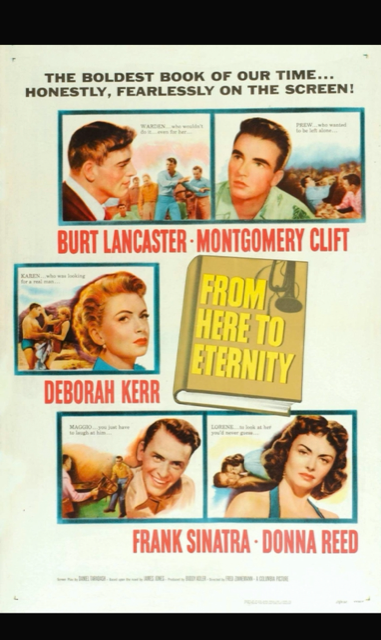 Greetings again from the darkness. “Entertaining” isn’t the usual description we think of for movies set during the Pearl Harbor attack. The Japanese-United States joint effort for TORA! TORA! TORA! (1970) probably did the best cinematic job re-creating the actual attack, and then there is whatever Michael Bay attempted to accomplish with his much-maligned PEARL HARBOR (2001). Each of those movies won an Oscar – Best Visual Effects for the former and Best Sound Editing for the latter, though neither could come close to the eight Oscars (on 13 nominations), the star power, or the entertainment value of Columbia Pictures’ 1953 classic FROM HERE TO ETERNITY.
The film won the Best Picture Oscar over ROMAN HOLIDAY, JULIUS CAESAR, SHANE, and THE ROBE, and director Fred Zinnemann won the Best Director Oscar over Billy Wilder (STALAG 17), George Stevens (SHANE), William Wyler (ROMAN HOLIDAY), and Charles Walters (LILI). Mr. Zinnemann’s career resulted in 4 Oscars (including A MAN FOR ALL SEASONS, 1966), and along the way he also picked up nominations for directing the classic HIGH NOON (1952) and JULIA (1977), plus the musical OKLAHOMA! (1955). He was married to his wife Renee for 60 years, and had the good fortune of directing the feature film debuts of Montgomery Clift, Marlon Brando and Meryl Streep.
Daniel Taradash won the Oscar for adapting James Jones’ 1952 novel for the screen. Mr. Taradash, a Harvard Law School graduate, also wrote the screenplays for PICNIC (1955) and MORITURI (1965), and later served as President of the Academy of Motion Picture Arts and Sciences from 1970-73. Novelist James Jones served in WWII and was present when the Japanese bombed Pearl Harbor. His novel “The Thin Red Line” was later turned into a 1998 film starring Sean Penn and Nick Nolte, and directed by Terrence Malick.
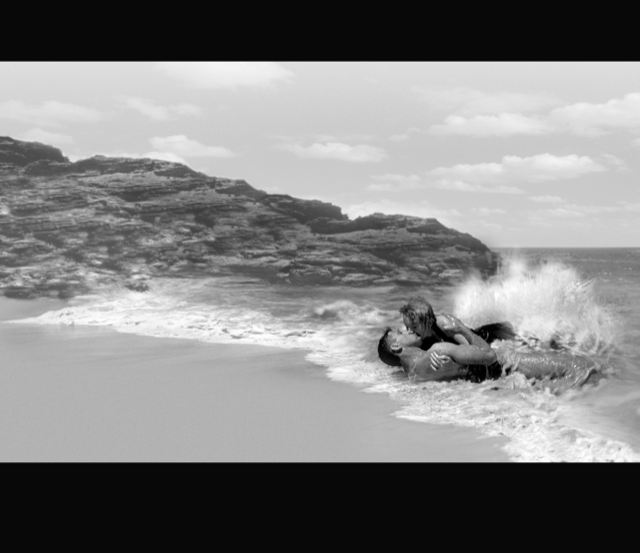 The first image most think of when this film is mentioned is the iconic kiss on the beach between Burt Lancaster and Deborah Kerr, as the ocean waves crash around them. Most war movies don’t have a smooch as their most memorable moment, though to be fair, until the bombing, this film is mostly about the daily lives of those living on and around Hickam Field in Hawaii in the days leading up to December 7, 1941.
Let’s dive into the overwhelming star power that’s on display for two hours. Montgomery Clift stars as Robert E. Lee Prewitt, a brooding and sensitive soldier who quickly gains the reputation as being hard-headed. Prewitt is a top-notch boxer and bugler who refuses to do either, focusing instead on being the best soldier he can be. Monty had a remarkable, yet all too brief career. He scored four Oscar nominations even though he only made 18 films. His early career was spent on stage leading to an intensity that he never lost while acting, and is even apparent in his film debut with John Wayne in John Ford’s RED RIVER (1948). A horrible car crash in 1956 required facial reconstruction surgery, and it’s said that his friend Elizabeth Taylor saved his life at the scene. His long time struggles with alcohol and drugs, as well as the pressure of keeping his homosexuality hidden, took a toll on his health. In 1961, Monty turned in a brief yet staggeringly effective performance in JUDGMENT AT NUREMBERG. Clift would be dead less than 5 years later at age 45.
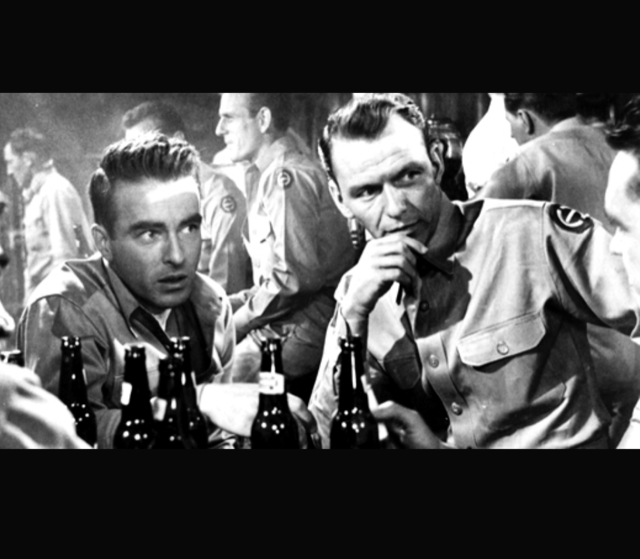 Prewitt’s only real buddy in the film is Angelo Maggio, played by Frank Sinatra, in a role that won him the Oscar for Best Supporting Actor over Eddie Albert (ROMAN HOLIDAY), Robert Strauss (STALAG 17), and two actors from SHANE, Jack Palance and Brandon De Wilde. At this point, Sinatra’s singing career was in a downturn, and it’s rumored that the “horse head” scene in THE GODFATHER was influenced by Sinatra’s mob connections getting him cast in this film. Of course, Sinatra went on to become one of the all-time great entertainers. Sinatra’s Maggio is a friendly guy who gets labeled “Tough Monkey” by the film’s most obnoxious and intimidating bully, and his dying scene is terrific and leads to his friend Prewitt’s heart-breaking rendition of “Taps”.
Monty went head-to-head in the Best Actor category with Burt Lancaster, although the Oscar went to William Holden for STALAG 17. Richard Burton (THE ROBE) and Marlon Brando (JULIUS CAESAR) were the other two nominees in the category. In a prolific career that spanned six decades, Lancaster would go on to three more nominations, winning for ELMER GANTRY (1961). Baseball fans recall Lancaster in one of his last roles as “Moonlight” Graham in FIELD OF DREAMS (1989), and he also played Wyatt Earp in GUNFIGHT AT THE OK CORRAL (1957), while famously turning down the role in BEN-HUR that ultimately went to Charlton Heston. Lancaster was at the center of one of my favorite “offbeat” movies, THE SWIMMER (1968), and having worked in a circus when he was younger, he performed many of his own stunts in TRAPEZE (1956). A 1991 stroke robbed Lancaster of his distinctive voice, and he passed away in 1994 at age 80. His son, Bill Lancaster, wrote the screenplay to BAD NEWS BEARS (1976), based on his own experiences being coached by Burt. In this film, Burt portrayed Sgt Milton Warden, a model of military efficiency, who has a soft spot for Monty’s Prewitt and all the rigors he’s being put through.
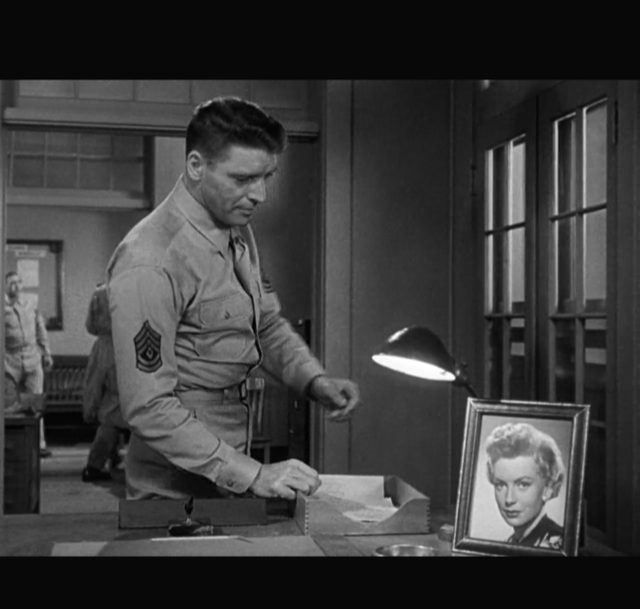 Burt’s Sgt Warden also happens to be having an affair with the base commander’s wife, Karen Holmes, played by Deborah Kerr. This affair leads to that iconic sandy beach kiss mentioned previously. She received one of her six Oscar nominations for this film, but lost to Audrey Hepburn in ROMAN HOLIDAY. The other nominees were Ava Gardner (MOGAMBO), Lesli Caron (LILI), and Maggie McNamara (THE MOON IS BLUE). Ms. Kerr was presented an Honorary Oscar in 1994, and is best remembered for starring in THE KING AND I (1956) opposite Yul Brenner (her singing voice was dubbed by Marni Nixon), starring opposite Cary Grant in AN AFFAIR TO REMEMBER (1957), and as the nun in BLACK NARCISSUS (1947). Her picture is frequently visible on her husband’s desk at the base, and she so vexes the stoic Sgt Warden that Burt gets the film’s best line: “I’ve never been so miserable in my entire life since I met you.”
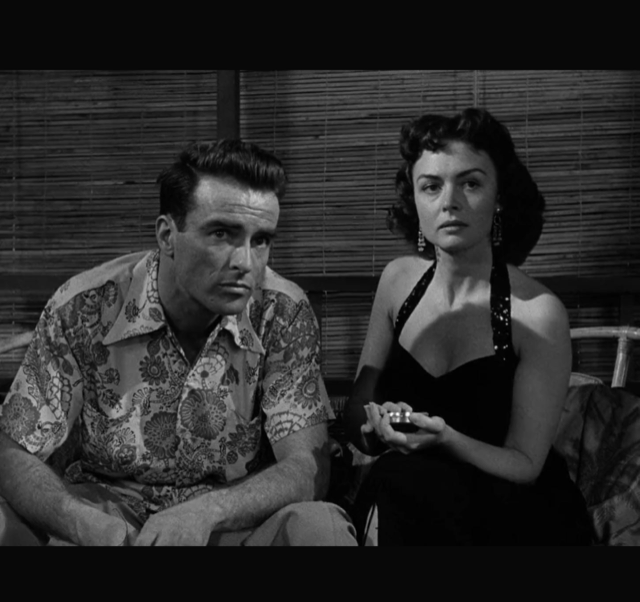 Donna Reed won the Best Supporting Actress (in her only nomination) for playing Prewitt’s love interest, Lorene/Alma, a hostess at The New Congress Club. The other nominees were Grace Kelly (MOGAMBO), Thelma Ritter (PICKUP ON SOUTH STREET, a film noir gem), Geraldine Page (HONDO), and Marjorie Rambeau (TORCH SONG). Ms. Reed had her own hit TV series, “The Donna Reed Show” that ran from 1958-66, and of course, she will live forever in cinematic infamy thanks to her performance as the beloved Mary in the Christmas classic, IT’S A WONDERFUL LIFE (1946). Her final acting gig was taking over for an ailing Barbara Bel Geddes as Miss Ellie in the hit TV series “Dallas”. Sadly, after one season, Ms. Reed passed away due to pancreatic cancer at age 64. In the film, she plays perfectly off of Montgomery Clift’s sensitive Prewitt, and despite her attraction to him, she holds firm to a “proper plan” for her life.
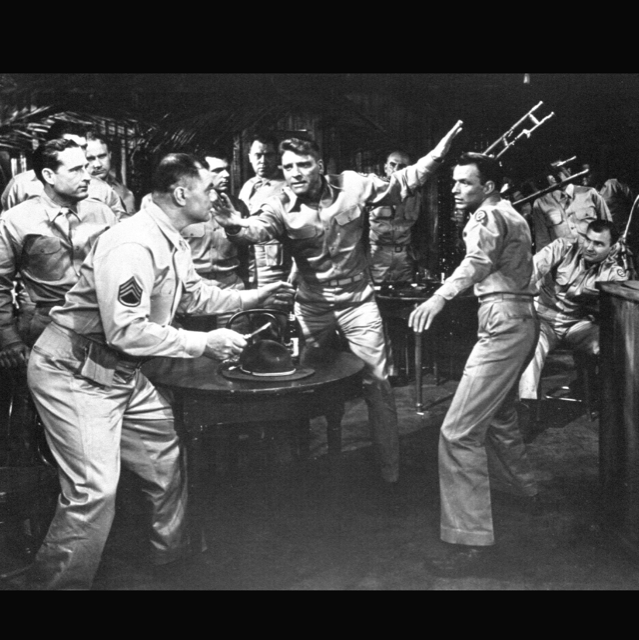 Now any respectable movie lover would be in awe with a cast that includes Montgomery Clift, Frank Sinatra, Burt Lancaster, Deborah Kerr, and Donna Reed. But this is no ordinary movie, and neither is the supporting cast. Philip Ober stars as Captain Dana Holmes, the base commander and husband to Kerr’s Karen, and the one putting a bit too much emphasis on getting Prewitt back in the boxing ring. You’ll recall Mr. Ober as Lester Townsend in Hitchcock’s classic NORTH BY NORTHWEST (1959). He was also married to Vivian Vance (Ethel in “I Love Lucy”) for 18 years. George Reeves is in a handful of scenes as one of the soldiers. Mr. Reeves played the Man of Steel in more than 100 episodes of the 1950’s series “Adventures of Superman”. This was the film that was supposed to make him a movie star, but many of his scenes got cut. The most memorable of the supporting cast is “Fatso”, the annoying and sadistic Sergeant of the Guard, played with gusto by Ernest Borgnine (Oscar winner for MARTY, 1956). It’s the violent action of Fatso that leads Prewitt to seek revenge for his friend Maggio. Jack Warden plays Cpl Buckley, and Warden is another actor whose career spanned six decades. He was seemingly everywhere in the 60’s, 70’s, and 80’s and was nominated for two Oscars in movies starring Warren Beatty. Mickey Shaunessey plays Sgt Leva, and you’ll recall him as Hunk in Elvis’ third movie, JAILHOUSE ROCK (1957). Other familiar faces include Claude Akins in his film debut, Joseph Sargent (the director of THE TAKING OF PELHAM ONE TWO THREE, 1974, and JAWS: THE REVENGE, 1987), Mary Carver (“Simon and Simon”), Willis Bouchey, Harry Belaver, Barbara Morrison, and Alvin Sargent (Oscar winning screenwriter of JULIA and ORDINARY PEOPLE). Supposedly, there is even a cameo from James Jones, the author of the novel on which this film is based, though I’ve never been able to spot him.
If you’ve seen this film, you already know it is much more than a stream of terrific and well respected actors. It’s a story of romance, self-determination, military machismo and brotherhood, friendship, and a historic and tragic attack on America … complete with the initial chaos that morning. There are some terrific scenes – like the first time Lancaster and Kerr meet at her house. There are some terrific lines – like when Prewitt says, “A man should be what he could be”. There are some subtle touches – like the wall calendar (Dec 6) next to Lancaster, or the “Pearl Harbor” street sign. Comedic effects are infused through the energy of Sinatra, and there is even a nice bit of trivia, as a large wicker chair reappears years later in “The Addams Family”.
From a technical aspect, the film is also quite an accomplishment. Renowned cinematographer Burnet Guffey won the Oscar, and he also won for BONNIE AND CLYDE (1967), plus he had three other nominations. He was the DP on Nicholas Ray’s superb film noir A LONELY PLACE (1950), a personal favorite of Humphrey Bogart and Gloria Grahame (and me). Film Editor William A Lyon won an Oscar for this film and PICNIC (1955), and edited more than 100 films during a 35 year career. John P Livadary won one of his 3 Oscars (plus numerous technical achievement awards) for Best Sound, and this was one of 5 Oscar nominations in a 7 year span for composer George Duning.
Late in the film, Country Music Hall of Fame singer-songwriter-guitarist Merle Travis appears and sings his song, “Re-enlistment Blues”. Travis also wrote “Sixteen Tons”, which became a number one hit for Tennessee Ernie Ford in 1955. In 1979, a 3-part TV mini-series “From Here to Eternity” was directed by Buzz Kulik (BRIAN’S SONG, 1971) and featured a cast with Natalie Wood, William Devane, Kim Basinger, Peter Boyle, and even an appearance by Andy Griffith. If nothing else, the mini-series proved just how strong James Jones’ characters and story were.
Over the years some have complained about having the attack on Pearl Harbor as the backdrop for a movie, rather than the centerpiece. However, it’s the human aspect that makes the attack so meaningful and powerful. Even though we as viewers feel the impending doom throughout the film, by the time the attack occurs, we know these folks and it becomes an attack on our country and our friends … which is exactly what it was. Director Zinnemann and the talented cast made certain that we were involved, not just along for the ride. The film is a true classic and it holds up well almost 70 years later.
WATCH THE TRAILER
 Greetings again from the darkness. Skipping the many films based on and around WWII and the Holocaust is understandable. Even the uplifting stories of heroism and survival are unsettling and tough to watch. However, so many lives lost in the name of a power-hungry madman means these stories must continue to be told – as a reminder to folks how dangerous and tragic it can be to blindly follow an authoritarian. Writer-director James Vanderbilt’s (TRUTH, 2015) second time directing is based on the writing of Jack El-Hai in “The Nazi and the Psychiatrist”.


 Posted by David Ferguson
  Greetings again from the darkness. Being courageous and heroic doesn’t mean one must wear a cape and possess super powers. In fact, some of the most courageous folks use their words (spoken and written), their feet (for marching into battle), and as we learn here, even their eyes. Lee Miller is a famous photojournalist who used her words to get to the front lines of WWII, her feet to march with soldiers, and her eyes to decide where to focus her camera. The film is based on the biography, “The Lives of Lee Miller”, by her son Antony Penrose. It’s directed by renowned choreographer Ellen Kuras (her feature film directorial debut) and co-written by Liz Hannah, Marion Hume, John Collee, and Lem Dobbs.
 Greetings again from the darkness. Ridley Scott long ago etched his name on the list of filmmakers whose projects are nearly always interesting and deserving of a watch. After all, he has helmed such beloved classics as ALIEN (1979), BLADE RUNNER (1982), THELMA AND LOUISE (1991), and Best Picture winner GLADIATOR (2009). Returning to the historical epic genre and working from a script by his ALL THE MONEY IN THE WORLD writer, David Scarpa, Scott takes on the life and legend of Napoleon Bonaparte. Of course, that legend is a bit conflicted since Napoleon and his bicorne hat remains a hero to France, yet something less to England.
 Greetings again from the darkness. The tough road this film faces could be blamed on the unfortunate timing of release on the heels of a similar story in GUY RITCHIE’S THE COVENANT; however, that’s not the only reason the latest collaboration between Gerard Butler and director Ric Roman Waugh (ANGEL HAS FALLEN, GREENLAND) will likely struggle to find an audience. Other obstacles include a script with entirely too many storylines and character arcs that dead end, as well as an overall lack of intensity when it was necessary.
 Greetings again from the darkness. There has been no shortage of conspiracy theories, either recently or historically, that have left non-believers bewildered at how ‘the other side’ held firm. Writer-director Arthur Harari and his co-writers Bernard Cendron and Vincent Poymiro bring the remarkable struggle of Hiroo Onoda to the screen. Onoda was a Japanese soldier who refused to believe WWII ended, and instead, continued his mission of resistance by spending thirty years in a Filipino jungle.
 Greetings again from the darkness. “Can I buy you a drink?” A simple phrase that can have a variety of meanings. In 1967, John “Chickie” Donohue did more than buy his buddies a drink. He hand-delivered beer after tracking them down at their military posts during the Vietnam War. Writer-director Peter Farrelly (an Oscar winner for GREEN BOOK, 2018) and co-writers Brian Hayes Currie (also an Oscar winner GREEN BOOK) and Pete Jones (HALL PASS, 2011) tell the story of Chickie’s dubious trip to the front lines. His mission was to show the neighborhood boys that folks back home care, and the results proved eye-opening.
 Greetings again from the darkness. I never cease to be amazed at the number of stories connected to WWII that translate so well to cinema. This one comes from director Andy Goddard (known mostly for his TV work) and his co-writers Eddie Izzard and Celyn Jones, and takes place in 1939 England, just prior to Germany invading Poland to start the war. The story was inspired by true events.

 Movie Reviews from the Dark