MOWGLI: LEGEND OF THE JUNGLE (2018)

December 6, 2018

 Greetings from the darkness. If your idea of “The Jungle Book” is Phil Harris’ Baloo singing a bouncy and memorable rendition of “The Bare Necessities” in 1967, or Christopher Walken voicing a giant orangutan in 2016, then be forewarned about this latest version of Rudyard Kipling’s classic stories … it’s dark and, at times, terrifying. It’s rated PG-13 to keep young kids away, so please keep your young kids away! One additional warning: this version is spectacular to look at and listen to.

Of course the story is quite familiar to most, but two things really stand out here: the amazing voice acting of the world class cast, and the look of the lush jungle with its vivid colors and textures. Director Andy Serkis is renowned for his stunning motion-capture work in such franchises as PLANET OF THE APES, LORD OF THE RINGS, and Peter Jackson’s KING KONG (2005) … along with many others … and for this project, he combines his motion-capture Baloo with top notch CGI, and the live performance of young Rohan Chand (THE HUNDRED FOOT JOURNEY) as Mowgli, the man cub.

The voice acting is worth raving about. We first hear Cate Blanchett as Kaa, the ancient python, and within the first two minutes of the opening, we are captivated. Other standouts include an unnerving and intimidating Benedict Cumberbatch as Shere Khan, the always-threatening Tiger, Christian Bale (periodically lapsing into Batman voice) as the growling black panther Bagheera, Naomie Harris as Nisha the mother wolf, and a terrific Peter Mullan as lead wolf Akela. The deep cast also includes the voices of Jack Reynor, Eddie Marsan and Tom Hollander, while Matthew Rhys (“The Americans”) appears as the hired tiger hunter, and Freida Pinto (SLUMDOG MILLIONAIRE) appears as Mowgli’s caretaker in the man village.

Many scenes are particularly captivating – some are exciting, while others quite scary. The “no rules” monkeys are comedic relief … right up until they kick off one of the darkest segments of the film. And there is an ongoing theme of the fine line between being ‘special’, ‘different’, or a ‘freak’, and the lessons learned here would be valuable for kids … if this were a kids’ movie … which it’s NOT! Although it’s difficult to discern the intended audience for this film, it’s quite a visual spectacle and entertaining from beginning to end.

watch the trailer:


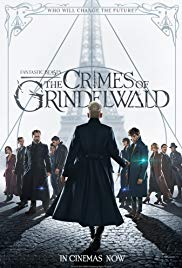
FANTASTIC BEASTS: THE CRIMES OF GRINDEWALD (2018)

November 15, 2018

 Greetings again from the darkness. It’s been seven years since the final Harry Potter movie, and this is the second entry in the planned series of 5 prequels entitled FANTASTIC BEASTS, based on a (fictional) Hogwarts’ textbook written by Magizoologist Newt Scamander (played by Eddie Redmayne). Of course the characters and stories are from the pen of J.K. Rowling, and who better to bring us the war pitting pure-blood wizards against Muggles?

FANTASTIC BEASTS AND WHERE TO FIND THEM was released in 2016, and it was mostly an introduction to these characters and to some of the cutest and oddest creatures we’d ever encountered on screen. This second entry is much darker and more sinister, and tries to develop quite a few characters … perhaps too many. On top of the roster of players, romantic complications abound, and a search for one’s roots/identity is yet another sub-plot. And then there’s that whole Nazi element – leaving us all a bit bewildered at trying to keep up (although, it is fun trying).

David Yates directed the last four Harry Potter movies, and now the first two Fantastic Beasts films. He kicks this one off with a spectacular action sequence featuring a black carriage being drawn by a team of majestic flying dragons during a driving rain storm … all part of a daring 1927 prison escape by the titular Grindewald (Johnny Depp with a bleach punk do). It’s a breathtaking sequence, and the best of many visual wonders throughout – including my favorite, a very cool statue effect and a fabulous kelp seahorse.

Most of the key players return from the first film, though, as previously mentioned, their stories are more elaborate. Eddie Redmayne returns as Newt, our main guide through this universe. Katherine Waterston is back as auror and fringy love interest Tina, Alison Sudol returns as Tina’s mind-reading sister Queenie, and Dan Fogler resumes his comic relief duties as Jacob. Jude Law is Albus Dumbledore (yes, the first name is needed), and he is prevented from fighting Gindewald (Depp) due to some youthful “bonding” that occurred years prior. Zoe Kravitz is Leta Lestrange, Carmen Ejogo is Seraphina Picquery, and Ezra Miller is the lost soul Credence Barebone. Newly introduced characters include Claudia Kim as shapeshifter Nagini, Callum Turner as Newt’s brother Theseus, and Brontis Jodorowsky (son of renowned cult director Alejandro Jadorowsky, EL TOPO) as non-ghost Flamel. If that’s not enough characters to track, you should know the story skips from New York to London to Paris and back around again.

Expect some happy gasps from the audience as Hogwarts is revisited, but the darkness and similarities to Nazi beginnings may surprise those expecting two hours of cutesy creatures springing from Newt’s coat … although, those exist as well. We do learn that ‘salamander eyes’ are not to be used while flirting, and it will be quite interesting to see how these stories close in to the Harry Potter world over the next 3 prequel-sequels (scheduled through 2024). It should be a fun ride – though not as fun as riding that seahorse.

watch the trailer:


THE NUTCRACKER AND THE FOUR REALMS (2018)

November 1, 2018

 Greetings again from the darkness. Missing: Tchaikovsky and Ballet. OK, not missing entirely, and it seems all we do is beg for creativity and new approaches in movies, so let’s give this one fair treatment. It’s not the traditional “Nutcracker” holiday fare you’ve come to expect on stage, on TV, in the mall, at schools, and just about everywhere. Instead, it’s a version wrung from both the 1816 original short story “The Nutcracker and the Mouse King” by E.T.A. Hoffman and the 1892 ballet by Marius Petipa with music from Tchaikovsky, yet also something quite different. Still, different doesn’t always mean better … sometimes it just means different.

We are treated to a beautiful extended opening shot as an owl swoops through old London. This acts as preparation for the abundance of stunning visuals headed our way throughout. Budding star Mackenzie Foy (INTERSTELLAR, 2014) plays Clara Stahlbaum, a young girl distraught that it’s her first Christmas without her beloved mother Marie, who recently passed away. Clara’s quietly grieving father (Matthew Macfadyen) delivers the presents Marie left for each of the three kids. Mechanically inclined Clara’s gift is an ornate egg that requires a specialty key to unlock the hidden message Clara believes her mother has left.

A lavish Christmas party at her Godfather’s (Oscar winner Morgan Freeman) mansion leads Clara to a parallel universe where her mother Marie was Queen of the four realms. This is a fantastical land that reminds (maybe a bit too much) of Tim Burton’s ALICE IN WONDERLAND and the classic THE WIZARD OF OZ. Clara buddies up with a live Nutcracker soldier Phillip (newcomer Jayden Fowora-Knight), who quickly becomes her trusted bodyguard. Land of Snowflakes, Land of Flowers, Land of Sweets, and the blighted Fourth Realm run by a cast-out Mother Ginger (Oscar winner Helen Mirren) make up this world. Keira Knightley stars as the Sugar Plum Fairy, and her devilishly fun performance is responsible for most of the energy, humor and entertainment outside of the visual effects. The two time Oscar nominee seems to relish the voice, the costumes and the chance to play a quirky character.

Disney touches like the animal sidekicks are noted: Phillip’s loyal steed, and the pesky little mouse that flashes more personality than anyone in the film outside of Sugar Plum. Most of the comedic secondary characters (including Richard E Grant and Eugenio Derbez) fall flat with very little do in a screenplay from Ashleigh Powell that gives the impression of multiple hands in the pie. Adding to the disjointed feel and lack of cohesion in the story flow is the fact that two very different directors worked on the project. Lasse Hallstrom (CHOCOLAT) handled principal photography and then Joe Johnston (CAPTAIN AMERICA: THE FIRST AVENGER) spent a month on re-shoots with attention to visual effects. The contrasts between these two directors is quite clear in the finished project despite the cinematographer of Oscar winner Linus Sandgren (LA LA LAND).

The mishmash of styles and tone prevents us from ever really connecting with characters or being drawn in by the story, but beyond that, there are some really terrific visuals and special effects. I especially liked the look of the enhanced tin soldiers and the work of two time Oscar winning costume designer Jenny Beavan. Of course, this is a familiar story and many viewers bring certain expectations into the theatre with them. The iconic Tchaikovsky music is played early and throughout the film, though mostly in teases and in blends with new music from James Newton Howard. We do get a glimpse of Maestro Gustavo Dudamel conducting the orchestra, and for those expecting ballet, the fabulous Misty Copeland performs a couple of times, though it’s likely not enough for those hoping for more of a ballet production. The end result is an impressive visual experience that will likely still disappoint those looking for another holiday watching tradition.

watch the trailer:


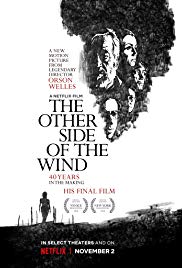
THE OTHER SIDE OF THE WIND (2018)

November 1, 2018

 Greetings again from the darkness. Film nerds unite! Most of us who (proudly) wear that label have known that filmmaker Orson Welles left a few unfinished projects when he died in 1985. The most famous – or infamous – of these was THE OTHER SIDE OF THE WIND. It was to be the comeback film for Mr. Welles, who had slipped from the artistic throne with his run of TV projects, shorts, and unsuccessful features during the 1960’s. Known as a perfectionist, and as someone more dedicated to the filmmaking part more than the “finishing” part, Welles filmed scenes for the movie from 1970-1976, and then picked it back up in the early 1980’s to begin the editing process … a process he never finished.

Best known for his all-time classics CITIZEN KANE (1941) and TOUCH OF EVIL (1958), Welles left mountains of copious production notes, and almost 100 hours of footage in multiple formats, and in both color and black and white stock, on this project that, even today, might best be described as experimental. Over the past 30 years there have been numerous attempts to raise the money required to finish the film, but all fell short until this one spearheaded by Peter Bogdanovich and Beatrice Welles (Orson’s daughter).

In what we can only interpret as semi-autobiographical, what we see on screen is the making of a documentary on a legendary director’s comeback film (his poke at artsy filmmakers). Clips of the unfinished film are shown throughout, while an industry party plays out, and numerous documentary filmmakers capture the scene from various angles with their always-present cameras. Got that?  Don’t worry, it takes at least a few minutes as a viewer to get the rhythm and layers of what’s unfolding before our eyes.

John Huston (himself an industry legend with 2 Oscars and 15 nominations) plays director Jake Hannaford, who is walking the fine line between Hollywood power and has-been. It’s his 70th birthday party, and Hannaford is compared to Hemingway (a description that better fit Huston than Welles), silently endures insinuations of his closeted homosexuality, desperately seeks funding to finish his film, and skulks around his own party winding through the hangers-on and those waiting for the final curtain.

Hannaford’s artsy film within a film, at least the clips we see, feature an inordinate amount of nudity from the leading lady (played by Welles 4th wife and the film’s co-writer Oja Kodar), and some ultra-coolness from the lead actor John Dale (played by Robert Random). Part of Hannaford’s desperation (both professional and persona) stems from a James Dean-type Dale walking off the set mid-picture.

Guests at the party include Peter Bogdanovich as director Brooks Otterlake, a young director once mentored by Hannaford. It’s an example of the student becoming the teacher. Susan Strasberg (daughter of famed acting coach Lee Strasberg) plays film critic Juliet Riche, a thinly-veiled portrait of Welles nemesis Pauline Kael. Other familiar faces in the cast include: Lilli Palmer, Mercedes McCambridge (Oscar winner), Edmond O’Brien (Oscar winner), Cameron Mitchell, Paul Stewart (from CITIZEN KANE), Tonio Selwart, Geoffrey Land, Norman Foster, Dennis Hopper (2 Oscar noms), Claude Chabrol, Stafford Repp (Sgt O’Hara from “Batman” series), plus Cameron Crowe (Oscar winner), William Katt, Frank Marshall (5 Oscar noms), Rich Little, Leslie Moonves (recently fired in disgrace CBS President), and Paul Mazursky (5 Oscar noms). It’s fascinating to see so many we recognize from more than 40 years ago. Of course, it’s Huston, with his face that’s made for black and white film, who is the dominating figure (his scenes were filmed prior to his work on CHINATOWN).

It’s easily viewed as a satire on the film industry, and it’s quite a fun, messy-by-design, now retro look at a fragile industry – and the even more fragile people who make movies. Welles’ love/hate relationship with the industry takes on an art form. He shows what’s good and what’s deplorable. Is it an experimental movie commenting on the post-studio world of independent filmmaking, or is it an iconic filmmaker, glory days behind him, in the midst of self-reflection. Perhaps it’s both. In addition to Welles’ early editing efforts, Oscar winning editor Bob Murawski (THE HURT LOCKER) was brought in to finish up what can now be described as a master class in film editing. It’s a wild ride for us film nerds. Are you ready to join us?

watch the trailer:


SUSPIRIA (2018)

October 25, 2018

 Greetings again from the darkness. It makes perfect sense when you think about it. After three artsy prestige projects (CALL ME BY YOUR NAME, A BIGGER SPLASH, I AM LOVE), Oscar nominated Italian filmmaker Luca Guadagnino decides to let his freak flag fly. And what better way than to pay homage to his fellow countryman Dario Argento’s 1977 surreal cult classic that featured a blinding color palette, obtuse camera angles, and enough schlock-horror (in a good way) to remain a midnight movie favorite for more than 40 years? While both movies are B**S**T crazy, we can’t help but think a filmmaker of Mr. Guadagnino’s caliber should have done better.

Dakota Johnson (FIFTY SHADES OF GREY) stars as Susie, a Bambi-eyed self-trained dancer raised in Ohio by her Mennonite parents. Following her dream, she shows up for an audition at the world renowned Markos Dance Company in Berlin. The film is set in 1977 (the same year as the original was released) and Susie sufficiently impresses the company director Madame Blanc (Tilda Swinton) to be invited to join.

A title card informs us that we are about to undertake “Six Acts and an Epilogue set in divided Berlin”. It should have added the run time of two-and-a-half hours (it seemed longer). For those of us who would pay to watch Tilda Swinton in any role, this one does deliver bonus value. The enormously talented actress who has disappeared into numerous characters over the years, plays two other roles here – disguised by heavy make-up in both. The trade-off is that Ms. Johnson is the lead, so not only are we subjected to the limitations of her acting, but also camera-trickery when it comes to her dance scenes. A bushy bushy red hairdo conceals her face during the most physically demanding dance sequences … think Cousin It from “The Addams Family”.

An almost entirely female cast features some interesting choices from across generational and geographical boundaries. Angela Winkler and Ingrid Caven have long been familiar faces on the big screen, and Mia Goth and Chloe Grace Moretz are fine choices for the younger company members. As an added bonus, Jessica Harper appears in one segment towards the end. Ms. Harper played the lead role of Suzy in the original. Other fun comparisons between the two films are the original score by Goblin compared to the updated (and more serene) score by Thom Yorke of Radiohead, and the muted color palette chosen by Guadagnino and cinematographer Sayombhu Mukdeeprom for this updated version.

The reason there is an open spot in the company for Susie is that Patricia (Chloe Grace Moretz) has disappeared after unloading her ‘coven of witches’ theory on an aged psychiatrist Dr. Josef Klemperer. Dr. Klemperer initially thinks the hysterical Patricia is delusional, and would prefer to wallow in his grief over his beloved wife Anke – missing since WWII. When Susie gets her shot at the lead in what is to be the company’s final performance of its most famous dance piece Volk, we get the film’s best sequence and one of a few WTF moments. A mirrored dance studio is the site of unexplained violence, and some terrific editing shoots us back and forth between art and mayhem. It’s difficult to watch but exceedingly well done.

Unfortunately, the truly bizarre and horrific moments are much too rare. In fact, some of the segments come off as unintentionally funny, which is not a good thing for a horror flick. The primal dancing never seems sensual, the bloodbath finale is too far over the top, and the political subtext with the Baader-Meinhof terrorist group just never seems to fit. While watching this, a few films came to mind: BLACK SWAN, THE WICKER MAN, MOTHER!, and ROSEMARY’S BABY, though this one doesn’t reach the level of any of those. Sometimes a movie just doesn’t lend itself to analysis or review, and it comes down to whether this is your cup of tea.

watch the trailer:


VENOM (2018)

October 4, 2018

 Greetings again from the darkness. For those movie-goers who believe there is no need for another comic book movie, you now have People’s Exhibit A. This is the 5th Marvel film of 2018 (yep, that’s a new one every other month!), and it’s the first one proving challenging to say much of anything that is positive or complimentary.

It should be noted that this is not a Superhero movie, but rather a film based on the Marvel Comic characters and stories of Todd McFarlane and David Michelinie. Four writers are credited with the screenplay, and it seems they either needed more or fewer. Director Ruben Fleisher (ZOMBIELAND, 2009) apparently worked with what he was given, hoping the stellar cast or the CGI could salvage the project.

The always terrific Tom Hardy (Bane in THE DARK KNIGHT RISES) stars as Eddie Brock, a renowned investigative reporter popular for breaking stories of corruption and fraud. Unfortunately, he has a significant lapse in ethics – an unusually forthright comment from Hollywood on today’s media. This lapse costs Brock his job, his girlfriend (4 time Oscar nominee Michelle Williams), and any semblance of normalcy. While investigating the unimaginable human-alien experiments of megalomaniac Carlton Drake (Riz Ahmed), Brock takes on the powers of the symbiote (Venom) and spends the rest of the movie either trying to control these powers, sitting back and letting the powers take over, or exchanging frat boy dialogue with the possessive being who picked up all nuances of the English language pretty darn quickly.

Venom was last seen in the lackluster SPIDER-MAN 3 and was played by Topher Grace. This time out, Venom is the focus and Spidey is nowhere to be found or mentioned … at least not until post credits (a terrific animated sequence). The CGI is at times very impressive – reminiscent of something John Carpenter might have ordered. Two sides of the Transamerica Pyramid provide a nice visual, however, the effects are not at all consistent. Far too often … especially the battle between Venom and Riot …it’s just plain messy (like letting a group of toddlers play with black and gray slime).

The film’s saving grace could have been the interactions between Mr. Hardy and Ms. Williams, both stellar actors, but the dialogue and situations are so ridiculous that even those scenes don’t click. The moments that draw laughter from the audience may or may not have been by design, but there are far too many ‘forced comedic moments’ that just fall flat.

Composer Ludwig Goransson (CREED, BLACK PANTHER) delivers some nice moments with the score, but the Eminem song over the closing credits sounds amateurish. The film is very loud, and not so much lacking direction as it is burdened with too many directions and misfires. A comic book movie’s first priority is to be fun, and this one just isn’t much of that. Surprisingly, the film is rated PG-13 rather than R, so the excessive violence (and there is plenty) never actually spills a drop of blood. Perhaps the goal was to make a Marvel movie so uninspiring that BLACK PANTHER’s Oscar chances would be enhanced.  Otherwise, there’s no excuse.

watch the trailer:


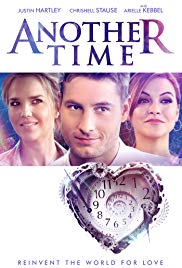
ANOTHER TIME (2018)

September 13, 2018

 Greetings again from the darkness. Dating back to H.G. Wells’ 1895 book and 1960 film THE TIME MACHINE, time travel has long been a favorite and familiar trope for filmmakers and writers. It’s been a central topic for comedies (BILL & TED’S EXCELLENT ADVENTURE, HOT TUB TIME MACHINE), science fiction (LOOPER, INTERSTELLAR), oddities (PLANET OF THE APES, DONNIE DARKO), adventures (BACK TO THE FUTURE, MIDNIGHT IN PARIS), and romance (SOMEWHERE IN TIME, ABOUT TIME).

Since time travel has crossed many genres, it only makes sense that a filmmaker looking to tackle the topic would understand something new must be brought to the party, if a new project can hope to have any appeal. Director/writer Thomas Hennessy and co-writer Scott Kennard attempt to blend romance with a dose of science and philosophy, but unfortunately, even as a low budge B-movie, it just comes across as a lackluster effort with a too-simple script. I’m not familiar with director Hennessy’s TV work on “Bugmashers” and “Ten for the Chairman”, but his background as a cinematographer should have at least resulted in a more visually impactful film.

Justin Hartley (“This is Us”) stars as Eric Lazifer, a successful Account Manager who saves his money, watches science shows on TV, and is easily “bored” by the married women who hit on him in bars. So, Eric is a fiscally conservative Brainiac who looks like a male model … clearly a rough way to go through life. Eric’s best bud Kal (James Kyson) serves as the comic relief, and is one of the few who bring some energy to their role. A recent company acquisition has Eric’s boss (Mark Valley) mandating he iron out the details with that firm’s leader Julia, played by Crishell Stause (Mr. Hartley’s real life wife).

It’s pretty easy to see where this is headed. Eric falls hard for Julia. However, she fails to swoon for his ice cream-philosophy-romance recipe since she is already engaged to a great guy. So Eric does what any guy would do … he tracks down disgraced Physics professor  Dr Joseph Goyer (Alan Pietruszewski) so that Eric can travel back in time to meet Julia before she connects with her fiancé. It’s a solid and logical plan with very little chance for something to go wrong (!). If the story was ever on track, it’s here that it really flies off the rails. Watching Eric assist the Physics expert with solving unsolvable equations is just a bit too much.

On the bright side, this segment allows Eric to meet a bartender named Ally, played by Arielle Kebbell. Ms. Kebbell definitely brings a welcome screen presence to this otherwise uninspired project. The soap opera look and feel likely relegate this one to the world of streaming, where, if it’s lucky, it might find some time travel obsessed viewers.

watch the trailer:


CHRISTOPHER ROBIN (2018)

August 2, 2018

 Greetings again from the darkness. “It’s always a sunny day when Christopher Robin comes to play.” You know when it’s not a sunny day?  When grown man Christopher Robin ignores his wife and daughter to work every waking hour at his job as an Efficiency Manager for a struggling luggage company. Whatever made the filmmakers spend so much time here on the gloominess of adulthood is beyond me, but oh my, when the friends all reunite in the Hundred Acre Wood, it’s truly a joy to behold.

It was only last year when GOODBYE CHRISTOPHER ROBIN hit the theatres, and while that was more of a biopic of A.A. Milne and the origin of Winnie the Pooh, this version focuses instead on the adult Christopher Robin, and how responsibilities can rob us of all the joys of childhood if we aren’t careful.

Ewan McGregor plays the grown-up Christopher Robin, and we see him back from WWII as a boring workaholic who has little time for his wife Evelyn (Hayley Atwell) or daughter Madeline (Bronte Carmichael). The story begins with young Christopher Robin (Orton O’Brien) sharing a farewell lunch with his friends just before he heads off to boarding school, leaving his childhood far behind. In addition to Pooh bear, we also see Rabbit, Piglet, Owl, Kanga and Roo, as well as a bouncy Tigger and classically mopey Eeyore. It should be noted that these aren’t the animated creatures you and your kids are accustomed to. These are stunning CGI stuffed animals modeled after the early drawn images of Ernest Shepard. They are lifelike … as much as talking stuffed animals can be … and kid viewers are likely to fall quickly for them.

There are three screenplay credits: Oscar winner Tom McCarthy (SPOTLIGHT), Oscar nominee Allison Schroeder (HIDDEN FIGURES) and Alex Ross Perry (LISTEN UP PHILIP). Their work is based on a story from Greg Brooker (STUART LITTLE) and Mark Steven Johnson (SIMON BIRCH), and of course the characters from AA Milne and Ernest Shepard. It might not surprise you that the director Marc Foster also directed the excellent FINDING NEVERLAND, but it’s a bit eye-opening to think he also directed MONSTER’S BALL and QUANTUM OF SOLACE, neither of which have a single scene that kids should watch!

Despite the heavy gloom of the portion of the story dealing with Christopher Robin’s family and job, the film (and the kids in the audience) lights up when all the friends are on screen. Playing the “Say what you see” game on the train emphasizes that creativity sprouts from nothing (doing nothing is a recurring theme in the Pooh stories), and of course, the ever-present red balloon plays a role (much different than the red balloon in IT), as does the familiar “Winnie the Pooh” song from 1977, which most everyone in the audience hummed along with in its various pop-ups during the movie.

The voice acting is necessarily superb, and credit goes to Jim Cummings as both Pooh and Tigger – roles he also voiced in the animated series and previous animated films. Of course the great Sterling Holloway was the original Pooh voice, and he passed away in 1992. Nick Mohammed is Piglet, Peter Capaldi is Rabbit, Sophie Okonedo is Kanga, while Sara Sheen is Roo. Toby Jones is Owl, and Brad Garrett gets some of the film’s best and funniest lines as everyone’s favorite downtrodden donkey Eeyore.

Pooh, the ‘silly old bear’, states “People say nothing is impossible, but I do nothing every day.” This type of humor and philosophy goes on throughout the film, whenever the friends are on screen. The moral of the story is that it’s crucial that we maintain some sense of childhood wonder and joy, even as adult responsibilities close in on us. If you can wake up each morning and say “Today is my favorite day”, you are likely not a bear of little brain … plus you’ll avoid Heffalump traps!

watch the trailer:


SORRY TO BOTHER YOU (2018)

July 12, 2018

 Greetings again from the darkness. All movie watchers know that the first rule of Fight Club is ‘Don’t talk about Fight Club’. And now we know that the first rule of Telemarketing is STTS: Stick to the script. The similarities between the two movies may be few, but hip-hop artist (The Coup) turned first time filmmaker Boots Riley comes out swinging in this offbeat, quite clever satire on race, corporate culture, economic factions, social division, and politics. It makes for a nice companion piece to last year’s critical darling, GET OUT.

LaKeith Stanfield (GET OUT, SHORT TERM 12) stars as Cassius “Cash” Green, a low key good dude living with his girlfriend Detroit (Tessa Thompson) in his uncle’s (Terry Crews) garage. Four months behind on rent, Cash wants to do something important with his life, he just doesn’t know how … and his current financial circumstances aren’t helping. You may call him a dreamer, but he’s not the only one (a Lennon reference seems fitting for this film).

Cash’s best buddy Salvador (Jermaine Fowler) gets him an interview at a dingy basement telemarketing firm – an interview that clues us in on the type of humor we are in for. Thanks to advice from one of the veteran telemarketers (Danny Glover), Cash utilizes his “white voice” and immediately has remarkable success … and we get some pretty funny sales call visuals to correspond to the obvious capitalism statement.

Ultimately his sales success gets him promoted to the “power caller” level and his own mentor, accessible only through the gold elevator. This leads to conflict with his friends, his girlfriend and his own moral standards. See, the basement dwellers are being led by Squeeze (Steven Yeun) in an effort to unionize for a living wage and tolerable work environment. As Cash continues to pursue … well, uh … cash … his friends carry out their form of civil disobedience. This leads to police brutality, examples of corporate greed, and the downside to individual ambition.

Armie Hammer plays Steve Lift, the egomaniacal corporate d-bag who takes Cash under his wing – for the purpose of making more money. The sales pitch turns to “Worry Free”, a lifestyle being marketed through brain-washing advertisements for guaranteed food and shelter. One need only commit to a lifetime of corporate servitude. If that sounds like slavery, well, that’s the point Riley is making. It’s not so far off from the life many of us lead today, but of course this is presented in satirical fashion, so we are manipulated into laughing at ourselves and our society. There is even a popular reality TV show titled “I Got the S**T Kicked Out of Me”, and folks can’t get enough!

The story kind of flies off the rails in the second half with some wacko-science fiction genetic engineering. The equisapiens have to be seen, as no written description will do. Even this segment has purpose. It speaks to how individuals and corporations can seize power and head in a questionable direction – all in the name of progress, efficiency and stock price.

Stanfield excels in one of his first lead roles, and Ms. Thompson is her usual shining star. Kate Berlant (as the humorously named Diana DeBauchery) has a couple of excellent scenes, and David Cross and Patton Oswalt are terrific as the (extremely) white voices of Cash and Mr. _________ (played by Omari Hardwick).

Filmmaker Riley offers up not a call to arms, but rather a call to wake up! Many of the decisions here mirror real life. Personal success can cost us friends, and political and professional choices may challenge our inherent morals (here, bordering on Faustian). The film is both provocative and funny, though a bit messy at times. You’ll laugh while you think, or laugh after you think, or think after you laugh … somehow you’ll do both. OFFICE SPACE and Terry Gilliam’s BRAZIL may be the closest comparisons; just be cautious if Boots Riley ever invites you to join in some horse play.

watch the trailer:


YELLOW SUBMARINE (1968, animation) revisited

July 7, 2018

 Greetings again from the darkness. “It was 50 years ago, Sgt Pepper taught the band to play”. OK, I know that’s not the lyric, but 50 fits better than 20 when we are talking about the latest re-mastered 4K version of the classic animated YELLOW SUBMARINE from The Beatles. Originally released in 1968, the story is by Lee Minoff and is based on the Lennon-McCartney song of the title. Additional dialogue and story elements were contributed by (at least) four other writers, including Erich Segal of LOVE STORY fame, and after all these years, the film not only remains quite entertaining, it has attained a certain legendary status.

Directed by George Dunning (animation producer), also instrumental in The Beatles “unaffiliated” animated TV series of the same era, the film requires a bit of historical perspective to bring the full picture into focus. This was the year before Woodstock, and the Beatles were no longer the four fresh faced lads from Liverpool. Their songs had not only changed the music world, it had changed them as individuals. Much of their charm had turned to cynicism, and drug use was prevalent. The band reluctantly agreed to allow production of this animated movie for the sole purpose of fulfilling their 3 film contract with United Artist (A HARD DAY’S NIGHT, HELP!). Other than the songs and a closing segment, they were barely involved … not even voicing their own characters.

The true legacy is what we see on screen, and after 50 years, it remains magical. The psychedelic pop art visuals were unlike anything most of us had ever seen. The colors and images seemed to explode in vibrancy and come alive before our eyes. Some have mistakenly credited pop artist Peter Max as the man behind the colorful images, and fans of Monty Python (especially Terry Gilliam) will easily recognize the stylistic influence. Sharp ears will pick up references to Beatles lyrics not included on the soundtrack, and much of the dialogue captures the droll tone of Lennon or the whimsy of McCartney. However, we never stop thinking about how much more effective this could have been with John, Paul, George and Ringo providing the voices.

An extended opening sequence provides the basics of the story – The Blue Meanies are coming (!) and they intend to expunge all music and color from Pepperland. The only way to stop them is with Beatles music. Once we ‘understand’ the story, we hear Ringo’s vocals kick off the title song over the opening credits. Through the adventure we meet some fascinating and creative characters, see an abundance of green apples (the logo for Apple Records), play spot the icon (with actual photographs), laugh along with Ringo and his “hole” in the pocket, and catch the essence of Beatles wit, though the dialogue is sometimes a bit muddled.

Of course, beyond the animation, it’s the music that matters. Two songs that stand out because of the corresponding animation are “Eleanor Rigby” and “Lucy in the Sky with Diamonds”.  Some of the 11 Beatles songs mish-mashed from various albums include:  “Sgt Pepper’s Lonely Hearts Club Band”, “All You Need is Love”, “All Together Now”, and “When I’m Sixty-Four”. There are also a couple of George Harrison songs that aren’t otherwise available, and a personal favorite, “Hey Bulldog”, which has its own sequence, and was originally only included in the UK movie version. We also notice the beautiful orchestra music composed by long-time Beatles producer George Martin.

At the time it was released, hippies would claim the movie looks better when you’re stoned, and it’s likely for those folks, that sentiment held true for most things in life. The message of the day and one present in much of the Beatles’ work, is that of Love. It’s a message that rings true today, and also part of why the film works so well for both kids and adults. Although we may be a bit disappointed that the fab four don’t provide the voices of their characters, the stunning visuals and classic songs make this a film for everyone. The short live action sequence at the end where we see the real John, Paul, George and Ringo is simply the cherry on top … or is that an Apple?

watch the (U.S.) trailer: