Greetings again from the darkness. It’s an impressive cast. The director, Henry Alex Rubin, gave us the excellent documentary Murderball. Unfortunately the material here is mostly obvious and cliché-filled with no real message, other than our dependency on technology is leading us to be less “connected” to those real life people we live with. Is there anyone who doesn’t know this … other than the characters in this movie?
I’m calling this movie “Crash on the World Wide Web”. Crashwas the 2006 Oscar winner for Best Picture. It had multiple story lines andworked extremely hard to appear very important, just like this one does. Disconnect shows us the Boyd’s – a family comprised of a workaholic lawyer dad (Jason Bateman always on the blackberry), a teenage daughter (Haley Ramm), a teenage loner son, and a mom (Hope Davis) who has no close bond with any of them. The boy (played by Jonah Bobo from Crazy Stupid Love) is cyber-bullied by two cruel boys (Colin Ford from a We Bought a Zoo, and Aviad Bernstein).
We also meet a married couple played by Paula Patton and Alexander Skarsgard. They learn they are the victims of identity theft and the source could be her online support chat room (grieving the loss of their young son) or his online gambling problem. They hire a cyber-crime expert (Frank Grillo) to help them track down the alleged perpetrator (Michael Nyqvist). This expert also happens to be the father of Colin Ford’s character – the cyber-bully from story 1.
Finally we see an ambitious local TV reporter (Andrea Riceborough) who stumbles onto an online sex chat room featuring young stud Max Thieriot. As the trust builds between these two, we know disaster is fast approaching.
The two father-son relationships take a turn after both fathers “invade” the privacy of the boys’ online accounts. What they learn is painful and enlightening. The real point or message of the stories seem to be that technology is killing real communication and human interaction. This is the disconnect that is occurring while online connections are thriving. Did we really need a movie to tell us this?
SEE THIS MOVIE IF: you are somehow oblivious to the inherent dangers of online communication OR if you are unaware that teenagers can be cruel and loneliness is open to all ages OR you want to see why I prefer Jason Bateman in dramatic roles rather than comedies
SKIP THIS MOVIE IF: you have been the victim of identity theft or cyber-bullying … no need to re-live that pain
Greetings again from the darkness. After some soul searching, I have decided to turn off the critical side of my brain and concentrate on what is good about this movie. As a baseball and movie fanatic, a bit of trepidation creeps in when the two worlds collide. However, this isn’t really a baseball movie, though the story focuses on what may be the most critical turning point in baseball history. In fact, this turning point was much bigger than the American Pasttime … it was also a key step in the early stages of the Civil Rights Movement. The movie is a reminder of how different things could have been with the wrong man rather than the right one … Jackie Robinson.
Writer/Director Brian Helgeland (s/p for L.A. Confidentialand Mystic River) takes a look at what occurred in 1945-47, when Brooklyn Dodgers President and GM Branch Rickey (played by Harrison Ford) made the business decision to integrate baseball. We see his selection process … Roy Campanella “too nice”, Satchel Paige “too old”. He settles on Jackie Robinson after their infamous 3 hour meeting where Rickey confronts Robinson with his need for a black player “with the guts NOT to fight back”.
Chadwick Boseman portrays Jackie Robinson as a man thoroughly in love with his wife Rachel (played by Nicole Beharie), and one who says he just wants to “be a ballplayer”, while at the same time taking pride in his world-changing role. We see his evolution from his stint as shortstop for the Kansas City Monarchs of Negro Leagues to his time with the Dodgers’ AAA minor league team in Montreal and finally to his introduction to the Major Leagues in 1947. Boseman flashes the charisma and athletic ability to pull off the role … there are times he looks identical to the young Jackie.
This is an earnest and sincere movie that removes the complexities of the times and the main characters. Much of it is portrayed as good guys versus bad guys. The good guys are really good and the bad guys are really bad. Alan Tudyk has the unenviable task of portraying Philadelphia Phillies manager Ben Chapman, who famously unleashed an in-game verbal assault of vile racism on Robinson. Mr. Rickey credited Chapman’s public small-mindedness as the single biggest factor in unifying the Dodger team around Robinson. The other famous moment given time in the movie is when beloved shortstop Pee Wee Reese (Lucas Black) put his arm around Robinson, shushing the hostile Cincinnati fans. Of course as a baseball fan, I enjoyed the all too brief antics of Brooklyn manager Leo Durocher (Christopher Meloni) whose place in the Robinson story would have been much more profound had he not succumbed to the weakness of the flesh (so to speak).
Other supporting roles include John C McGinley, who is spot on as the Hall of Fame announcer Red Barber, Derek Phillips as an unusually quiet Bobby Bragan, Jesse Luken as Hall of Famer Eddie Stanky, Andre Holland as Wendell Smith (the Pittsburgh Courier reporter assigned to follow Robinson), Peter Mackenzie as Commissioner Happy Chandler and young Dusan Brown as a 10 year old boy who would grow up to be major leaguer Ed Charles. Some comic relief is provided by Hamish Linklater as pitcher Ralph Branca (one of the first who welcomed Robinson to the clubhouse, and who would go down in baseball history as the pitcher who surrendered the 1951 “shot heard round the world” by Bobby Thomson).
Filmmaker Helgeland provides a tale of morality and social change, and provides a glimpse at the character and strength required by those involved. The story has much more to do with demonstrating how the times began to change than it does with how Jackie Robinson, an unpolished ballplayer but superior athlete, transformed himself into a perennial all-star and league MVP. And that’s as it should be. As Rickey stated, acceptance will only occur if the world is convinced Robinson is a fine gentleman and a great baseball player. That burden must have weighed heavily at times, but it’s very clear that Robinson was the right man at the right time.
**NOTE: the time frame for this story is limited to Robinson’s historic, barrier-crashing major league debut, but it should be noted that Robinson won the Rookie of the Year Award in 1947, the MVP in 1949, played in 6 all-star games and World Series in his 10 year career,and was a first ballot Hall of Famer in 1962. Prior to his baseball career, he was a four sport letterman at UCLA and also served in the US Army. Robinson died in 1972 from a heart condition and complications from diabetes. His wife is still active and still running the foundation that provides scholarships for youngsters. Quite an amazing lady.
Here is a photo of the real Jackie Robinson and Branch Rickey:
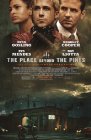
Greetings again from the darkness. With an extended tracking shot to open the film, we follow Ryan Gosling, a motorcycle stunt rider, from his trailer through the carnival grounds and right into the metal sphere with his co-riders. It’s an exhilarating start to the film and introduces Luke (Gosling) as a heavily-tatted star attraction on the carnival circuit.
This is director Derek Cianfrance’s follow-up to his 2010 critically acclaimed Blue Valentine(which also featured Gosling). While that film painfully presented the gut-wrenching misery of a crumbling marriage, this latest shows multi-generational fallout from poor decisions and faulty father-son relationships. Cianfrance has quite an eye for well-intentioned, but inadequate personality types. This latest is presented in triptych format … three distinct story divisions. The first segment is mesmerizing and top notch filmmaking. It follows Luke’s attempt to “do right” by his newly discovered infant son – the result of last year’s carnival trip to this same town and a tryst with Romina, a local gal played by Eva Mendes.
Gosling is especially effective (yet again) as he falls in with a local mechanic played by a terrific Ben Mendelsohn (frightening in Animal Kingdom). The two hatch a scheme to capitalize on Luke’s bike riding skills by robbing banks. These “jobs” allow us to see the other side of Luke, who seems sincere in his desire to provide for the child and win back Romina. Things go badly when Luke crosses paths with rookie street cop Avery Cross (played by Bradley Cooper). Watching Gosling’s contradictory personalities is quite amazing … he flips from quietly charming to cold-blooded brutal bank robber in the blink of an eye.
The story then shifts to follow Avery and his strained relations with his wife (Rose Byrne), their infant son, and Avery’s former state Supreme Court judge father (Harris Yulin). A sub-plot brings in police department corruption led by … who else? … Ray Liotta. Mr. Liotta still possesses the beady-eyed stare that can scare the crap out of his fellow actors and anyone watching the movie. This corruption and the idealistic and ambitious nature of Avery aren’t a very pleasant mixture, but it sets the stage for the final act.
Flashing forward 15 years, brings us to a fairly predictable situation that still proves interesting. The previous stories focused on the failed relationships of Luke and his father, Luke and his mis-fired attempt at being a dad, and the awkwardness of Avery and his father. Now we see the resulting mess that are the two now teenage boys. The sons are played by Emory Cohen and Dane DeHaan (memorable as Cricket in Lawless). DeHaan especially shines as the Gosling/Mendes prodigy.
Sean Bobbitt is the film’s Director of Photography and he deserves special mention for his work with Cianfrance in bringing a different and intimate look to the characters, setting and story. Also, Mike Patton’s unusual score fits perfectly and keeps the viewer on track. This is a very uncomfortable movie to watch, but those who enjoy tough, artsy films will be rewarded.
*NOTE: During the Q&A after the screening, director Cianfrance mentioned that Ryan Gosling is not “typical” actor, but that he has quite a feel for characters and visual story telling. Unfortunately, a couple of days later Mr. Gosling announced he was taking a sabbatical from acting. Luckily for us, he has built a pipeline of movies that should keep us satisfied for the next couple of years.
SEE THIS MOVIE IF:you are a fan of gritty independent films OR you enjoy triptych story structure OR you just want to see Ryan Gosling at his coolest riding motorcyles
SKIP THIS MOVIE IF: you are looking for an uplifting, inspirational story … no superheroes saving the world in this one.
Greetings again from the darkness. It’s been over 50 years since the film’s initial release and more than 20 since I last viewed it on the big screen. When Cinemark announced it as part of the Classic Film Series, I circled the date on my calendar. While most movies are best viewed in a theatre setting, no other film absolutely demands such a setting.
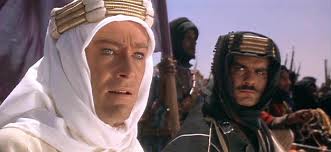
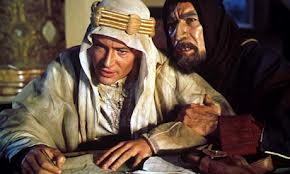
There are many elements that contribute to the well deserved “classic” label: David Lean‘s direction, Freddie Young‘s photography, the star-studded support cast, the historical significance, Maurice Jarre‘s iconic score, and of course, Peter O’Toole‘s standout and unusual performance. This is an action-adventure film with up close battle scenes filmed with no CGI aid. The famous shot of Omar Sharif‘s Sheriff Ali slowly making his initial appearance on the desert horizon is breathtaking on a 60 foot screen. Watching Lawrence’s victory dance on top of the train is majestic in the theatre, and the big screen provides the necessary ominous feeling as the Arabs slowly navigate the blowing sands of the Nefud Desert culminating in an amazing single shot of the attack on Aqaba.
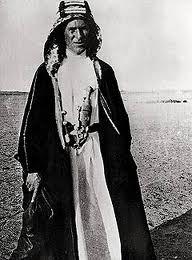
T.E. Lawrence was a fascinating man, though there has been much debate about the film and his legend. Lawrence’s own writings in “Seven Pillars of Wisdom” provided many details used by screenwriters Robert Bolt and Michael Wilson, as well as the writings of American photo-journalist Lowell Thomas … depicted in the film as Jackson Bentley (Arthur Kennedy). The real life Thomas was looking for a hero and likely sensationalized his story of Lawrence, but most believe the foundation is fairly accurate. As if to offer an upfront disclosure, Lean begins the film with notice that no one really knew the man.
While the story of T.E. Lawrence is incredibly interesting, the story in the film is somehow just part of the experience. Director David Lean’s movie is a true experience for movie lovers. This was Mr. Lean’s middle film of an incredible streak of three … The Bridge on the River Kwai(1957) and Doctor Zhivago(1965) being the others. Lean insisted on filming on location, rather than in studio despite the nearly four hour run time, and the nearly insurmountable challenges faced when filming in the desert. This decision drove the cost up, but allowed for the stunning visuals that set it apart … and influenced so many future films, not the least of which were Star Wars, 2001: A Space Odyssey, and of course the Indiana Jones franchise.
In addition to O’Toole’s performance, it is quite exciting to see the dynamic Omar Sharif, the powerful Anthony Quinn (as Auda abu Tayi), the classy Alec Guiness (as Prince Faisal), the kinda creepy Jose Ferrer, the familiar Jack Hawkins and the slightly slimy Claude Rains. Missing from this list is any actress. The movie features exactly zero speaking roles for women … allowing for even more focus on the tendencies and mannerisms displayed by Lawrence.
Maybe the only two actors of the era who could have competed with this fabulous landscape were Peter O’Toole and Marlon Brando. Brando was actually first cast as Lawrence, but soon dropped out to star in Mutiny on the Bounty. O’Toole’s blue eyes and white robe create quite the contrast to the sandy desert. Speaking of contrast, the two times he admires his reflection in his knife are visual keys to his evolution from God complex to broken man. After attending the premiere, writer Noel Coward told O’Toole, “If you had been any prettier, the film would have been called Florence of Arabia.”
The movie received 10 Oscar nominations. It walked away with 7 wins including Best Picture, Director, Cinematogapher, and Score. O’Toole lost out to Gregory Peck (To Kill a Mockingbird). Mr. O’Toole has received 8 Best Actor nominations without ever winning (he does have an honarary Oscar). Watching this film (more than once) is a must for any movie lover. The opportunities to view it in a theatre setting are quite rare, so please seize the chance should it present itself. Your four hour commitment will be rewarded with a movie memory you’ll never lose. And keep in mind, if the movie makes you feel small, “we can’t all be lion tamers“.
Greetings again from the darkness. Though it’s billed as a comedy, you would be best prepared walking into expect a dramatic rom-com. The mere presence of Tina Fey and Paul Rudd (their first collaboration) could lead you to assume that it’s a slapstick comedy. Even though it isn’t, these two would elevate most any script and movie. They are inherently likable and talented, and that’s a lucky thing for director Paul Weitz (About a Boy).
The movie plays like a coming-of-age flick … not for the gaggle of high school students … but rather for Tina Fey’s character. She portrays a Princeton admissions officer named Portia Nathan, and it’s her job to weed through the files of thousands of over-achieving 18 year olds who are dreaming of attending the prestigious Ivy League school. Her serious approach to her work is complicated by a competition with her inner-office rival (Gloria Reuben) and by a going-nowhere relationship with boyfriend Michael Sheen (unrelated to their “30 Rock” relationship).
All of that sounds pretty straight-forward, so the story takes a left turn when Portia makes a campus visit to the Quest School, an experimental campus run by ultimate good guy John Pressman (Paul Rudd). Pressman is the guy who rebels against his privileged childhood and bounces from world-changing missions to life-altering experiences. His current stop as an administrator for a school filled with off-beat genius kids is focused on Jeremiah (Nat Wolff). Jeremiah is an autodidact (reads everything, self-taught) who was never understood by mainstream schools, but has his particular intelligence recognized at Quest.
So Paul Rudd approaches Tina Fey in hopes that she will take an interest in Jeremiah’s passion for learning and overlook his lack of satisfactory resume. There are also side-plots featuring a possible genetic link and a couple of strained maternal relationships from both Rudd and Fey, the latter’s mom played with zeal by Lily Tomlin.
There are no real surprises here, but the movie benefits from Fey, Rudd, Tomlin and the always fun Wallace Shawn. The whole elitist college admissions process is fascinating, but really impacts only a very small segment of society. The over-bearing parent aspect could be further analyzed from either a comedic or dramatic approach. Because of that, and the limited laughs offered by the script, it’s difficult to imagine the film gathering any real following … though here’s hoping Tina Fey and Paul Rudd work together again very soon.
SEE THIS MOVIE IF: you have been through the college admissions process OR you want to see Tina Fey and Paul Rudd wise-cracking as they share a shower
SKIP THIS MOVIE IF: you are in the mood for a slapstick comedy in the vein of Anchorman
Greetings again from the darkness. Dwayne “The Rock” Johnson has carved out a terrific career alternating between major action movies (Fast Five) and comedy flicks (The Other Guys) … both which take advantage of his real life Hulk-like physique and presence. Apparently two film genres is not enough. This time out he attempts to transition to a serious dramatic role as the Construction Company owner-divorced/remarried-suburban father who will do anything for his quasi-estranged teenage son. This would have been a Harrison Ford role back in the 1990’s and probably better suited to Matt Damon today.
Jason (Rafi Gavron) makes a dumb mistake by accepting delivery of a shoebox full of Ecstacy from his best friend. Next thing you know, Jason has fallen victim to the exceptionally strict minimum sentence federal drug laws for first time offenders. Enter Jason’s earnest, hard-working dad who pushes the politically ambitious federal prosecutor (Susan Sarandon) to allow him to infiltrate the drug world in an effort to reduce his son’s sentence.
John (The Rock) has a nice suburban home, with a nice second wife (Nadine Velazquez from Flight), a nice young daughter, and a stressed-out ex-wife (Melina Kanakardes from “CSI:NY”) whom he kinda blames for Jason’s mess. John has loads of family drama plus financial issues at work as he is trying to expand his business. Now he has to figure out how to get into the dirty drug distribution world. His first attempt leaves him face down in the dirt after getting his ass kicked – not a sight we are accustomed to with this giant of a man. Finally, he gets help from one of his ex-con employees (Jon Bernthal) who is trying to stay clean, but really needs the money John is offering.
A meeting with scary Michael Kenneth Williams (Chalky from “Boardwalk Empire”) leads to a meeting with a Mexican drug lord known as El Topo (Benjamin Bratt). John’s access to 18-wheelers is just what this drug cartel needed. For some reason, these brilliant drug dealers would rather trust some unknown trucker dude than spend part of their $83 million on buying their own rig. All logic aside, John works closely with a DEA Agent played by Barry Pepper, who is sporting the worst facial hair this side of Gandalf.
The director and co-writer is Ric Roman Waugh, who made his name as a super Hollywood stunt performer (and also directed Felon). His co-writer is Justin Haythe also wrote Revolutionary Roadand the upcoming The Lone Ranger. The story is based on a true to life “PBS: Frontline” about a family who went through a similar ordeal. In spite of the overuse of the “shaky cam” there is some confusion on whether this is a political statement concerning the stringent drug laws, the abuse of power by political officials, or an insight into the moral dilemmas faced by “normal” types in this day and age. The script seems to exploit the issues in the same manner those with power exploit the first time offenders (often high school and college age kids).
The trailer is a bit misleading as the film only features two real action sequences and both are sampled in the trailer. This is more of a family drama with some moral dilemmas sprinkled in. Pepper and Bernthal are especially effective in their roles, while The Rock is just too distracting to play the typical suburban dad. He is a giant and you can’t ignore that he still looks like a world class wrestler and not a guy you would see at a PTA meeting. Still, if you don’t think too much, this one is entertaining enough for a February release.
SEE THIS MOVIE IF:you want to see The Rock’s attempt to transition to serious drama
SKIP THIS MOVIE IF: you are expecting the next big time action flick from The Rock
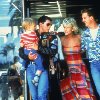
“I feel the need … the need for SPEED!” A recent one week run of the re-mastered 3D IMAX version of Top Gunprovided the opportunity to re-evaluate the 1986 film that catapulted Tom Cruise to the highest level of movie stardom. It seems my initial reactions 27 years ago were spot on. The best parts are still exhilarating and pure joy to watch, while the worst parts are still cringe-inducing and torturous to sit through.
Testosterone overload, hyper-competitiveness, and Type-A personalities were perfectly displayed thanks to the cocky actors that made up the Navy pilot training class: Tom Cruise, Val Kilmer, Anthony Edwards, Rick Rossovich, Barry Tubb, Tim Robbins and Whip Hubley. Whether these guys are prepping for flight, ruling the skies, or peacocking afterwards, they are a blast to watch and perfectly capture that familiar pilot-persona. The Navy cooperated with the filmmakers … producers Don Simpson and Jerry Bruckheimer, and director Tony Scott … to ensure the training was realistic and the flight sequences were breath-taking. Additionally, some high-powered and experienced Navy pilots were brought in as consultants.
Tom Cruise was considered an up-and-coming actor when cast as “Maverick”. His 1983 film Risky Businessbrought him much notice … especially for dancing in his tighty-whities … but this is the role that vaulted him into leading man status. What’s interesting is that many critics pegged Val Kilmer (Iceman) as the future star. While Mr. Kilmer has had a very impressive career, it certainly doesn’t compare to that of Mr. Cruise. The female lead went to Kelly McGillis (Charlie), whose star was rising quickly after Reuben, Reuben(1983) and Witness (1985). Instead of this being her breakout, that label instead went to Meg Ryan (Goose’s wife) who turned a minor role into almost two decades of cute blonde roles in box office favorites.
The sequences featuring the fighter jets and pilots in action are some of the best ever captured on film. We never get the feeling that we are being tricked with slick editing or special effects. On the contrary, it feels like we are in the cockpit and involved in extended dogfights. Another superb element comes courtesy of the two Commanders featured. James Tolkan plays the cigar chomping Commander of the USS Enterprise, while Tom Skerritt plays Viper, the super pilot and Commander of NAS Miramar’s Fightertown, USA … better known as Top Gun. The real life Viper, Pete Pettigrew, is seen on screen as Charlie’s date Perry in the first bar scene (just after Maverick sings “You’ve Lost That Lovin’ Feeling”).
Over the years, there has been much analysis, speculation and even spoofs concerning the supposed homo-erotic undertones … especially the infamous volleyball game. At the time, no one would have guessed that the real sexual complexity and confusion would come courtesy of a Kelly McGillis confession twenty years later.
The “worst” parts referred to earlier include the post-production add-on scenes filmed to allow for a wider audience (interpretation: to appeal to more women). The love scene between Cruise and McGillis is filmed in the shadows and made even more painful by the blasting of Berlin’s “Take My Breath Away”. The shadows were necessary due to hair style and color changes of the leads since production had wrapped weeks before. That scene and the elevator scene were added because test audiences were disappointed the sparks between Cruise and McGillis had previously dead-ended. Those scenes combined with the “Miami Vice” feel of many of the non-pilot sequences, and the Kenny Loggins “Danger Zone” agony, provide the Jekyll and Hyde feel that wreaks havoc on the viewer.
The changes translated into major profits for the filmmakers as Top Gun became the highest-grossing film of the year. It was nominated for four Academy Awards and won for Best Song (“Take My Breath Away”). Although composer Harold Faltermeyer was not nominated for his Top Gunscore, he was nominated the following year for his song “Shakedown” from Beverly Hills Cop II. Simpson and Bruckheimer were the Super Producers of the 1980’s with other hits like Flashdance and Beverly Hills Cop. Mr. Simpson died in 1996 at age 52, and Bruckheimer has gone on to produce Pearl Harbor, the Pirates of the Caribbeanfranchise, and TV series such as “The Amazing Race” and “CSI: Miami”. He is consistently rated as one of the most powerful people in Hollywood. Director Tony Scott mastered his domain in the Action-Thriller genre with Crimson Tide, Man on Fire, and Unstoppable. Mr. Scott, who is the brother of director Ridley Scott, died in 2012.
Should you feel “the need for speed”, Top Gunis a great call … except when it’s not.
**NOTE: It’s difficult to imagine anyone but Tom Cruise as Maverick, but the role was first offered to others, reportedly including Michael J Fox and Scott Baio. Oh my.
**NOTE:Rick Rossovich who plays Slider is the brother of Tim Rossovich. Tim was a Pro Bowl Linebacker for Philadelphia Eagles, Tom Selleck’s roommate at USC, and had a nice acting career as a movie and TV tough guy.
**NOTE: The Navy capitalized on the popularity of the film by setting up recruiting tables at the largest theatres where the movie was showing.
watch Tom Cruise (Maverick) put his best move on Kelly McGillis (Charlie):
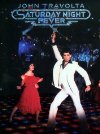
Strutting, Smiling, Smirking, Sulking. This was a young John Travolta at his best. It was also director John Badham at his best, as he and screenwriter Norman Wexler adapted a New York Magazine article written by Nik Cohn entitled “Tribal Rites of the New Saturday Night”. Their work, along with Travolta’s dance moves, changed the way young adults spent their weekend nights.
Given his recent disturbing mentions in the news, it might be difficult to imagine, but in the mid-1970’s, Travolta as Vinnie Barbarino on “Welcome Back Kotter” was idolized (and lusted after) by just about every teenage girl on the planet. At the peak of that TV show’s popularity, Travolta exploded onto the big screen as Tony Manero, the king of the disco dance floor. It wasn’t long before every guy’s wardrobe included multi-colored polyester shirts and maybe even a white 3 piece suit. This movie now serves as a time capsule of the disco era. But it’s also much more.
Saturday Night Fevercan be viewed from a couple of different perspectives. Many view it as a snapshot of the short-lived disco era, replete with the clothes, music, drugs and preening. I have always found it even more effective as a coming-of-age story for working class youngsters trying to make sense of the world as they head into adulthood. Tony realizes he won’t fit in much longer living with his family, but the tough love and advice provided by his paint store boss (Sam Coppola) falls on deaf ears. When Stephanie (Karen Lynn Gorney) starts spouting off her “whole other world” stories from Manhattan, Tony realizes brawling with his buddies is no answer to life’s mysteries.
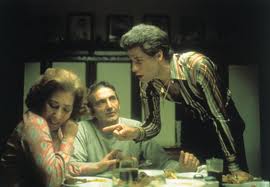
Tony is a 19 year old living at home with his traditional Italian parents. His mother, played by Julie Bavasso, is a religious woman who takes great pride in her eldest son Frank Jr (Martin Shakar) being a Priest. His father, played by Val Bisoglio, is a recently unemployed emotional man who takes his anger out on the family by lashing out. Their family meals are loud and aggressive events filled with pride, physicality and hurtful words. Tony’s joy in receiving a raise at work is quickly shut down thanks to the belittling reaction from his father. Dancing at 2001 Odyssey is Tony’s escape from the realities of his world … and the only place where he is admired for being something special. It’s a feeling he relishes and one everyone should experience.
As viewers, we recognize that this little world of Tony’s threatens to lead him down an obvious path where he will wake up 20 years later as a bitter 39 year old, not so different from his father. Hanging out with his friends, each searching for their own path while trying not to appear desperate, provides momentary escape but no promise of a brighter tomorrow. When Stephanie enters the scene, Tony sees her as a guiding light to a new world. As viewers, we easily see her insecurities and faux-cultural maturity, but to Tony she offers a ray of hope. A way out.
Tony’s buddies are entertaining in their own ways. Joey (Joseph Cali) and Gus (Bruce Ornstein) are just good, solid guys. Double J (Paul Pape) is the quietly aggressive one. He’s the guy that views every day as a chance to seek revenge on anyone who might have done him wrong, even if accidently. Mr. Pape went on to become a prolific voice actor (more than 500 credits). That’s a bit ironic since he is the quiet one of the group. Bobby C (Barry Miller) and Annette (Donna Pescow) are the ones who break your heart. Bobby’s girlfriend is pregnant and he is desperate for a magical solution, while longing to be as cool as Tony … or at least not invisible. Annette is a sad creature who just wants to be loved. She misreads Tony’s signs and covers her grief with booze, drugs and regrettable sexual activity.
John Badham was mostly a TV director when he assumed the helm for Saturday Night Fever. He had some Hollywood success the year before with a Negro League baseball comedy featuring Richard Pryor and James Earl Jones called The Bingo Long Traveling All-Stars & Motor Kings. Mr. Badham, the brother of Mary Badham (Scout in To Kill a Mockingbird), went on to have some box office success with War Gamesand Stakeout, but in 1997, he returned to TV projects and has remained there since. The film is also known for launching the hugely successful soundtrack, which was the top selling album of all-time until passed by Michael Jackson’s “Thriller” in 1983. Many of the Bee Gees songs are still played on classic stations today, and “Stayin’ Alive” became the title for the film’s sequel. The 1983 movie followed Tony’s attempt to break through on Broadway and was directed by Sylvester Stallone. It received brutal reviews and has since faded into oblivion. In another example of how small the Hollywood community is, Stallone’s girlfriend in Rocky was played by Talia Shire. Ms. Shire’s first husband was David Shire, who composed the score for Saturday Night Fever. When they divorced, Mr. Shire married Didi Conn, who co-starred with Travolta in Grease.
Travolta is clearly the most interesting story here. Seemingly at his peak, his career took another leap forward when Saturday Night Fever producer Robert Stigwood hired him for the musical Grease the following year. In 1980, Travolta was again front and center in a cultural shift as his turn in Urban Cowboyshifted focus from disco dancing to the Texas Two-Step, and the subsequent trend towards mainstream “country” music. Travolta’s career then went quiet until his first comeback with Look Who’s Talking in 1989. His second comeback came thanks to Quentin Tarantino casting him in Pulp Fiction. What many don’t know is that while filming Saturday Night Fever, Travolta’s love interest, actress Diana Hyland died of cancer. Ms. Hyland had appeared as Dick Van Patten’s wife in season one of “Eight is Enough” and upon her death, his character was presented as a widower.
It’s interesting to note that a substantial number in the cast were making their feature film debuts. That includes Fran Drescher (“The Nanny”) who plays local girl Connie. Her dancing skills, or lack thereof, lead Tony to make assumptions about her other talents. Also making quick appearances are Travolta’s sister Ann (as the pizza girl) and his mother Helen, who scolds him in the paint store for making her wait so long. The posters in Tony’s room include Al Pacino in Serpico, Stallone in Rocky, and the iconic Farrah Fawcett swimsuit poster. Travolta had a key role in the horror classic Carrie, and just missed out on being cast as Meadows in one of my favorite movies The Last Detail. Randy Quaid was ultimately cast. The great film critic Gene Siskel always said Saturday Night Feverwas his favorite all-time movie and he even purchased and displayed Tony’s white suit from the film’s climax.
Regardless of how you view it, this little film certainly has its place in Hollywood lore. It launched the film career of John Travolta, changed the cultural nightlife for a generation, taught us not to play on bridges, to take only your allotted time when sharing the backseat, to always chew your food, and whether you are feeling up or down … it helps to strut.
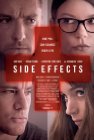
Greetings again from the darkness. Director Steven Soderbergh says this is it. His final film. At age 50, he says he is walking away from making movies. Over the years, he has provided some good and some not so good, but never has he bored us. Movie lovers will always be grateful to him for his 1989 Sex, Lies and Videotape, which single-handedly brought the spotlight back to indie film. While I am quite skeptical of his retirement claim, it’s noteworthy because the absence of one of today’s true auteur’s would be a loss for the art of cinema.
As for this “last” film, it begins as Hitchcock-esque, but concludes as more like Basic Instinctor Dressed to Kill. Put simply, the first half is mesmerizing while the second half devolves into a trashy pulp thrille … which, depending on your tastes, may or may not be a negative.
The first half brought to mind the term pharmacological thriller. It seems as though Soderbergh and frequent writing collaborator Scott Z Burns (Contagion, The Informant!)are making a statement about our current societal trend of seeking answers, and even cures, through medication … despite the risky side effects. We meet Emily and Martin Taylor (Rooney Mara and Channing Tatum) as he is released from prison (insider trading) and she is falling back into her depressive ways. She is soon enough being treated by Dr. Jonathan Banks (Jude Law), a doctor who seems typical in his belief that finding the right pill cures most ills.
Since this is a suspense thriller filled with numerous twists and double, even triple-crossings, it’s impossible to go too deep into what happens without spoilers … something I won’t do here. What can be said is the pharmacological thriller shifts into legal drama and finally a who-done-what kind of conclusion. The solving of the mystery comes courtesy of another oft-used Hitchcock theme: the wronged man seeking vindication.
Rooney Mara and Jude Law are both excellent here and to whatever extent the story works for you, they deserve the credit along with Soderbergh. Ms. Mara was outstanding in the American version of The Girl with the Dragon Tattoo, and Mr. Law continues his transition from lame rom-com’s to quality dramatic actor. The same shouldn’t be said for Catherine Zeta-Jones, who plays Dr Victoria Seibert, Emily’s first psychiatrist. Every scene she shares and every line she speaks just screams “look at me”, not a desired quality for a supporting role.
Support work is provided by Polly Draper, Mamie Gummer (Meryl Streep’s daughter), Vinessa Shaw, Peter Friedman, Laila Robins, and Ann Dowd. Soderbergh does not disappoint from a technical aspect. His odd camera angles and unique shots are quite impressive and effective in sustaining the mood, even as the story spirals towards far-fetched. If it’s truly his swan song, it seems appropriate that we see both the highs and lows of director Soderbergh. Here’s hoping he returns very soon to the medium where his impact is needed. If not, the side effects aren’t pretty.
**NOTE: If you look quick, there is an advertising poster featuring Julia Roberts. (Ms. Roberts is a Soderbergh favorite from films such as Erin Brokovich)
**NOTE: Soderbergh does have a TV project set to air later this year. Behind the Candelabrais the story of Liberace starring Michael Douglas and Matt Damon
SEE THIS MOVIE IF: you believe it’s Steven Soderbergh’s final movie OR you enjoy a pulpy thriller
SKIP THIS MOVIE IF: you prefer psycho-thrillesr that avoid the slide towards trash-pulp
“As far back as I can remember, I always wanted to be a gangster.” That’s how Henry Hill introduces himself. He is the narrator and key figure in director Martin Scorcese’s 1990 masterpiece. What follows Mr. Hill’s intro is the film version of Nicholas Pileggi’s non-fiction book, Wiseguy: Life in the Mafia Family (published 1986). Every so often the perfect match of writer, director and cast occurs, and Goodfellas is one of those rare treats.
Viewing a 35mm print at the historic Texas Theatre just seemed apropo. Knowing that this is the realized vision of Mr. Scorcese and his long time editor, Thelma Schoonmaker, caused the numerous VHS and DVD viewings over the years to simply fade away. The silver screen works wonders for a film with such “big” characters, such startling violence, and such a perfectly inter-woven soundtrack.
Ray Liotta plays Henry Hill, the real life gangster who ended up snitching on the mob and entering the Federal Witness Protection program. This should not be considered a spoiler because Hill’s story is known worldwide and, well, the movie is 23 years old! Liotta was a relative newcomer when he exploded onto the screen in Jonathan Demme’s Something Wildin 1986. His manic performance in that movie led Scorcese to cast him as Henry Hill. The real life Hill spoke at length with Pileggi for the novel, and the result is a very detailed and nuanced look into the life inside a New York crime family.
The fascinating aspects are too numerous to touch on them all, but there are some that really stood out in this latest viewing. First, Lorraine Bracco plays Hill’s wife Karen. Watching the development of her character is pure gold on screen. She starts out as a fresh-faced blind date, who pulls no punches in putting Hill in his place after he stands her up … and right in front of his fellow gangsters, no less. Watching her fall for “the life” is like watching someone get gradually intoxicated. She seems aware but numb to the rational side of her brain. As Karen develops, she battles through some really tough situations, continues to be Hill’s biggest supporter, and finally his cohort in crime near the end. She is one of the most interesting and best developed female characters from any gangster movie.
Another really fascinating character to follow is that of Tommy Devito played by Joe Pesci. Tommy is a tough guy born into the life, but the prime example of just never being satisfied. His short fuse temper is responsible for some of the most memorable scenes in the movie. The “funny like a clown” scene and the fallout from “go home and get your shinebox” are two of the more frightening sequences ever seen on screen, and are perfect examples of what a loose cannon Tommy is. This character is based on the real life Tommy “Two Gun” DeSimone, muscle for the Lucchese crime family.
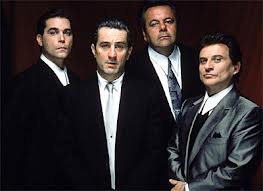
In addition to Karen, Henry and Tommy, the other main character is Jimmy Conway, played by Robert DeNiro. Conway is based on the real life Jimmy “The Gent” Burke, who was supposedly the mastermind behind the infamous Lufthansa heist depicted in the movie. The Conway character perfectly represents paranoia and greed, while hiding behind the mob loyalty pledge. DeNiro never once overacts here, but his Conway dominates the screen despite the strong presence of Liotta and Pesci … and even Paul Sorvino, who plays mob boss Paulie. Paulie is based on Paul Vario, the head of the Lucchese crime family. Sorvino plays him as quietly powerful and a guy with a phone phobia (for good reason). Sorvino’s Paulie is the centerpiece of the mob and is totally believable as a guy you better not cross.
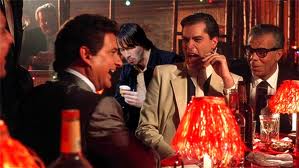
One of the more memorable scenes features Jimmy, Henry and Tommy stopping off at Tommy’s mother house to pick up a shovel … and a large, useful knife. While there, Tommy’s mother (played by Catherine Scorcese, Martin’s mother) not only makes them a huge 3 am Italian meal, but also shows off some of her artwork, and even tells a joke!
What’s really fun to watch as the film progresses is the change of pace and camera work. Watching young Henry earn his stripes is treated with a light, almost comical touch. As he becomes fully entrenched, we see a young man enjoying the power and respect of his position. This is crystallized by Scorcese’s infamous long-tracking shot through the back entrance and kitchen of the Copacabana as Henry and Karen end up front row by the stage. The downward spiral is much more frenetic with fast cuts and a desperate feel. Scorcese helps us feel the drug-induced paranoia that dominates Henry.
David Chase has stated that Goodfellas had quite an impact and inspired him to create “The Sopranos”, and the marks are quite clear. There is even a significant crossover in the cast as both feature Frank Vincent, Tony Sirico, Frank Pellegrino, Michael Imperioli and, of course, Lorraine Bracco (who was Tony Soprano’s psychiatrist).
Goodfellas was nominated for six Academy Awards, and Joe Pesci was the only winner (Best Supporting Actor). It lost out in the Best Picture category to Dances with Wolves. Scorcese has since directed two other critically acclaimed gangster films: Casino (1995, from another Nicholas Pileggi book), and The Departed(2006, which won Scorcese his first Oscar and also won Best Picture). You might also like to know that Pileggi is the creator of “Vegas”, the new TV show starring Dennis Quaid and Michael Chiklis. The show is about the mob’s influence in the early “wild west” days of Las Vegas.
For years, movie lovers have been debating whether The Godfatheror Goodfellas is the best gangster film. As much as I love debate, I see no reason to choose … they are both exquisite filmmaking, though quite different in style. Both films have provided us direction in life. The Godfatherinformed us that “It’s not personal, Sonny. It’s strictly business”. Goodfellas counseled us “Never rat on your friends, and always keep your mouth shut.” Far be it from me to question the source of good advice!
***PROFANITY WARNING*** This is the unedited “funny like a clown scene” and it’s definitely NSFW!!!
 Greetings again from the darkness. It’s an impressive cast. The director, Henry Alex Rubin, gave us the excellent documentary Murderball. Unfortunately the material here is mostly obvious and cliché-filled with no real message, other than our dependency on technology is leading us to be less “connected” to those real life people we live with. Is there anyone who doesn’t know this … other than the characters in this movie?
 Zoo, and Aviad Bernstein).
 Finally we see an ambitious local TV reporter (Andrea Riceborough) who stumbles onto an online sex chat room featuring young stud Max Thieriot. As the trust builds between these two, we know disaster is fast approaching.


 Posted by David Ferguson