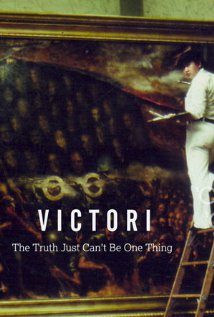
VICTORI: THE TRUTH JUST CAN’T BE ONE THING (2014, doc)

March 8, 2015

victori Greetings again from the darkness. Artists often don’t make for the best interviews. They usually best express themselves through their art – whether that’s music for the ears, words on a page, or paint on a canvas. So it’s understandable that director Michael Melamedoff thought it wise to focus attention on Ed Victori, the young, articulate, poised and educated son … rather than on the eccentric artist himself, Victor Victori. Unfortunately, this approach leaves us tired of Ed and longing for more Victor.

Victor emigrated to the U.S. from South Korea in 1972, and his first major project was a mural depicting all Presidents to that point in time. The mural is still displayed in the White House even today. Much of his career was spent traveling the country painting portraits … not just celebrities and industry leaders, but also the general public. Many of his stops were in shopping malls where his unusual speed allowed him to crank out enough portraits to make money and move on to the next stop.

Director Melamedoff picks up the story when Ed had been laid off from his corporate job in Finance, and has decided to become an art consultant representing his father’s work. We see the build up to the 2012 New York Art Expo, where Ed and his mother Maria do most of the marketing and set-up, while Victor continues to paint. The emphasis seems to be selling Victor’s immense body of work (more than 50,000 per Maria) with a concentration on Multiplism … a self-titled art movement that captures multiple faces and emotions of the same subject within a painting.

By far the most interesting moments come courtesy of the interviews and insight from Victor himself. He is a fascinating guy with the true artist’s disposition – enough ego to believe his work belongs alongside the greats, and enough insecurity to facetiously explain his lack of mass audience acceptance with “I’m sorry I didn’t paint pretty pictures”. That comment is in reference to the immensely popular works of Thomas Kinkade, whom Victor accuses of “cheating” through mass-produced reproductions that are nothing more than “pasting on canvas”. His frustrations are palpable. Victor also claims he pays no attention and is not influenced by other painters, but rather by the music of Beethoven … an unusual revelation by one who paints and sculpts.

While at the Expo, there are some quick exchanges with other artists who display a similar ego/insecurity/desperation blend. It’s during the Expo that Ed’s clinical and business-type approach is most obvious. He clashes with Maria, who just wants to sell enough of the work to make money, while Ed’s vision is to establish his father as a great artist, thereby establishing himself as a legitimate art consultant. The age old clash of commerce and art is on display, but all we really want is more time from Victor, so we can hear him explain why Andy Warhol is not a great artist, but he himself should be recognized as one.

watch the trailer:


MY LIFE DIRECTED BY NICOLAS WINDING REFN (2014, doc)

March 2, 2015

My Life Directed by Greetings again from the darkness. For those of us born without the “creative” gene, it can be quite intriguing to get even a quick peek behind the curtain of an at-work auteur or creative genius. Blend in the highly stressful family dynamics of having one’s spouse behind the camera for this peek, and it shoots right past intriguing and into the realm of captivatingly mandatory viewing … and provides double meaning to the title.

Nicolas Winding Refn is the creative force behind such films as Drive (2011) and Bronson (2008). Now elevated from his status as cult-favorite, this behind-the-scenes documentary explores his pressure and anxiety of the next project (Only God Forgives) – one the director proclaims “is not Drive 2”. While that is more than sufficient for a premise, this one adds the unique complexity of having NWR’s wife direct and shoot the documentary.  Because of this, we gain a highly unusual look at the added stress of personal and family life, as the whole family (including their two daughters) spends six months in Bangkok.

The film begins with an odd sequence showing legendary director Alejandro Jodorowsky (El Topo) reading tarot cards at the request of NWR. The resulting advice is that success can change an artist’s approach, and in a quite off-setting moment, Mr Jodorowsky directly addresses Liv Corfixen (as she films) and admonishes her to support her man. This certainly sets the stage for the relationship strains during production and up to the Cannes premiere of Only God Forgives.

“How to make a movie” is not the focus here, though we do see the storyboarding and some director-actor interactions (Ryan Gosling, Kristin Scott Thomas). Rather, the camera lens is aimed at what impact making a movie has on the director and his family.  He struggles with “what the audience wants” (more Drive) versus “what the artist wants”. A key line from NWR is “It would be boring if we all made the same films”.  And therein lies the motivation and challenge for a true auteur – how to remain true to one’s artistic vision, while still remaining commercially viable (a requirement if one wishes to continue creating).

Ms. Corfixen doesn’t shy away from filming the many moods and insecurities of her husband … sometimes filming him in bed, hinting that remaining there might be an option. We see the confidence of the director on set, but more interestingly, his ups and downs, and his various happy-depressed-angry moments while in the privacy of the family apartment (well as private as it can get with a camera in one’s face).

Being a film director is an odd combination of processes – both collaborative and solitary. Having one’s family along for the ride brings an added challenge that taxes one’s patience. Performing all of this with one’s spouse filming most of it exposes parts of one’s character and make-up that most of us would prefer stay hidden from public consumption. Upon reflection, maybe it is an effective starter kit for “how to make a movie”.

watch the trailer:


RED ARMY (doc, 2014)

February 26, 2015

red army Greetings again from the darkness. You need not be a hockey fan to be familiar with the “Miracle on Ice” upset of the seasoned Russians by the upstart Americans at the 1980 Olympics in Lake Placid. Often referred to as a battle of cultures – “our way vs their way, capitalism vs communism” – most articles, TV shows, and movies have been presented from the American perspective.  It’s only now, in this informative and entertaining documentary from filmmaker Gabe Polsky, that we gain some insight into the Russian players and their way of life.

Mr. Polsky is the son of Russian immigrants, and grew up playing hockey in Chicago and later for Yale. His research into Russian hockey evolved into a documentary that blends sports, geopolitics, history, culture, and personal stories. He mixes in some fantastic archival film footage from the 1970’s and 80’s, but the heart of everything here flows from the interviews with Russian hockey legend Vyacheslav Fetisov, who is a vital and unique link to past and present. Much of this is set to the distinctive sounds of Russian folk music.

Fetisov is sometimes playful and sometimes snide in his remarks, but he basically narrates the history of Russian hockey – starting with Stalin’s founding of the organization, through the two key coaches: father figure Tarasov and the militant Tikhanov who followed. Stalin was convinced that Russian domination of global sports would clearly establish communism and the Russian culture as far superior to capitalism and the carefree ways of the west.  This led to the Red Army hockey camps being run by the military. The players were isolated for eleven months each year, training and playing in a manner that generated ultimate teamwork, but also quite unhappy young men.

We see the influence of Russian chess (Karpov) and the Bolshoi ballet for training methods, and we also see the ever-present KGB ensuring no “escapes”, or what we might know better as defections. We learn about the Russian Five (including Fetisov) who were so dominant that the team went two years without losing.  Gold medals in Sarajevo (1984) and Calgary (1988) occurred just prior to the 1991 dissolution of the U.S.S.R. and the economic crisis of the region.

This is what opened the door for Russian hockey players to enter the NHL, though the transition was smoother for some than others. After a few years of adjusting, it was coach Scotty Bowman’s 1997 Detroit Red Wings that won the Stanley Cup with a contingency of Russian players (including Fetisov) who were given free reign to play their own game while on the ice. Their movements and intricate teamwork clashed mightily with the individualistic style of westerners … and that group of Russian players can be credited with helping the game to evolve to its current style.

Much of the insight comes from the faces of the men who are interviewed. Their stoicism and lack of emotion is a microcosm of the society in which they were raised. Their country was obliterated by war, and then led by a megalomaniac who wanted to rule the world. Human emotion and the rights of individuals mattered little, and we see that despite the years of hardship, these players remain (mostly) true and loyal to their country. This is a fascinating look at human nature and how the culture of one’s youth can directly impact the beliefs as an adult, so many years later.

watch the trailer:


MANNY (2014, doc)

February 8, 2015

manny Greetings again from the darkness. Growing up in extreme poverty in the Civil War-torn Philippines, sleeping in a hut made from coconut tree leaves, and working with fishermen as a young boy, Manny Pacquiao spent his childhood not dreaming of becoming a world champion boxer and celebrity, but rather wondering if there would be food to eat on any given day. This background is probably what inspired co-directors Ryan Moore and Leon Gast (Oscar winner for When We Were Kings) to focus less on Manny’s personal flaws and more on his extraordinary road to success.

Opening with Michael Buffer’s familiar “Let’s get ready to rumble“, the film does exactly that. Obviously much of the film highlights Manny’s boxing career, beginning as an extremely young fighter with a slight build and carrying through to his record-setting titles in 8 weight classifications, but it also does an admirable job of helping us get to know the man behind the fame.

As Pac-Man finds more success in the ring, we witness the exponential growth of the circus environment – his training camp, the media onslaught, the endorsements, the lousy movies, his re-discovery of religion, and his political aspirations. We meet his cutting edge fitness trainer Alex Ariza and his long-time boxing trainer and friend (and former boxer) Freddie Roach. Freddie’s story is probably worthy of its own documentary, as he trained under his mentor, the legendary Eddie Futch, and blames his Parkinson’s Disease on staying in the game a few fights too long.

The film acknowledges, but only in a cursory manner, the dark side of boxing. Manny’s first two managers are blamed for some of his early financial woes, as is his business adviser Michael Koncz … and promoter Bob Arum is certainly a guy who deserves a bit more scrutiny. Questionable decisions in key matches are mentioned, but no further investigative reporting is offered … handled just as the sport itself does. This hole would be less obvious had not so much of the film focused on Manny’s boxing career.

We get a taste of Manny’s charm and appeal. Actor and fight fan Mark Wahlberg makes a great observation in his interview, as he points out that Manny’s entry into the ring for a fight is filled with smiles and waves … as if he had not a care in the world. But then once he steps into the ring, he can “flip the switch” and find the focus to fight his fight. We also see Manny on talk shows, and in a truly priceless sequence, we go into the recording studio as Manny sings “Sometimes When We Touch” … while being mentored by the song’s original singer/songwriter Dan Hill.

The film does nice work in letting us see Manny make the move into politics – he’s now a twice elected representative in his hometown Sarangami province. There is also footage of him in his ministry as he confesses to a sinful past left behind in favor of his family and clean living. Some of the interviews with Jinkee (his wife) are the most emotional moments in the film. Along the way, we are privy to some of Manny’s philosophical thoughts: “Loss is a reminder of what’s important in life“, and when times are tough, “You get back up. You fight again“. Manny’s talent has etched his place in boxing history, but his approach to life is what contrasts him from many other great fighters like Floyd Mayweather (whose brief appearances flash enough ego to turn anyone’s stomach). That hut in the Philippines may be long gone, but the film shows us that Manny is here to stay.

watch the trailer:


ROAD TO PEACE (2012, doc)

January 21, 2015

road to peace Greetings again from the darkness. This 2012 documentary from director Leon Stuparich is an intimate portrait of Tenzin Gyatso, the 14th Dalai Lama of Tibet. The cameras follow his holiness on his two week trek through Great Britain in 2008. We get so close that we can’t help but feel as if we are present – if not physically, at least spiritually.

An introductory history lesson provides details such as Dalai Lamas have been around since the 8th century, and each has chosen to be re-born to better serve others. The 14th Dalai Lama took full political control of Tibet at age 15 in 1949. Ten years later, the Chinese Army crushed the Tibetan uprising and the Dalai Lama led 80,000 Tibetans across the Himalayas on foot to a peaceful settlement. In 1973, he became the first Dalai Lama to spread his wisdom and message of peace to the western world. That message?  Universal Responsibility: promotion of human values, promotion of religious harmony, and to continue serving Tibetan people.

What really stands out, as we follow on his fast-paced agenda, is the description of him as a “peaceful presence” and “a joyful being”. His impact on those he meets is immediate and heart-felt. Never shying away from touch, it’s clear his sense of compassion and peace are there for anyone open to his message. Somewhat surprising is his frequent laughter, smiles, waves and show of appreciation. This is a man of peace as well as at peace.

But make no mistake, his vision and message remains strong. He wants a better life for Tibetans, and he wants a better world for us all. His 1989 Nobel Peace Prize has provided even more opportunity for him to spread the message. This 2008 United Kingdom trip took him to such places as Albert Hall, Lambeth Palace, Oxford University and Nottingham. He spoke to such diverse groups as the Tibet Society, politicians, educators, students, religious leaders, the press, and a Mongolian audience.

We never see his energy wane nor his message waver, though we do see various signs of emotion depending on the audience. No matter one’s religious beliefs, it is quite powerful to see one man making such an impact through a message of peace and tolerance, and sage advice such as stay on the path for knowledge, inner-strength, and compassion. This little film is as close as most of us will ever come to being in the Dalai Lama’s presence … and it feels pretty darn close.

The film’s website: http://www.roadtopeace.co.uk/


THE JOE SHOW (2014, doc)

December 19, 2014

joe show Greetings again from the darkness. Quick! Name the Sheriff in your County. It’s highly unlikely that you can (unless you also serve in Law Enforcement). In fact, you probably can’t name any real Sheriff currently in office – that eliminates Wyatt Earp and Mayberry’s Andy Taylor. If you can name one, it’s likely to be Joe Arpaio of Maricopa County in Arizona.  This guy gets as much publicity as a Kardashian, and director Randy Murray spent 8 years following and researching Joe’s antics, record and policies.

The first third of the movie solidifies the case of Arpaio as the “PT Barnum of Sheriffs”. Thanks to his longtime Media Relations Director, Lisa Allen, Sheriff Joe has become the go-to guy for local, and sometimes national news outlets.  We see a never-ending stream of stunts that keep Joe’s face on the tube, his voice on the radio, and his words in print. You may remember the “Walk-a-Con” where he escorted 2500 convicts to the new prison. What made this fodder for cameras?  How about the pink underwear each of the convicts was wearing for the trek! Joe is also known for his “Tent City” of convicts … a cost-saving measure. You might also have seen Joe on shows such as “20/20” or “60 Minutes” as he explained his crusade against illegal immigrants (he was actively enforcing the Arizona state law).

Those interviewed include politicians, journalists, and state employees, Ted Nugent, Steven Segal, Hugh Downs, Larry King and Noam Chomsky. Descriptions of Joe include: flamboyant, tough, media hound, shoot-from-the-lip guy, and bully. It may come as a surprise that he has won 6 elections (the first in 1992), so clearly there are voters who agree with his “prison should be punishment” policy, and are able to overlook the many issues brought up in the final 2/3 of the film.

A change in tone occurs in the movie as we start to look behind the façade of this media hound. A “culture of cruelty” and corruption has led to 150 deaths and $25 million in settlements since he took office. There were an unfathomable 400 sex crime cases apparently swept under the rug to avoid costly investigations. The history of brutality in the ranks, some of it caught on video, is easily tied back to Joe’s attitude. His ability to balance his roles as Law Enforcement officer, master Politician, and media hound was exposed by his latest opponent, Democrat Paul Penzone … but one last publicity stunt allowed Joe to raise a record $8 million in campaign funds.

Director Murray does a terrific job of starting us off with what appears to be just a colorful character, and then leading us down a much darker path of the reality behind the distractions. We see Sheriff Joe criticized for using unreasonable force, ruling through a climate of fear, and abusing the power of his position. Watching how Sheriff Joe responds to this criticism is truly a fascinating psychological character study, and it acts as a reminder of how his addiction to the media is simply a means to an end … the way to maintain his reign and fame.

watch the trailer:


INSIDE THE MIND OF LEONARDO (2014)

December 17, 2014

inside the mind of leonardo Greetings again from the darkness. Whenever you start to feel confident – even a little cocky – about how good you are at your job, stop for a moment and consider Leonardo da Vinci. How is this for a dose of humility? Even today, Leonardo is still considered one of the foremost painters, sculptors, inventors, engineers and mathematicians. This despite no formal education … and dying almost 500 years ago! It makes you wonder what he could have accomplished with computers and the internet.

History Films and director Julian Jones were provided access to Leonardo’s private notebooks, drawings and journals … more than 6000 pages that range from shopping lists, to mechanical inventions, to nature drawings. This Docu-Drama is presented in the unique manner of casting actor Peter Capaldi (“Dr Who”) as the interpreter of Leonardo’s words and works. He facilitates the movements between Leonardo’s childhood (as an illegitimate kid) in Tuscany, his move to Florence at age 16, his nearly two decades in Milan, and subsequent return to Tuscany where he spent 15 years painting a merchant’s wife … a painting now known as the “Mona Lisa”.

Playing very much like an educational tool designed for junior high and high school students, the film is also is an engaging way to present some insight into history’s single most observant and curious deep thinker. We see and hear Leonardo’s thoughts on war strategy and weapons, the geometrics of the human face, tips on fitness (“eat only when hungry”) and of course, his obsessions with human flight and anatomy. Beyond that, the journals offer a taste of his sense of humor and thoughts on sexual desire. It’s clear his thoughts bounced from topic to topic, and his sense of wonder created a never ending flow of ideas. While we often term it observation and analysis, Leonardo’s words are translated into experiencing something and then seeking out the cause. Newly filmed images are blended with Leonardo’s own drawings to keep the viewer on track.

Vitruvian Man is one of the more iconic images seen throughout society, and Leonardo’s painting “The Last Supper” has been copied and reproduced frequently. Although he died in France at age 67 having finished only 21 paintings, and having most of his inventions survive in theory only, the breadth of his knowledge and writings explain why the phrase “Renaissance Man” was coined to describe Leonardo (as well as Michelangelo). The film offers an entertaining and engaging introduction to Leonardo da Vinci, and today’s “thinkers” will undoubtedly be inspired to learn more.

watch the trailer:


THE BAREFOOT ARTIST (2014, doc)

December 14, 2014

barefoot artist Greetings again from the darkness. Those who strive to make the world a better place deserve their moment in the spotlight. Lily Yeh is an artist with whom you may be familiar if you’ve ever stumbled upon the Village of Arts and Humanities in northern Philadelphia. Perhaps you have seen her beautification projects in other parts of the globe – Rwanda, Kenya, Taiwan, Mexico or numerous other areas that once desperately needed a facelift.

Ms. Yeh is a spry 70 year old who was born in China and college educated in the United States. Her father was a general in the Chiang Kai-shek army, and was a natural leader and brilliant war strategist. Because of this, she was raised in prestige and with respect. Much of her early motivation came from her father’s inspiration and she clearly worshipped him. It wasn’t until Lily had her (beautifully detailed) landscape paintings ignored by the public in favor of the pop art of the 60’s did she come to realize that true art must come from within. And thus began her journey of self-discovery.

The film is co-directed by Glenn Holsten and Daniel Traub. Mr. Traub is Lily’s son from a failed marriage, and as with many documentaries, his closeness to the subject is both a blessing and a curse. The film is a bit awkwardly divided into two segments. By far the more interesting is the story of Lily’s global work in bringing “art to places lacking in beauty”. One of her projects is a memorial for a mass grave in a Rwandan Genocide Survivor’s Village. Her efforts turn a shabby lean-to into a beautiful setting for reflection and peace.

The other story line plays as more of a home movie than a documentary. We follow Lily as she chases her father’s history through his journal entries. His writings take her back to her birth country of China as she uncovers a family secret that leads to more surprises. It’s understandable why co-director Traub sees the value in documenting this, but it doesn’t really play for the rest of us.

Lily Yeh is a fascinating woman who has made a real difference in many part of the world. She states “beauty is intimately engaged with darkness” and follows through on her vision. When the movie concentrates on Lily’s philosophy and wisdom, we get gems like “broken places are my canvas”. Her personal journey of self-discovery is where her value lies. She confesses that she “was the one who needed help” and “was missing something”. Bringing art and beauty to those places and people lacking, is what allowed Lily to find her own center. And that’s a beautiful thing.

watch the trailer:


NASH (2014, doc)

December 4, 2014

nash Greetings again from the darkness. In the way that Steve Nash is a different kind of professional athlete, this is a different kind of documentary about a professional athlete. Despite the film’s subject being a 7-time NBA All-Star and 2-time League MVP, there are only a few game clips and highlights. Instead co-directors Michael Hamilton and Corey Ogilvie focus their attention on something much more interesting … Steve Nash, the man.

The celebrity talking heads offering insight into Nash include not just the expected hoopsters like Kobe Bryant and Dirk Nowitzki, but surprise commentary from folks such as actor Owen Wilson, Todd Marinovich (former football prodigy), director Ron Howard, and even President Obama. We soon enough understand why the list of Nash fans is so varied and extensive.

The film shows Nash as a very talented Canadian high schooler whom most doubted could play Division 1 ball. Nash never doubted. A few years later, most scouts doubted that the skinny Santa Clara point guard had an NBA future. Nash never doubted. After being selected 15th overall in the 1996 draft, most doubted he would ever be a starting player. Nash never doubted. After leading the Canadian Olympic basketball team to a strong finish, Nash came back as one of the best players in the league in 2001. Later, as a free agent, he went through a nasty contract battle between Mark Cuban (Dallas Mavericks owner) and the Phoenix Suns. Nash became a very rich man, and no doubters remained.

That’s the stuff that most basketball fans know. The off-the-court Steve Nash is a family man who loves his 3 kids – even signing with the Lakers to be close to them. This Steve Nash has a foundation that builds hospitals and helps underprivileged kids. This Steve Nash started a film production company that produced the award-winning documentary Into the Wind on Canadian hero Tony Fox. This Steve Nash is the guy that when things don’t go his way says “That’s life”, and he just keeps moving forward.

One segment of the film contrasts the hype of a player like Lebron James coming out of high school versus the underdog, little noticed player like Nash. It’s a reminder of the celebrity society we live in, and how a few seem to be able to avoid the spotlight and live a productive life. So while most know Steve Nash as one of only 3 point guards to win the NBA MVP (Magic Johnson, Bob Cousy), this film introduces us to the Steve Nash that we would really like to know … the skateboarding guy doing good things for our world.

watch the trailer:


THE LAST IMPRESARIO (2014, doc)

December 4, 2014

last impresario Greetings again from the darkness. In the biographical documentary genre, a stream of talking heads is ordinarily my least favorite approach. However, director Gracie Otto (sister of actress Miranda) understands that when your subject is “the most famous person you’ve never heard of”, it’s pretty impressive and effective to line-up 50+ celebrities to offer their thoughts and memories of the man.

Michael White. Maybe you know the name, maybe you don’t. Even before the opening credits, we get rapid-fire celebrity descriptions of Mr. White and his impact on theatre, film and the creative society of the 1960’s and 70’s. Director Otto explains how she first noticed Mr. White at the Cannes Film Festival as a slew of celebrities paid their respects. She then began her research into this most interesting man whose 50 year career has left quite a personal stamp.

We hear descriptions such as “he likes people” and he “likes being where the action is”. This about a man who grew up in Scotland, was educated in Switzerland, and worked in New York … before making a real mark in London’s West End Theatre district. His infamous dinner parties allowed paths to cross between the brightest in stage, art, film, and publishing. He had an eye for talent outside the mainstream – experimental and avant garde appealed to him … those who pushed the envelope (or ignored it completely). Because of this, his sphere of influence included such diverse personalities as Pina Bausch, Yoko Ono, John Waters and Kate Moss. His stage production of “Oh! Calcutta” was a major cultural breakthrough and led to others such as the original “Rocky Horror Show”, and the iconic comedy film Monty Python and the Holy Grail.

When Ms. Otto asks him why he has so many friends, Mr. White replies that “you never lose a friend”. This comes after we have learned that powerful music producer Lou Adler took advantage of him during negotiations for the Rocky Horror rights in the U.S. White does acknowledge that he has been “cheated” a few times over the years. Another apt description is that he is “drawn to excitement more than money”. It’s then that we learn of his incredible archive of 30,000 photographs – from a time before the paparazzi ruled the world.

The odd font style makes some of the onscreen graphics difficult to read, but the music reminds us that Michael White’s legacy from the swinging 60’s as a playboy and gambling Producer is quite secure Today Mr. White lives a modest life, and periodically has to auction his collections to raise funds. He has had a couple of strokes, walks with the aid of two canes, and is sometimes difficult to understand. He still has regular dinners with friends … after all, with this attitude in life, one never loses a friend.

watch the trailer: