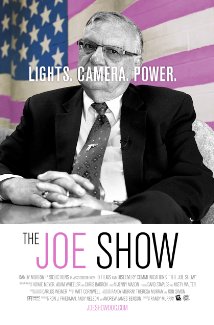
THE JOE SHOW (2014, doc)

December 19, 2014

joe show Greetings again from the darkness. Quick! Name the Sheriff in your County. It’s highly unlikely that you can (unless you also serve in Law Enforcement). In fact, you probably can’t name any real Sheriff currently in office – that eliminates Wyatt Earp and Mayberry’s Andy Taylor. If you can name one, it’s likely to be Joe Arpaio of Maricopa County in Arizona.  This guy gets as much publicity as a Kardashian, and director Randy Murray spent 8 years following and researching Joe’s antics, record and policies.

The first third of the movie solidifies the case of Arpaio as the “PT Barnum of Sheriffs”. Thanks to his longtime Media Relations Director, Lisa Allen, Sheriff Joe has become the go-to guy for local, and sometimes national news outlets.  We see a never-ending stream of stunts that keep Joe’s face on the tube, his voice on the radio, and his words in print. You may remember the “Walk-a-Con” where he escorted 2500 convicts to the new prison. What made this fodder for cameras?  How about the pink underwear each of the convicts was wearing for the trek! Joe is also known for his “Tent City” of convicts … a cost-saving measure. You might also have seen Joe on shows such as “20/20” or “60 Minutes” as he explained his crusade against illegal immigrants (he was actively enforcing the Arizona state law).

Those interviewed include politicians, journalists, and state employees, Ted Nugent, Steven Segal, Hugh Downs, Larry King and Noam Chomsky. Descriptions of Joe include: flamboyant, tough, media hound, shoot-from-the-lip guy, and bully. It may come as a surprise that he has won 6 elections (the first in 1992), so clearly there are voters who agree with his “prison should be punishment” policy, and are able to overlook the many issues brought up in the final 2/3 of the film.

A change in tone occurs in the movie as we start to look behind the façade of this media hound. A “culture of cruelty” and corruption has led to 150 deaths and $25 million in settlements since he took office. There were an unfathomable 400 sex crime cases apparently swept under the rug to avoid costly investigations. The history of brutality in the ranks, some of it caught on video, is easily tied back to Joe’s attitude. His ability to balance his roles as Law Enforcement officer, master Politician, and media hound was exposed by his latest opponent, Democrat Paul Penzone … but one last publicity stunt allowed Joe to raise a record $8 million in campaign funds.

Director Murray does a terrific job of starting us off with what appears to be just a colorful character, and then leading us down a much darker path of the reality behind the distractions. We see Sheriff Joe criticized for using unreasonable force, ruling through a climate of fear, and abusing the power of his position. Watching how Sheriff Joe responds to this criticism is truly a fascinating psychological character study, and it acts as a reminder of how his addiction to the media is simply a means to an end … the way to maintain his reign and fame.

watch the trailer:


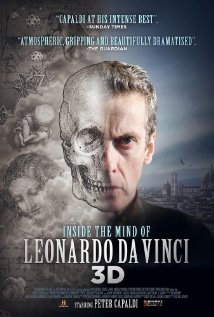
INSIDE THE MIND OF LEONARDO (2014)

December 17, 2014

inside the mind of leonardo Greetings again from the darkness. Whenever you start to feel confident – even a little cocky – about how good you are at your job, stop for a moment and consider Leonardo da Vinci. How is this for a dose of humility? Even today, Leonardo is still considered one of the foremost painters, sculptors, inventors, engineers and mathematicians. This despite no formal education … and dying almost 500 years ago! It makes you wonder what he could have accomplished with computers and the internet.

History Films and director Julian Jones were provided access to Leonardo’s private notebooks, drawings and journals … more than 6000 pages that range from shopping lists, to mechanical inventions, to nature drawings. This Docu-Drama is presented in the unique manner of casting actor Peter Capaldi (“Dr Who”) as the interpreter of Leonardo’s words and works. He facilitates the movements between Leonardo’s childhood (as an illegitimate kid) in Tuscany, his move to Florence at age 16, his nearly two decades in Milan, and subsequent return to Tuscany where he spent 15 years painting a merchant’s wife … a painting now known as the “Mona Lisa”.

Playing very much like an educational tool designed for junior high and high school students, the film is also is an engaging way to present some insight into history’s single most observant and curious deep thinker. We see and hear Leonardo’s thoughts on war strategy and weapons, the geometrics of the human face, tips on fitness (“eat only when hungry”) and of course, his obsessions with human flight and anatomy. Beyond that, the journals offer a taste of his sense of humor and thoughts on sexual desire. It’s clear his thoughts bounced from topic to topic, and his sense of wonder created a never ending flow of ideas. While we often term it observation and analysis, Leonardo’s words are translated into experiencing something and then seeking out the cause. Newly filmed images are blended with Leonardo’s own drawings to keep the viewer on track.

Vitruvian Man is one of the more iconic images seen throughout society, and Leonardo’s painting “The Last Supper” has been copied and reproduced frequently. Although he died in France at age 67 having finished only 21 paintings, and having most of his inventions survive in theory only, the breadth of his knowledge and writings explain why the phrase “Renaissance Man” was coined to describe Leonardo (as well as Michelangelo). The film offers an entertaining and engaging introduction to Leonardo da Vinci, and today’s “thinkers” will undoubtedly be inspired to learn more.

watch the trailer:


THE BAREFOOT ARTIST (2014, doc)

December 14, 2014

barefoot artist Greetings again from the darkness. Those who strive to make the world a better place deserve their moment in the spotlight. Lily Yeh is an artist with whom you may be familiar if you’ve ever stumbled upon the Village of Arts and Humanities in northern Philadelphia. Perhaps you have seen her beautification projects in other parts of the globe – Rwanda, Kenya, Taiwan, Mexico or numerous other areas that once desperately needed a facelift.

Ms. Yeh is a spry 70 year old who was born in China and college educated in the United States. Her father was a general in the Chiang Kai-shek army, and was a natural leader and brilliant war strategist. Because of this, she was raised in prestige and with respect. Much of her early motivation came from her father’s inspiration and she clearly worshipped him. It wasn’t until Lily had her (beautifully detailed) landscape paintings ignored by the public in favor of the pop art of the 60’s did she come to realize that true art must come from within. And thus began her journey of self-discovery.

The film is co-directed by Glenn Holsten and Daniel Traub. Mr. Traub is Lily’s son from a failed marriage, and as with many documentaries, his closeness to the subject is both a blessing and a curse. The film is a bit awkwardly divided into two segments. By far the more interesting is the story of Lily’s global work in bringing “art to places lacking in beauty”. One of her projects is a memorial for a mass grave in a Rwandan Genocide Survivor’s Village. Her efforts turn a shabby lean-to into a beautiful setting for reflection and peace.

The other story line plays as more of a home movie than a documentary. We follow Lily as she chases her father’s history through his journal entries. His writings take her back to her birth country of China as she uncovers a family secret that leads to more surprises. It’s understandable why co-director Traub sees the value in documenting this, but it doesn’t really play for the rest of us.

Lily Yeh is a fascinating woman who has made a real difference in many part of the world. She states “beauty is intimately engaged with darkness” and follows through on her vision. When the movie concentrates on Lily’s philosophy and wisdom, we get gems like “broken places are my canvas”. Her personal journey of self-discovery is where her value lies. She confesses that she “was the one who needed help” and “was missing something”. Bringing art and beauty to those places and people lacking, is what allowed Lily to find her own center. And that’s a beautiful thing.

watch the trailer:


NASH (2014, doc)

December 4, 2014

nash Greetings again from the darkness. In the way that Steve Nash is a different kind of professional athlete, this is a different kind of documentary about a professional athlete. Despite the film’s subject being a 7-time NBA All-Star and 2-time League MVP, there are only a few game clips and highlights. Instead co-directors Michael Hamilton and Corey Ogilvie focus their attention on something much more interesting … Steve Nash, the man.

The celebrity talking heads offering insight into Nash include not just the expected hoopsters like Kobe Bryant and Dirk Nowitzki, but surprise commentary from folks such as actor Owen Wilson, Todd Marinovich (former football prodigy), director Ron Howard, and even President Obama. We soon enough understand why the list of Nash fans is so varied and extensive.

The film shows Nash as a very talented Canadian high schooler whom most doubted could play Division 1 ball. Nash never doubted. A few years later, most scouts doubted that the skinny Santa Clara point guard had an NBA future. Nash never doubted. After being selected 15th overall in the 1996 draft, most doubted he would ever be a starting player. Nash never doubted. After leading the Canadian Olympic basketball team to a strong finish, Nash came back as one of the best players in the league in 2001. Later, as a free agent, he went through a nasty contract battle between Mark Cuban (Dallas Mavericks owner) and the Phoenix Suns. Nash became a very rich man, and no doubters remained.

That’s the stuff that most basketball fans know. The off-the-court Steve Nash is a family man who loves his 3 kids – even signing with the Lakers to be close to them. This Steve Nash has a foundation that builds hospitals and helps underprivileged kids. This Steve Nash started a film production company that produced the award-winning documentary Into the Wind on Canadian hero Tony Fox. This Steve Nash is the guy that when things don’t go his way says “That’s life”, and he just keeps moving forward.

One segment of the film contrasts the hype of a player like Lebron James coming out of high school versus the underdog, little noticed player like Nash. It’s a reminder of the celebrity society we live in, and how a few seem to be able to avoid the spotlight and live a productive life. So while most know Steve Nash as one of only 3 point guards to win the NBA MVP (Magic Johnson, Bob Cousy), this film introduces us to the Steve Nash that we would really like to know … the skateboarding guy doing good things for our world.

watch the trailer:


THE LAST IMPRESARIO (2014, doc)

December 4, 2014

last impresario Greetings again from the darkness. In the biographical documentary genre, a stream of talking heads is ordinarily my least favorite approach. However, director Gracie Otto (sister of actress Miranda) understands that when your subject is “the most famous person you’ve never heard of”, it’s pretty impressive and effective to line-up 50+ celebrities to offer their thoughts and memories of the man.

Michael White. Maybe you know the name, maybe you don’t. Even before the opening credits, we get rapid-fire celebrity descriptions of Mr. White and his impact on theatre, film and the creative society of the 1960’s and 70’s. Director Otto explains how she first noticed Mr. White at the Cannes Film Festival as a slew of celebrities paid their respects. She then began her research into this most interesting man whose 50 year career has left quite a personal stamp.

We hear descriptions such as “he likes people” and he “likes being where the action is”. This about a man who grew up in Scotland, was educated in Switzerland, and worked in New York … before making a real mark in London’s West End Theatre district. His infamous dinner parties allowed paths to cross between the brightest in stage, art, film, and publishing. He had an eye for talent outside the mainstream – experimental and avant garde appealed to him … those who pushed the envelope (or ignored it completely). Because of this, his sphere of influence included such diverse personalities as Pina Bausch, Yoko Ono, John Waters and Kate Moss. His stage production of “Oh! Calcutta” was a major cultural breakthrough and led to others such as the original “Rocky Horror Show”, and the iconic comedy film Monty Python and the Holy Grail.

When Ms. Otto asks him why he has so many friends, Mr. White replies that “you never lose a friend”. This comes after we have learned that powerful music producer Lou Adler took advantage of him during negotiations for the Rocky Horror rights in the U.S. White does acknowledge that he has been “cheated” a few times over the years. Another apt description is that he is “drawn to excitement more than money”. It’s then that we learn of his incredible archive of 30,000 photographs – from a time before the paparazzi ruled the world.

The odd font style makes some of the onscreen graphics difficult to read, but the music reminds us that Michael White’s legacy from the swinging 60’s as a playboy and gambling Producer is quite secure Today Mr. White lives a modest life, and periodically has to auction his collections to raise funds. He has had a couple of strokes, walks with the aid of two canes, and is sometimes difficult to understand. He still has regular dinners with friends … after all, with this attitude in life, one never loses a friend.

watch the trailer:


THE IMMORTALISTS (2014, doc)

November 27, 2014

immortalists Greetings again from the darkness. These days most tend to define anti-aging as the desire to look younger … vitamins, lotions, botox, and plastic surgery all thrive in a society obsessed with never looking old. Co-directors David Alvarado and Jason Sussberg introduce us to two of the world’s leading anti-aging scientists, and neither of them specializes in facelifts.

Bill Andrews is 61 years old, runs ultra-marathons, and his catchphrase is “cure aging, or die trying”. Dr. Andrews is convinced human beings can live forever. Fifty year old Aubrey de Gray is the heavily bearded (think “Duck Dynasty”) founder of the SENS Foundation, which is dedicated to stopping/correcting the aging process. While some, especially the old guard of biologists, label their missions as pseudo-science, a 2011 Harvard project actually reversed aging in mice – lending credence to the work of these two (and others).

As with many frontiers in science, this subject begs two questions: Can we? Should we? One additional question fits snugly here as well: What happens if we do? Each of our scientists gets his shot at explaining his theory. The two theories actually contradict each other, leading to a somewhat friendly rivalry.

Rather than remaining focused on the science and the works of many other doctors dedicated to anti-aging, the film evolves into a character study of two distinct personalities. Bill’s mission is personal as he confesses his desire to live forever, to save his dad who suffers from Alzheimer’s, and to cure his best friend who has cancer. Aubrey, on the other hand, states his work is not personal in the least. His sights are set on saving humanity.

The personal side of these two dominates the film. We see a great deal of Bill running – sometimes while giving interviews, and sometimes struggling to breath while (twice) attempting a 138 mile marathon through the Himalayas. We see even more (so to speak) of Aubrey as he enjoys a nude picnic with his biologist wife, and later a glass of champagne with one of his two younger girlfriends in the woods near his California commune. These are two eccentric, but very different gentlemen who are attractive subjects for a documentary. Unfortunately the blistered feet and shaggy beard take away from the more interesting topic of curing aging.

The accusations of quackery are met with the obvious comparisons to early flight technology. We couldn’t fly until we could. Will humans someday live forever? Can the aging process be reversed? It appears more likely that de Gray’s SENS Foundation has a better chance of success since it has received funding, while Andrews’ research company is nearly bankrupt. Very little time is given to the “What happens if we do?” question. The filmmakers assumed we would find the two gentlemen as fascinating as they do. Instead, the film left me wishing for more insight on the science, and less spotlight on the scientists.

watch the trailer:


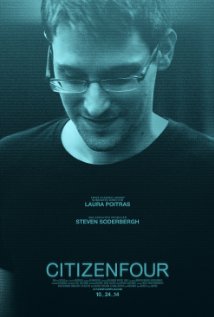
CITIZENFOUR (2014, doc)

November 20, 2014

citizenfour Greetings again from the darkness. Edward Snowden. You know the name and you know the story. Hero of the People or Enemy of the State? Ultimate Patriot or a double-spy for the Russians? Protected as a Whistle-Blower or Guilty of Treason? Chances are you long ago made up your mind on how you view Ed (his stated name preference).

In January 2013, Snowden contacted documentarian Laura Poitras via an anonymous email name “Citizenfour”. By June, the two were meeting in a Hong Kong hotel along with journalist Glenn Greenwald. What follows is a mesmerizing look at the actual footage shot of Greenwald interviewing Snowden. This is Ed Snowden before the media storm. This is Ed Snowden continually proclaiming that he is not the story, and he is trusting Greenwald to determine what documents are fit for public release. He voices concern about jeopardizing national security, while at the same time being adamant about exposing the immense and widespread governmental tracking of digital movements by millions of people … most with no known ties to terrorism.

The timeline is public record, so the core of the film is really an intimate look at the man who, acutely aware of the coming fallout, proceeded with pulling the curtain back on NSA actions that he deemed inappropriate. Ms. Poitras structures the film as a thriller, and it will certainly cause tension in every viewer. We can’t help but put ourselves in Snowden’s shoes. Would we feel the need to go public with proof?  Who would we tell?  How would we tell them?  Would we be willing to release our name, knowing it could put everyone we love in danger?  Would we be prepared to watch our President publically call us out as unpatriotic and a danger to the nation?  These questions are impossible for us to answer, but add weight to the scenes of Snowden answering Greenwald’s questions while Ms. Poitras works the camera.

One of the more interesting points made in the movie is that what we once termed individual freedom and liberties, is now couched as privacy. We have come to expect our privacy, and certainly don’t appreciate our government digging through our emails, search history, texts and phone calls. But how to balance the individual “right” to privacy with the government’s need to collect intelligence in the name of national security? That’s the key question, and one with no clear answer.

Regardless of your opinion on Snowden and his actions, the film presents him as an idealist believing he is doing the right thing. Most of this occurs before the media firestorm, but we do see the anticipated fallout. Once Snowden goes into hiding, we witness Greenwald becoming the face and voice of the cause. He is a talented journalist and exceptional speaker, and doesn’t back down from the reaction of those who stand accused.

The film allows us to take notice of the personal attacks on Snowden as an attempt discredit his documentation. Making Snowden the story distracted the media and the general public from the real issue. It’s a fascinating film that will surely make you uncomfortable and cause re-evaluation of the chain of events. You may not change your mind, but you will most certainly have a better understanding of the human side.

watch the trailer:


WALKING THE CAMINO: SIX WAYS TO SANTIAGO (2014, doc)

November 20, 2014

walking the camino Greetings again from the darkness. There aren’t many traditions that span more than 1200 years, and only one of those involves walking 500 miles … the Camino de Santiago. Its origin is as a religious trek to Santiago de Compostela where tradition holds that the magnificent cathedral contains the remains of St. James the Apostle. These days, the Camino is no longer limited to those with Christian beliefs, and in fact many modern day pilgrims take it on as a personal quest rather than a spiritual journey.

Director Lydia B Smith and her camera allow us to travel along with a group of (six) pilgrims, each with their own story, background and motivation. The journey involves both physical and emotional challenges, and results in varying degrees of self-awareness. One obvious difference in today’s pilgrims versus those of medieval times is the experience is much more communal these days. Not only do the walkers eat and sleep in the same hostels along the route, they also freely share their emotions and thoughts with each other (and the camera). This contrasts greatly with the tradition of solitude and quiet introspection.  Call it a lesson in generational differences.

The elements rotate between favorable and challenging. The pilgrims must face cold, hot, rain, and wind. These obstacles of nature are magnified with foot blisters, sore knees and other bodily ailments. However, for most of these people, the mental challenge is every bit as steep. For 6 plus hours each day over approximately 35 days, they focus on the incredible scenery as well as their own thoughts. It’s impossible to hide from one’s self, even though friendship … and even relationships … form along the path.

Each of those who complete the journey realizes it’s not about the destination, but rather the inspiration and spiritual enlightenment – even if it wasn’t their original goal. There is talk about the “internal Camino” and how you walk with your heart. Reflection on this spectacular path leads to harmony with nature and self. A lovely Spanish guitar accompanies our viewing pleasure, and it’s impossible not to imagine ourselves on this journey. If inspiration strikes, just be aware that spending that much time with one’s self is an activity far removed from our generation’s typical day.

watch the trailer:


MISS TIBET: BEAUTY IN EXILE (2014, doc)

November 14, 2014

miss tibet Greetings again from the darkness. Proving once again that real life provides the most fascinating topics and characters, documentarian Norah Shapiro takes a look at cultural identity and the slow process of exiled-Tibetans adapting to the outside world. Her project takes us inside the Miss Tibet Beauty Pageant … “a pageant with a difference”.

Tenzen Khecheo is the film’s focus. She appears to be a pretty typical teenager living in Minneapolis, though we soon enough learn her family history. Her father received one of the rare immigration visas issued by the U.S. to exiled Tibetans. His family later joined him in the states, and Tenzen’s story picks up after his death. She decides to enter the 10th annual Miss Tibet pageant, and is accompanied by her mother and sisters as they head off to Dharamsala in the Indian Himalayas.

The pageant is run by a self-described “small town impresario” named Lobsang Wangyal, who is more flamboyant and publicity-addicted than any of the six women in the pageant. The stated ideal behind the pageant is to empower Tibetan women and provide them confidence and a platform to have their voice heard. Of course, this seems ironic to us Americans who have heard for years that these pageants are the polar opposite of empowering. But this contradiction helps us understand some of the basic cultural differences in the United States (where freedom is abused) versus exiled-Tibet where morals, honesty, kindness, modesty and spirituality are the most adhered to traits.

What follows is more or less a Westernized Beauty Pageant replete with segments of swim suit modeling, personal talent, current events, and photography sessions. And just like in the U.S., scandal, controversy, and accusations of fraud and unfairness follow the announcement of the winners. This ugly scene captures the essence of what we previously heard from those interviewed – competition goes against the nature of this culture. While they are not against modernization and adapting, the idea of becoming more Westernized is quite unappealing to many.

Ms. Shapiro is kind enough to provide a brief history lesson on Tibet, and how the invasion of China led to the exiled community who for years has followed the guidance of the Dalai Lama. We also meet Ama Adhe, a long time political prisoner, who meets with the girls – driving home the difference between those who have truly suffered for their beliefs and those who simply talk a good game. Tenzen Khecheo mostly behaved like a typical American teenager, though she did show moments of humility when she doubted her relevance among the Tibetan women. It’s always interesting to get a glimpse inside another culture, especially one that is in slow transition.

watch the trailer:


SHOWRUNNERS (2014, doc)

October 30, 2014

showrunners Greetings again from the darkness. It’s simultaneously “the best job and the worst job”. While not a definition of a TV Showrunner, that is certainly the best description. With the recent renaissance of TV, and the competition between networks, cable and the internet, an incredible level of creativity and freedom has produced a more cinematic effect on the small screen. Whose broad shoulders are responsible for what we watch? The Showrunners, that’s who.

This is a behind-the-scenes look at the process of getting a show to air, and then struggling to keep it there … it takes an enormous amount of talent and a ton of good luck. We learn that 84% of new TV shows fail, and it’s important to note that good shows often fail – not just bad ones. Director Des Doyle presents an extremely impressive succession of interviews. These are the writers, producers and showrunners of some of TV’s most innovative shows: JJ Abrams (“Lost”), Joss Whedon (“Buffy the Vampire Slayer”), Terence Winter (“The Sopranos”, “Boardwalk Empire”), and Janet Tamaro (“Rizzoli & Ives”) just to name a few. This who’s who of showrunners generously share their insight and observations on the business that more than a few call “a grind”.

Especially interesting is the concentration on the writing process. We go inside the writer’s room and hear discussions on the importance of looking at the entire season, rather than a specific episode. We learn the importance of “quality scripts on time”, meaning the writing must be good and must come fast – episodes frequently air within a month of filming. Joss Whedon advises writers to focus on moments, not on moves. Collaboration is crucial, and while nothing beats an actor who embodies a particular role (Michael Chiklis in “The Shield”), never lose sight that writing is the heart of TV shows.

Discussion of the various outlets (networks, cable, internet) leads to an explanation of how TV writing has evolved. Some shows are now designed for the increasingly-popular “binge watching”, while network shows are still in the business of “selling ads”. Another significant shift is due to Social Media. TV is described as now being like the theatre – immediate feedback is available (Twitter, Facebook). While ratings are still important, interaction between the industry and viewing public is now standard operating procedure.

It’s not often we are allowed behind the curtain in the entertainment business, but this one should be mandatory viewing for anyone with an itch to become a TV writer. You should know the stress and insecurities that accompany the talent and ego. You should understand the time pressures and the lack of recognition that often follows even those who prove successful. You should also know that for those who have it in their blood, nothing else compares. This is truly “the art of running a TV show”.

watch the trailer: