ONE TO ONE: JOHN & YOKO (2025, doc)

April 10, 2025

Greetings again from the darkness. So why did John Lennon and Yoko Ono leave England to live in New York? This film provides the answer. Where did they choose to live? The film provides the answer. Why did John perform his only full post-Beatles concert in 1972? This film provides the answer. Why did they become so politically and socially active during those first 18 months in the States? This film provides the answer. And if you ever wondered how John felt about American television, well you guessed it … this film provides the answer.

Where did all of these answers come from? Well, Oscar winner Kevin Macdonald (ONE DAY IN SEPTEMBER, 1999; THE LAST KING OF SCOTLAND, 2006; MARLEY, 2012) co-directs with Editor/co-director Sam Rice-Edwards and they focus on a very brief timeline, so that we might better understand John Lennon and Yoko Ono. You might think you know all you need to know about this famous couple, but the filmmakers, along with Producer Sean Ono Lennon, ensure that you see and hear clips you haven’t seen or heard before.

Much of this is centered around John’s only full post-Beatles concert in 1972, entitled “One to One”. Its purpose was to raise funds for kids through Willowbrook State School. And that’s not the only storyline about a kid – it turns out, one of the reasons John and Yoko moved to the states was her hope in reuniting with a long-lost daughter named Kyoto. It’s just one of the elements of the film that makes this much more of a personal story than simply a recap of celebrities. 

The film also works as a snapshot of the era. President Richard Nixon (one clip shows him sporting a maroon blazer), extremist Jerry Rubin, “The Mike Douglas Show”, Dick Cavett, Attica, Andy Warhol, and Billy Graham all have their moments. The attempted assassination of George Wallace is shown, as are numerous TV ads, TV series clips, and some news reports. The Vietnam War and Watergate are featured, yet somehow Allen Ginsburg reciting an ode to wiping one’s rear-end nearly steals the show.

We’ve all seen clips from Lennon’s One to One concert, and here they are remastered and sound terrific. “Instant Karma”, “Hound Dog”, “Cold Turkey”, “Imagine”, “Give Peace a Chance” are all shown, but it’s the scorching version of “Come Together” that really stands out. Of course, we are subjected to Yoko’s onstage banshee screeching … though thankfully near the end of the film, she gets a more heartfelt chance to actually sing.

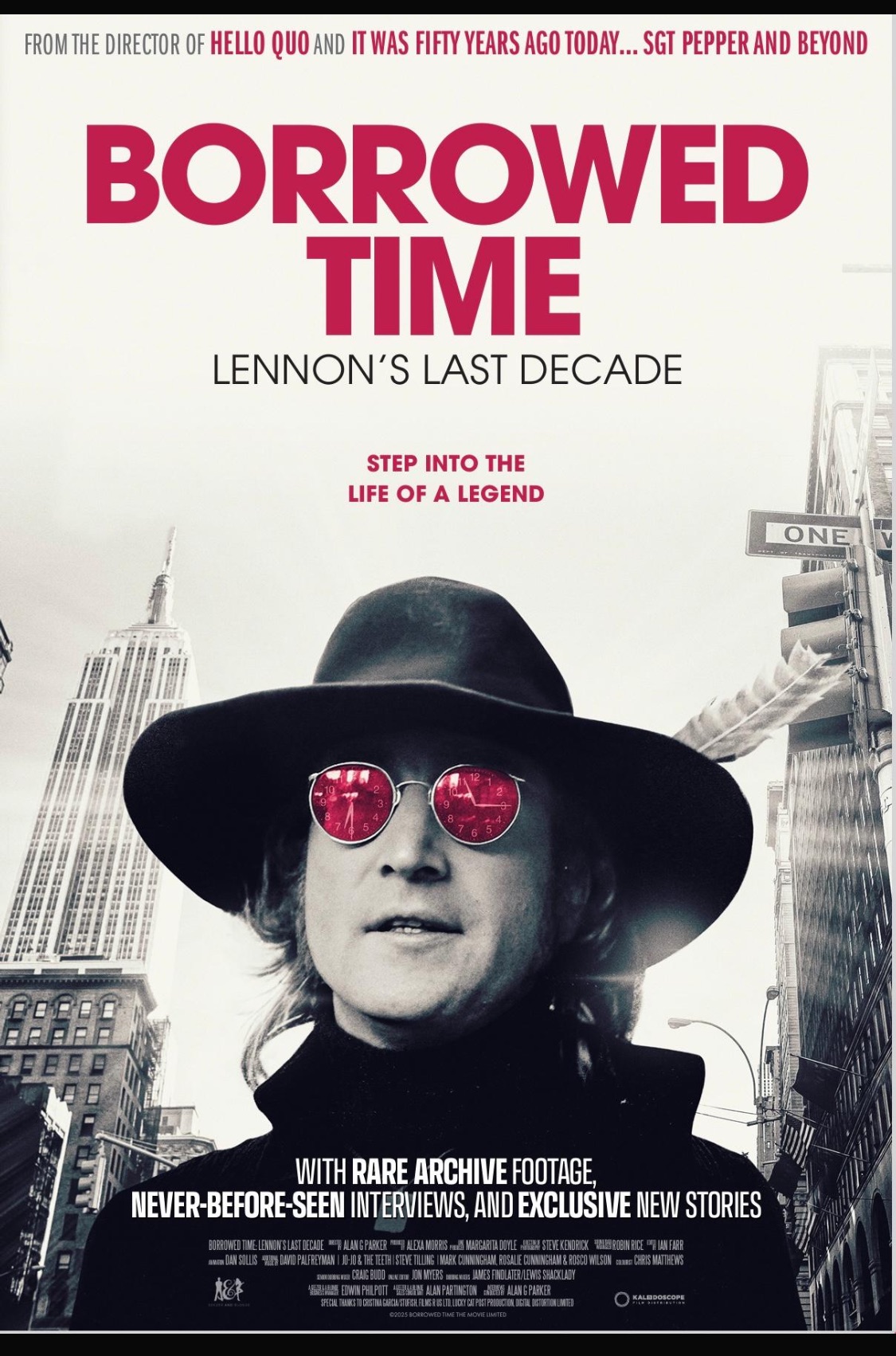
During the film, the contrast with Nixon is obvious. John and Yoko are sincerely committed to peace, love, and justice, while Nixon’s politics for power stands opposed. The recreation of John and Yoko’s small apartment in the Village is quite something to behold – and remarkable when compared to the photographs and archival footage. When John describes his early obsession with TV as ‘a window into the world’ and a replacement for the fireplace of his youth, we gain even more insight into the man known mostly for his music and quips. In 1973, John and Yoko moved from the small apartment in the Village to the swanky Dakota building. His wish for the couple to be remembered as “two lovers” comes closer to reality with this film. Some of their home movies (with Sean) are played as the runtime ends.

In IMAX theaters on April 11, 2025

WATCH THE TRAILER


THANK YOU VERY MUCH (2025, doc)

March 28, 2025

Greetings again from the darkness. It’s been more than forty years since cancer took the life of 35-year-old Andy Kaufman, and we still don’t know how best to describe him: actor, comedian, illusionist, performance artist, prankster, or something more bizarre. It’s like no one knew ‘the real Andy’, and whether that was his intent or not, that’s the feeling we are left with after watching this bio from Alex Braverman.

Despite often stating that he was born on an island in the Caspian Sea, Andy was actually from Long Island, and Braverman describes what was truly a turning point in young Andy’s life. He was incredibly close to his grandfather … theirs was a special relationship. When he died, Andy’s parents decided to tell young Andy that the grandfather took a long trip. This feeling of rejection and abandonment changed the boy’s personality and perspective. It also formed the structure of his career – misdirection and trickery – a way to mess with reality.

Braverman includes input from many of Andy’s contemporaries, friends, and associates. We hear from Danny DeVito, Steve Martin, Robin Williams, Marilu Henner, Laurie Anderson, and Garry Shandling (first name often misspelled as Gary). We also hear from Andy’s dad, who confirms the mistake regarding the grandfather’s death, Andy’s longtime girlfriend, and his friend and writer, Bob Zmuda. We even hear from his college friend who claims to be the ‘real Latka’, the inspiration for Andy’s beloved character in “Taxi”.

A treasure trove of archival clips reminds us of some of Andy’s most memorable performances, as well as some we’ve not previously seen. His initial performance at The Improv is complemented by a memory from the club’s renowned owner, Bud Friedman. Andy’s stint on “The Dating Game” remains stunning, and we even get a clip of his 1975 screen test for SNL … where on the first episode he did his “Mighty Mouse” bit.

Transcendental Meditation and Maharishi Mahesh Yogi played a role in helping him get clean, and we learn how important his Carnegie Hall appearance was to him. Along the way, there were some baffling moments. His Elvis impersonation. The whole Tony Clifton phase. Reading “The Great Gatsby” on stage. Each of these had their detractors, but it was Andy’s wrestling – first with women – and then his confrontation with Jerry Lawler, that had folks wondering if he was slipping from reality.

Andy was often so far “out there”, that when he visited a healer in The Philippines, many wondered if his cancer was simply the next prank. Braverman’s film drives home Andy’s desire to make people laugh AND squirm (one or the other was not enough). He was truly a visionary and performance artist, and the documentary gives him his due.

Opens in theaters on March 28, 2025

WATCH THE TRAILER


LIZA: A TRULY TERRIFIC ABSOLUTELY TRUE STORY (2025, doc)

March 15, 2025

Greetings again from the darkness. The list of icons known by a single name is relatively short and includes such luminaries as Elvis, Prince, Cher, Bono, Beyonce, and Sting. Immediately recognizable with only her first name, Liza Minnelli also fits right in. Documentarian Bruce David Klein has delivered a tribute to her early years as the daughter of worshipped idol Judy Garland and famed film director Vicente Minnelli, and outlines her own path to stardom after tragedy to being recognized as one of the greatest performers of all time.

Liza is now 79 years old and wheelchair bound, and yet when the lights are on and the camera is rolling, her entertainer side takes over and she’s charming, and a bit naughty. The death of her mother in 1969 (at age 47) was a distinct turning point in Liza’s life. She says she was born and they took a picture – meaning she has spent her entire life in the spotlight … although she makes it clear she was not born in a red sequin dress.

We learn about those who have influenced her career, her life, and her style. Singled out are Kay Thompson as a mentor, Charles Aznavour who taught her performance, Fred Ebb and musical partner John Kander, Broadway legend Michael Feinstein, and famed choreographer Bob Fosse. We also learn of Liza’s four marriages and divorces to Peter Allen, Jack Haley Jr, Mark Gero, and David Gest. Though Liza offers no real comment on the marriages, those interviewed are particularly harsh when discussing the late Mr. Gest.

Liza’s brilliance has resulted in the rare EGOT, with her Emmy and Oscar being won in the same year (“Liza with a Z”, CABARET). Not surprisingly, her outstanding performance as Sally Bowles in CABARET (1972) draws a significant portion of the commentary here, and it’s stunning to hear Liza remark, “I don’t think I’m a real good singer, but I can act a song.” Her loyalty to friends is emphasized on multiple occasions – never more dramatically than when she saved the Broadway production of “Chicago” by substituting for Gwen Verdon.

Not much time is devoted to the dark period, although her friendship with Halston (clothes and parties at Studio 54) is mentioned. Liza’s half-sister Lorna Luft appears briefly, but not much personal insight is provided. Rehab for Liza is acknowledged, but let’s be clear, Bruce David Klein set out to make a loving tribute to a fascinating performer, and that’s exactly what this is.

Opens in theaters on March 14, 2025

WATCH THE TRAILER


CORONER TO THE STARS (2025, doc)

February 28, 2025

Slamdance Film Festival 2025

Greetings again from the darkness. Most Americans can’t name their county’s Chief Medical Examiner-Coroner. However, when one person held the position in Los Angeles County from 1967 through 1982, it’s understandable that he spent an inordinate amount of time in press conferences and TV interviews. Dr. Thomas Noguchi has been described as a “Renaissance Man” – a doctor, chef, and artist, as well as a pursuer of fame. Co-directors Ben Hethcoat and Keito Ideno present the story of Dr. Noguchi, “Coroner to the Stars”.

Should you question the label, know that, prior to his promotion, Dr. Noguchi personally handled the autopsy of Marilyn Monroe. Once he was leading the department, his high-profile cases included Robert Kennedy, Sharon Tate, Janis Joplin, William Holden, Natalie Wood, and John Belushi. Now that’s some star power. What really stands out here is Dr. Noguchi’s personality. Obviously a knowledgeable and talented doctor, he never shied away from the spotlight and pledged to “tell it like it is.” That may seem like a simple thing for a Medical Examiner, yet he was constantly reminded of the political pressures and battles. Instead of bowing to these pressures, he vowed “No more Dallas” … referring to the Feds taking over the autopsy of President Kennedy in 1963, opening the way for numerous conspiracy theories.

Fellow Japanese-American George Takei offers some insight through interviews, as do Noguchi’s attorney and a news reporter who covered Los Angeles during that era. The film includes quite a few nuggets, including Noguchi’s findings that there was a second shooter (friendly fire) in RFK’s assassination, and William Holden did not die from a heart attack. It’s interesting to note that Noguchi was the inspiration for the TV show, “Quincy, M.E.”, where Jack Klugman played a Medical Examiner. Many scenes were shot at Noguchi’s facility, where we also glimpse the massive crypt filled with a staggering number of corpses.

Dr. Noguchi’s career provides a wealth of topics, issues, and events, and the filmmakers do a nice job of presenting this in a manner that’s interesting and easy to follow. With courtroom hearings and politics involved, the reality seems very complex, yet we end with an understanding of the ups and downs of Dr. Noguchi’s career. He’s now 98 years old and his wife has passed, but this is a man who was the leader for Forensic Pathology, and whose work often helped make sense of challenging situations.


40 WATTS FROM NOWHERE (2025, doc)

February 28, 2025

Slamdance Film Festival 2025

Greetings again from the darkness. Music lovers know very well how radio changed in the 1990’s. Consolidations, mergers, and mandated playlists became the norm. Traveling from city to city and town to town made this abundantly clear. Where once independent stations were keyed in to local culture, corporate radio commanded the airwaves. The exceptions were ‘pirate radio stations’ and Sue Carpenter not only founded one of the best (KBLT), she put together this documentary on how she did it.

By definition, pirate radio is breaking the rules set by the FCC … taking over an open frequency in a market while being unlicensed. Of course, this only works at low power levels, and the film does a nice job of explaining the technical aspects, stopping short of the dizzying specifications required to broadcast. It’s those FCC rules that forced Ms. Carpenter to use Paige Jarrett as her business name – no need to make it easy for someone to track you down. She provides a brief history of her move from San Francisco to the Silver Lake area of Los Angeles, including input from Stephen Dunifer of Free Radio Berkeley. We see archival clips of Mr. Dunifer, as well as a more recent interview.

Most famously, the history of pirate radio must include a tip of the cap to Radio Caroline, the UK pirate radio station that broadcast from ships (plural) as early as 1964. Richard Curtis (loosely) based his 2009 film, THE BOAT THAT ROCKED, on Radio Caroline. Still, it makes sense for Sue Carpenter to focus on her accomplishments with KBLT, as she broadcast from a closet in her small house. It’s fascinating to hear her recall the assistance she received in bringing on DJ’s for the station … musicians and music lovers who thrived on the independent nature and freedom to play the tunes and bands and artists they appreciated. Many of the original DJ’s appear for interviews here and there are enough home movies for us to get the feel for the times.

KBLT broadcast from 1995 through 1998, and not only was it a much needed outlet for the thriving underground and alt-rock music scene, it also carried with it a bit of civil disobedience for those involved. It’s described as going ‘viral in the 1990’s’ (prior to social media). A live, on air, in-studio acoustic performance by the Red Hot Chili Peppers was a highlight, and KBLT has been described as a real life version of PUMP UP THE VOLUME (1990). While those involved muse about what a great time it was, the impact on music remains undeniable.

WATCH THE TRAILER


WILL & HARPER (2024)

January 11, 2025

Greetings again from the darkness. Realistically speaking, there should be more words for ‘friendship’, designating the multiple levels on which ‘being friends’ can occur. If Financial Advisors can have “A” (like Warren Buffett), B, C, and D (like me) clients, then wouldn’t it be reasonable for us to have levels of friendship for those we entrust with our kids and a house key versus those we meet periodically for happy hour, or those we acknowledge in the grocery store with a wave and a smile? OK, so while the viability of friendship by ranking is not likely, this latest from Josh Greenbaum (BARB AND STAR GO TO VISTA DEL MAR, 2021) introduces us to a friendship we can all strive for.

Andrew Steele was the head writer for “Saturday Night Live” from 1995 through 2008. Nominated many times for Emmys and WGA awards, he won an Emmy in 2002. During the time at SNL, Steele struck up a friendship with the great Will Ferrell, who was a memorable cast member from 1995 through 2002, before striking gold in movies. Almost thirty years into the friendship, Steele informed Ferrell that Andrew was now Harper (an interesting story behind the name choice), and her transition had begun in 2022. Now, keep in mind that Will Ferrell is a guy in his mid-50’s. Sure, he’s been around Hollywood for decades … but still, this information from a long-time friend would surprise most anyone.

Going back to levels of friendship, Ferrell suggests the two take one of Harper’s beloved cross-country road trips together. Watching the film, it plays like Ferrell prefaces this as a way for the two to reconnect, but on a deeper level, it translates into Ferrell making it easier for Harper to get more comfortable in public with her new self. Either way, this is a friendship to admire and the type of character we should each respect.

We have all seen many movies where buddies take a road trip together. However, these 16 days become much more personal and eye-opening than the average buddy flick. The two friends exchange personal details, and respectfully, Ferrell allows Harper to vocalize and process what this new identity means, how it feels, and how she is accepted by others (who are not long-time friends). There are many stops along the way, including parking lots, sporting events, and a dive bar in Oklahoma. Most of this provides some insight, although the over-staged bits (disguises) seem out of place.

Will Ferrell does in fact reward us with doses of humor. “Are you a worse driver now?” is an instant classic, and their friendship-based banter helps us feel like we are along for the ride. There are segments featuring Harper’s daughters and SNL celebrities, and Harper sometimes reminds us of her prolific comedic writing skills. Perhaps the most telling interactions are those with strangers – related both to Ferrell’s status and Harper’s gender. These days, there is a growing anti-trans sentiment that threatens to destroy the advances made over the past years. It seems to me that the message being delivered here is not one of celebration or special treatment, but rather acceptance and friendship … allowing adults to be who and what they want to be, as long as they aren’t harming others. That also seems like the definition of human decency. This one will likely have you analyzing your own reactions, and you’ll definitely want to stick around for Kristin Wiig’s remarkable song at the end.

available on Netflix

WATCH THE TRAILER


SUPER/MAN: THE CHRISTOPHER REEVE STORY (2024, doc)

January 4, 2025

Greetings again from the darkness. Almost all little kids imagine themselves as Superman, a larger-than-life figure who accomplishes incredible things … while flying through the air! Filmmakers Ian Bonhote and Peter Ettedgui collaborate again, this time to tell the story of the man who became Superman on screen for a new generation, and then, after a horrible accident, became a real-life inspiration and advocate for so many folks around the world. We also note that it’s impossible to tell the Christopher Reeve story without also gaining insight into his equally determined wife and caregiver, Dana Reeve.

You are still you, and I love you.” These are the words Dana spoke to Christopher after the 1995 riding accident when his horse refused to jump a fence, sending Reeve flying in such a way that the landing left him a quadriplegic near death. Rather than fading, her words gained strength over time, right up until his death in 2004. The film offers a profile of Reeve’s early days, first as a roommate of Robin Williams at Julliard, and later as an up-and-coming actor. There is discussion of his attempts to break away from the Superman cape, most noteworthy in films like SOMEWHERE IN TIME (1980) and DEATHTRAP (1982).

Personal insight is provided by Reeve’s own children, Gae Exton (his ex and mother of two of his kids), and friends and colleagues – Whoopi Goldberg, Jeff Daniels, and Glenn Close. Some of this is focused on his post-injury career when he pursued acting and directing (1998 TV Movie, REAR WINDOW), yet the most personal and insightful bits come courtesy of the home movies through the years, offering a window into the man, rather than the actor. It’s that man that shines through once he transitions into Christopher Reeve, activist for spinal injuries.

Reeve displayed little self-pity, instead determined to move forward with a new life where his celebrity status could bring attention (and money) to the cause. He gave speeches (the Democratic Convention) and made appearances (one at the Academy Awards ceremony less than a year after his accident). Always by his side was Dana. She was an incredible caregiver, yet so much more as she shared his determination in fundraising and medical research. A little off topic, but there’s a clip of her singing in 1987, displaying significant talent.

A devastatingly emotional sequence occurs as we see the family visiting Reeve’s death bed. He was 52 years old when he passed. Proving that the universe bears no sense of fairness, non-smoker Dana was diagnosed with lung cancer less than a year later, and died at age 44, a mere 17 months after Christopher’s death. It’s rare for a documentary to deliver such personal insight, and even rarer for one to pack such an emotional wallop. The stories of Christopher and Dana Reeve serve to remind us of what matters in life … that’s their legacy (more so than a cape).

*On a personal note, I sat by Christopher Reeve at the LA Coliseum during an NFL playoff game between the Cowboys and Rams in January 1979. He took pleasure in talking trash to the young man (me) wearing the Cowboys jersey … at least until the good guys took a commanding lead and he left early.

WATCH THE TRAILER


STUDIO ONE FOREVER (2024, doc)

January 3, 2025

Greetings again from the darkness. Apologies in advance for any improper labels or descriptions included here. This documentary dates back fifty years to when the term “gay lifestyle” was acceptable. Further to the point, the focus is on Studio One, a West Hollywood disco for gay men. It took a while for the doors to open for other persuasions in what is now referred to as LGBTQ+. Filmmaker Marc Saltarelli really delivers a history lesson – not just for a landmark building, but for an era when gay men were sometimes arrested for simply walking down the street together.

The archival clips and photos often feature sweaty torsos dancing to disco music in a cavernous warehouse located on LaPeer Drive. So why does this particular disco warrant a documentary? Partly because of when it opened (1974), partly for how long it lasted (19 years), and mostly for the people who played and worked within those walls. In 1974, this was one of the few places gay men could hang out together and party. And oh my, did they party!  We hear stories from patrons, performers, DJ’s, and bartenders … stories that include feeling safe and free and cutting loose with music, booze, and drugs (etc etc).

It wasn’t all dancing and gyrating. Studio One became a key force in the Gay Rights Movement, as well as the war against AIDS. Additionally, once the “Backlot” was opened upstairs, it developed into a popular performing spot for musicians and comedians, plus as a hangout for celebrities. Boston Optometrist Scott Forbes founded the club, but the building itself had quite a prior history. In 1929 it hosted a movie camera factory, and during WWII it served as a munitions storage facility. In 1967, “The Factory” opened as a private club partially owned by actor Paul Newman. It was 1974 when Forbes opened Studio One, setting in motion a cultural shift for southern California.

When the film opens, we are informed that a real estate developer has petitioned the city to demolish the building. Those with so many memories of the place work to defend it. Ultimately, a surprising compromise is reached. Along the way, we hear from Chita Rivera, Bruce Vilanch, Liz Torrez, and others as they discuss the impact of this hot spot, and how it evolved into a stage for top performers – including Joan Rivers during her cause to help find a cure for AIDS. It was also a hangout for A-list celebrities like Cary Grant, Rock Hudson, and even Bette Davis.

Disco music and discotheques went out of style many years ago, yet the most startling revelation of the film is in the club’s own policy of discrimination. When it began, Forbes envisioned this as a place for gay men to experience each other. We even learn his preference was for blond gay men. Not so welcome were people of color, lesbians, or others outside of the preferred demographics. The club (and its owner) was racist and sexist … quite surprising from a group that society had so severely discriminated against.

The history lesson continues with a segment on the filming of CAN’T STOP THE MUSIC (1980) at the club, and how Steve Rubell was influenced by Studio One when he founded the infamous Studio 54. The emotions run deep as our talking heads recall those who were lost to the AIDS epidemic, but the smiles are present as they reminisce about the good times. The film provides an unusual look at a specific time in history … one that shifted society.

Available on Digital Platforms beginning January 6, 2025

WATCH THE TRAILER


BEATLES ’64 (2024, doc)

November 28, 2024

Greetings again from the darkness. It’s been 60 years since ‘Beatlemania’ hit the United States. As impressive as Taylor Swift’s ascendance has been, it pales in comparison to the cultural impact of the Fab Four those many years ago. Documentarian David Tedeschi, working with raw footage shot by brothers and renowned documentary collaborators, Albert Maysles and David Maysles, takes us back to those frenzied 14 days of The Beatles’ first U.S. trip, including the infamous appearance on “The Ed Sullivan Show”.

The footage is fascinating not just because it includes the band performing live on Sullivan, at the Washington Coliseum, and at Carnegie Hall, but rather because it puts us in the Plaza Hotel room where they stayed, and in the backseat of the cars as they are transported. We hear interviews and conversations, and gain some perspective on what these young men went through physically and emotionally and musically on their first trip across the pond. Girls were hyped for this group of four lads who certainly didn’t fit the mold of traditional masculinity, while parents were caught off-guard.

What I found most thought-provoking of all was Tedeschi’s presentation as history intertwined with one of the most impactful moments in U.S. history. President John F Kennedy was assassinated on November 22, 1963. The plane carrying The Beatles touched down on February 7, 1964. In plain language, Beatlemania struck as a nation mourned. You may view these as unrelated, but music is known to heal. Perhaps the frenzied young fan reactions to “I Want to Hold Your Hand” that caused the rift with parents and older Americans was just the diversion needed to help a country move forward. That first appearance on the Sullivan show took place on February 9.

Tedeschi supplements the video with a multitude of interviews. We hear from fans, other musicians, and the band members themselves … even Marshal McLuhan. Surviving members Paul and Ringo were involved in the film’s production, as were the estates of John and George. Archival interviews are included here – George from his own lawn, and John on a couple of TV talk shows. Paul is shown at the museum that featured Beatles photography. Yet, the interview that packs the biggest punch is likely that of Ronald Isley of The Isley Brothers. He acknowledges the impact of sales when The Beatles recorded “Twist and Shout”, and he punctuates this with the fact that it did not lead to an invitation for The Isley Brothers to perform on the Sullivan show.

It’s clear how much respect these four young lads had for black musicians and how much their music influenced The Beatles. They were excited to meet with and learn more about the key black musicians such as Little Richard or the Ronettes. Ronnie Spector is interviewed here and offers her recollection of the band, the music, and the times. Tedeschi’s (and the Maysles’) work offers an inside glance at what was happening at the time, and when we hear the wisecracking and see the raw energy of the boys, it helps to know that George (the youngest) would not turn 21 until the band returned to England. We get the feeling they believed this happened to them, not that they caused it. Perhaps they were at least partially right … as the times, they were achangin’.

Streaming exclusively on Disney+ beginning November 29, 2024

WATCH THE TRAILER


PORCELAIN WAR (2024, doc)

November 22, 2024

Greetings again from the darkness. While we have grown accustomed to movies about war, this documentary is a true and stunning war movie. There are no special effects or stunt doubles or guns with blanks. The bombs are as real as the three people bringing us an all too intimate look at the war.

Slava Leontyev creates porcelain figurines, and his wife Anya Stasenko paints them – often with color and inspiration from nature. Slava and Anya are dedicated artists and it’s art that connects them to their friend Andrey Stefanov. Slava and Anya bring the personal aspect to this film, while Andrey’s work with the camera speaks the horrific truth. The war in Ukraine began in 2022, and when we meet Slava and Anya, they are in Kharkiv, a mere 25 miles from Russia.

“We are ordinary people in an extraordinary situation.” What initially hits as such an understatement, soon make sense as we watch Slava and Anya go about living within their new reality … a reality that involves warning sirens, underground shelters, and the whistle of incoming bombs that lead to explosions causing and property damage and human deaths. The tenacious and disrespected Ukrainian army is made up mostly of civilians willing to fight for their country after the invasion. Slava spends a good amount of time training civilians on basic firearm usage. It’s quite a contrast to his art, yet both are crucial.

We are told, “If one doesn’t stop evil, it keeps going” … a lesson we hope world leaders understand. The homes and lives of these folks will never be the same, but as they explain, stories told through art prevent erasure. Andrey states, “Bad people are not as creative at being bad, as good people are at being good.” We hope he’s right and we hope that matters. These stories are told amidst craters and rubble and incoming missiles. The danger and urgency of each minute ensures the horror is always as present as their pet pooch, Frodo. It is explained to us that porcelain and Ukraine are similar in that they both break but are nearly impossible to destroy. Co-directed by Brandon Bellomo and Slava Leontyev, this was the Grand Jury Prize winning documentary at Sundance.

PORCELAIN WAR will open in theaters, beginning on November 22, 2024 in NYC, on November 29 in Los Angeles, followed by a roll out across North America

WATCH THE TRAILER