THE GRADUATE (1967) revisited

August 9, 2012

 Greetings again from the darkness. It’s the 45th anniversary of this film’s release and it was awarded a limited theatrical re-release, which I took advantage of last evening. Unlike so many films, the big screen doesn’t really bring anything special here, but then, it really doesn’t require any assistance. I fall into the category of those who consider this one of the all-time best films. Not only is it off-the-charts entertaining, the dialogue is brilliant, the performances are pitch perfect, and the camera work and soundtrack are highly complimentary.

 As my number of viewings have increased over the years, I have become a true admirer of the performance of Anne Bancroft as Mrs. Robinson. It is heart-breaking and emotional. The first glimpse of her always makes me smile … she is in the background as Ben (Dustin Hoffman) pinballs through the party trying to avoid the clutches of his parents’ friends. In her scene in bed when she tells Ben about her college background in art and how her dreams came crashing down, her voice and facial features are filled with pain. Watch the movie from Mrs. Robinson’s point of view and my guess is you too will have a renewed understanding.

Of course, the age differences of the lead actors breaks all of my “movie pet peeve” rules. Dustin Hoffman was 30 at the time and he is playing a soon to turn 21 year old Ben. Anne Bancroft has a line to Ben where she says she is “twice your age“. Actually, she was only 36 at the time, and Katharine Ross (Elaine) was 27. Also, William Daniels who plays Ben’s dad, was only 10 years older than Hoffman.

 The movie is based on the Charles Webb novel and the screenplay was written by Buck Henry, who also plays the hotel clerk with whom Ben has an ongoing dialogue. Calder Willingham is also credited thanks to a lawsuit brought after the fact. The director, Mike Nichols has had a terrific career, and was also a co-founder of Chicago’s Second City Improv. He is also one of only 12 EGOT’s: winners of an Emmy, Grammy, Oscar and Tony. One of Mr. Nichols’ most famous collaborators is Elaine May, who plays the roommate delivering the note to Ben … and is the target of a most interesting camera angle.

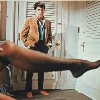
There are so many iconic moments and shots from the film. Everyone is aware of Mr. McGuire’s “Plastics” advice to Ben, and we see Norman Fell as Ben’s landlord who has no appreciation for “agitators“. It’s also fun to note that we see a glimpse of a young Richard Dreyfuss who says he’ll “get the cops“, and Mike Farrell (from “MASH”) makes his film debut as a bellhop at the hotel. It’s also the final screen performance for Alice Ghostley, who many know from “Bewitched”. One of the most famous film posters in history shows Dustin Hoffman photographed through the leg of Mrs. Robinson. Actually, that leg belongs to Linda Gray, who went on to fame as Sue Ellen Ewing in the “Dallas” TV series. It should also be noted that the pivotal Taft Hotel in the film is actually the very famous Ambassador Hotel, which of course, is where Presidential candidate Robert F Kennedy was assassinated in 1968. The hotel was later demolished in 2005.
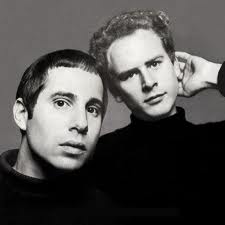
 On a personal note, some of my favorite moments in the film include the shot of Mrs Robinson reflected in the glass top table as she arrives for her first night with Ben. Also, director Nichols allows the camera to linger on a furious and disgusted Bancroft as Hoffman shows up for his date with Elaine. And yes, it should be mentioned that Katharine Ross became the “dream girl” of the 1960’s thanks to this role and her role in Butch Cassidy and the Sundance Kid. As for the Simon and Garfunkel music, the most interesting piece is the unfinished “Mrs. Robinson” song that Nichols selected, even though Paul Simon presented it to him as “Mrs. Roosevelt” (as in Eleanor). Singing only the chorus and relying on acoustic guitar and an endless supply of Di-di-di’s, the unfinished version is a perfect fit for Ben’s pursuit of Elaine. One of my guilty pleasures from the film is courtesy of Murray Hamilton who seems to just choke on his lines as he spits them out to Ben – in both of their key scenes together. Hamilton went on to be Mayor of Amity in Jaws, but his career peak was in not shaking hands with Ben.

Though it’s not technically the final shot, the faces of Elaine and Ben on the bus is one of the most memorable endings in movie history … the cherry on top for one of my absolute favorite films.


Mrs Robinson opening up her personal life for Benjamin:


NORTH BY NORTHWEST (1959) revisited

July 19, 2012

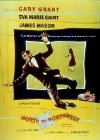
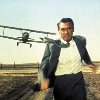
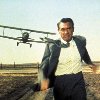
 Greetings again from the darkness. It seems apropos that Hollywood’s first stylish thriller with tongue planted firmly in cheek should come from director Alfred Hitchcock. We get two of the most iconic scenes in one film: Cary Grant being targeted by a crop duster, and the chase across the faces of Mt Rushmore. That combined with the stellar writing of famed screenwriter Ernest Lehman (West Side Story, The Sound of Music) provide one of the all-time most entertaining and beloved thrillers.

Cary Grant plays Roger O Thornhill (the O stands for nothing), a Madison Avenue Advertising hotshot who gets mixed up in a wild case of mistaken identity that involves the CIA and an unnamed foreign intelligence agency. Spies who nab the wrong guy … there’s something funny about that, as long as you aren’t “the guy”. The story is tied into the Cold War, but really the fun part of the film involves watching Thornhill maneuver his way through the maze with very little assistance. Well, Eve Kendall (played by Eva Marie Saint) says she is helping, but it doesn’t take long to figure out that she’s no innocent bystander … what blonde is ever innocent in a Hitchcock film? The bad guy is Vandamm, played with true menace by James Mason (whose wonderfully creepy voice always made him a terrific villain). His henchman is a young Martin Landau, whose mannerisms will have you raising an eyebrow throughout. While many rave about the scenes with Grant and Ms. Saint, my favorites involve Grant and Mason. Two suave masters going at each other with verbal sparring that stands up more than 50 years later.

 This was Hitchcock’s only film for MGM, and I would argue it is his most visually stylish … clothing, set decorations and the beautiful scenery and camera work. Also, he makes his cameo very early here … just missing a city bus as the doors close in his face.  And of course, one can’t help notice the poor gray suit that Grant wears through most of the film. It looks fabulous on him, even after he crawls out of the corn fields. Mr. Grant may be the most elegant actor to ever grace the silver screen. He moves like a dancer and has the face of model. This is a true movie star. I have often stated that he mastered the confounded grimace and the quick, sly smile and built a career.

Bernard Herrmann delivered yet another perfect score and Lehman’s risqué’ (for the times) dialogue is especially fun in the train’s dining car. Finally getting to see this one on the big screen gave me a whole new appreciation for the crop dusting scene and Mt Rushmore. The scale of both segments is pure Hitchcock art. On a final note, there are so many character actors whom you will recognize throughout the film. Many went on to long careers in the 60’s and 70’s and even beyond. A true classic from the master.

**Note: Jessie Royce Landis plays Cary Grant’s mother in the film … actually, she was only 7 years older than Grant.

watch the trailer:


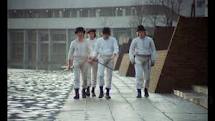
A CLOCKWORK ORANGE (1971)

July 12, 2012

 Greetings again from the darkness. Director Stanley Kubrick only made 11 feature films, and there have been arguments made for all 11 to be considered cinematic classics. This one must surely be included with Spartacus, Dr Strangelove, 2001: A Space Odyssey, and The Shining as films that are safe and secure in movie history. Based on the novella from Anthony Burgess, the focus on Alex makes this an extremely disturbing and uncomfortable film to watch, even 41 years after original release.  Still, I couldn’t resist an opportunity to watch it one more time … with a full house on the big screen.

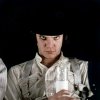
Malcolm McDowell is just terrific as Alex, the sadistic, remorseless, psychotic leader of a pack of hoodlums who terrorize innocents just for the sake of doing so. To emphasize Alex’s distorted view of society, Kubrick utilizes a wide-angle lens to show us his Point of View. There is much commentary in the film and most of it is quite obvious. One of the least discussed is the interaction of Alex and his “droogs”. When they tire of his relentless power-mongering and the lack of big scores from all of their criminal activity, we see how young thugs would handle such a situation.  Got milk?

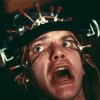
 There is also much criticism directed at the British government and the world of psychiatry, especially mind-control. Kubrick obviously had extreme views on these topics as he went off-track from the source material to make his points in extreme fashion. The idea of moral choice being the distinguishing factor of a man could be debated, but seems logical when contrasted with the anti-violence rehabilitation system favored by the minister.

There are some fascinating visuals with the milk-plus bar, the artwork and wide-angle lens … especially when focused on Patrick Magee’s face during the rape scene. Also, the use of Ludwig van Beethoven to put Alex in the mood for “ultra-violence”, and then his subsequent song and dance to “Singin in the Rain”, show what the other side of music can mean to those not quite right in the head.  Don’t worry about missing some of the “droogs” dialogue.  They have a language of their own and it is based in Russian roots.  Michael Bates adds a touch of comedy relief as the over-bearing prison guard. His mannerisms are quite funny, yet somehow believable.

The film received four Oscar nominations including Best Picture and Best Director, though sadly, McDowell was not recognized. While there is much in the film that is difficult to watch, the brilliance of the material, script, acting and directing are a treat for movie lovers. One bit of trivia: that is David Prowse who plays the writer’s bodyguard. Mr. Prowse would go on to play Darth Vader in the Star Wars films.

not sure if this is an official teaser trailer, but it provides a taste without spoiling any scenes:


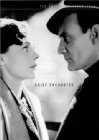
BRIEF ENCOUNTER (1945)

July 5, 2012

 Greetings again from the darkness. The Magnolia Theatre in Dallas included this one in its Summer Classic series and it drew a decent sized audience, even though the one-night-only showing was on the same evening as many of the local fireworks shows for Independence Day. If you are unfamiliar with this film, you should know that it garnered director David Lean his first of seven Oscar nominations. In contrast to this “little” film, Lean went on to direct such epics as The Bridge on the River Kwai, Lawrence of Arabia, and Doctor Zhivago.

Marital infidelity has long been a favorite topic in Hollywood … umm … I mean on screen. Rarely is it treated with such respect as it is here. The story is based on a short play from the great Noel Coward. With numerous scenes added for the film version, it never feels forced or over-written. What really makes this one standout is that the two lead characters are basically happily married people who just stumble into each other and a bond forms … despite their level-headed acknowledgments that it’s not a good idea.

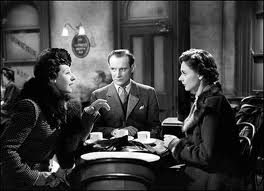
 Laura (Celia Johnson) and Alec (Trevor Howard) are just going about their daily routines when circumstances bring them together at the hectic train station. We learn this in the opening scene (pictured left) through the internal-dialogue (narration) coming from Laura. See, the bulk of the movie is a flashback as we are really starting at the end. This opening scene is brilliant as we can all relate to the frustration Laura feels as her yappy, but well-meaning friend, unwittingly crashes the going-away party. We see the torture on the faces of Laura and Alec, but it takes the rest of the movie for us to get the full story.

 The setting of a train station adds a time-sensitive element to the rushed time together. While they bond through tea, food and movies, the train whistle is the reminder that the precious moments are at the mercy of a schedule that won’t allow for flexibility. This is no Meet-Cute of which films today seem to think is a required element. No, these are two real adults who have not before noticed an element missing in their lives. Perhaps Coward is saying that nothing must be missing for two kindred spirits to connect, but that the real choice continues to lie within each of us … loyalty, fidelity and judgment are on constant alert.

 It should be noted that Celia Johnson’s performance really carries the film. She was nominated for an Oscar and is just brilliant in her emotional roller coaster ride. Trevor Howard, a strong character actor, makes a terrific partner for her. They strike us as real people, not movie stars, caught in a real life dilemma. To prevent an over-wrought emotional wringing, we get the comedic balance of conductor Stanley Holloway and his flirtatious ways with prim and proper shopkeeper Joyce Carey. Their playful (yet similar) relationship counteracts the upper-crust complexity of Laura and Alec.

The film and its players offer up a few interesting side notes. Celia Johnson was not a fan of acting. She was seduced into playing the role after her friend Noel Coward personally read the script to her. Celia was married to Peter Fleming, older brother of Ian Fleming – he of James Bond fame. Noel Coward had a multi-faceted career that included playwright, actor, songwriter and singer, novelist and even director. Mr. Coward personally selected the Rachmaninoff piano concerto that so wonderfully accompanies the movie’s happenings. The bookstore shown in the film was later spun off from Boots Pharmacy, which only this year was purchased by Walgreens. Lastly, the film was originally banned in Ireland for showing marital infidelity in such a positive light. Though released in 1945, it wasn’t shown in the United States until 1946, thereby pushing the Oscar nominations to 1947.

** Note: don’t mistake the 1974 TV version featuring Richard Burton and Sophia Loren for this far superior David Lean version

watch the trailer:


COOL HAND LUKE (1967) revisited

June 21, 2012

 Greetings again from the darkness. Entirely too many years have passed since I last saw this movie, so when Cinemark included it in the summer classic film series, I was in my seat nice and early. Mention this movie and the first thing people do is quote one of the most famous lines in movie history: “What we’ve got here – is failure to communicate.” No question that’s a great line. But there is so much more to this movie and it holds up beautifully 45 years after release.

Based on the novel by Donn Pearce, who spent two years on a chain-gang, this is the story of Luke (Paul Newman) who just can’t bring himself to conform to the rules, regardless whether those be the rules of the military, society, prison, or self-imposed by his fellow convicts. We are introduced to Luke as he drunkenly cuts off the top of parking meters on main street of a small town. Later, in a throw away line, we learn he was gaining revenge on someone. It’s the clear indication that while he doesn’t always want to fit in, Luke clearly knows right from wrong.

 There are so many terrific scenes in this film, that it’s not possible to discuss each. Every scene with the prison warden, played by Strother Martin, is intense. Each of the Boss guards are frightening, especially Morgan Woodward as the sharpshooter behind the mirrored shades. There are numerous impactful scenes featuring the group of convicts. Even though we learn little about the individuals, we realize the fragile male psyche is on full display. Despite the power of all of these characters and scenes, the real strength of the film is the relationship between Luke and Dragline (George Kennedy). Watching the early cat and mouse game, and the subsequent transfer of power, we realize this is two amazing actors at the top of their game.

 George Kennedy rightfully won the Best Supporting Actor award and continued on to become one of the most successful and prolific character actors of the 70’s and 80’s, and his career culminated with his iconic role in the Naked Gun series. As for Paul Newman, this is one of his best performance in a long line of standout performances. This one is in the middle stage of his career and he exuded manliness with a touch of sensitivity. He and Strother Martin would meet again in one of the best sequences of Butch Cassidy and the Sundance Kid.

 Watching Luke win over all the convicts, including the previous leader played by Kennedy is stunning, yet gut-wrenching when offset by the scenes with the guards who are hell bent on getting Luke to understand his place. They understand the risk he poses to the systematic rhythms of the prison.  What no one seems to understand is Luke’s odd need for misery … he allows himself only moments of joy before lapsing back into some odd form of sacrifice. Study the famous egg scene.  50 eggs. 50 inmates.  The pain he endures and the scene ends with a crucifix pose. Now take that to the final few scenes that take place in the church. Luke is asking the questions, but he refuses to hear the answer.

 The supporting cast is downright incredible. This was the feature film debut for: Ralph Waite (4 years later he became the beloved paternal figure of TV’s “The Waltons”); Joe Don Baker (Buford Pusser from Walking Tall); James Gammon (later the crusty manager in Major League); and Anthony Zerbe, another iconic character actor of the 70’s and 80’s. Also featured are Dennis Hopper, Harry Dean Stanton (singing a few songs), Wayne Rogers (from “MASH”), Richard Davalos (James Dean’s brother Aron in East of Eden), and Rance Howard (Ron’s dad as the sheriff). In a brief, but truly great scene, Jo Van Fleet (also from East of Eden), appears as Arletta, and we quickly understand Luke’s background and inability to find himself.

Often overlooked by film historians, “Lucille” putting on a show for the convicts as she washes her car, is a scene that is meant for more than titillation. As she creatively buffs the windows, the reaction of the convicts reminds us that these are still men and no amount of humiliation and degradation can change that. One of my friends (Big E) argues that Joy Harmon was clearly cheated out of an Oscar for this scene.

The score is the handy work of Lalo Schifrin and expertly captures the moment … especially in the black tar scene. Director Stuart Rosenberg (working here with the great Conrad Hall) was known only for his TV work when he got this script. He went on to direct another prison movie in 1980 called Brubaker. Starring Newman’s Butch Cassidy co-star Robert Redford, the film was a decent prison drama, but not at the level of Cool Hand Luke … which by the way, was installed into the National Film Registry in 2005.


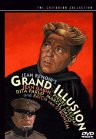
GRAND ILLUSION (La Grande Illusion, Fr, 1937)

June 15, 2012

 Greetings again from the darkness. Often cited as one of the all-time great films, I was fortunate enough to catch this one again in a limited theatrical release … a staggeringly beautiful and crisp print. The picture is so clear it looks new, and the updated subtitles make sense and are easy to read. As amazing as it looks, the real value is in the film itself.

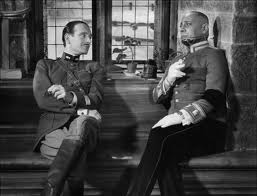
Directed by the great Jean Renoir, the story takes place during WWI and shows a much different viewpoint than what we would normally expect from a war movie. But then, this is not really a war movie … or a POW movie … or a Political statement. The real core of this story is the respect and gentlemanly nature exhibited by the men from opposing sides of the war. It is a reminder that war itself is the grand illusion. We also see the results of class differences. When German pilot von Rauffenstein shoots down a couple of French planes, he tells the recovery team to “invite them to lunch” if they are officers. And then we see the similarities of the aristocratic officers as von Rauffenstein and Captain de Boeldieu discover their common bonds.

 The influence of this film is quite obvious in two scenes. The digging of the escape tunnel and subsequent emptying of pockets on the prison grounds were “borrowed” in The Great Escape. Also, the singing of “La Marseilles” to annoy the Germans was used quite effectively in Casablanca. We also see a quite daring bedside death scene with the pure admiration between opposing officers who decide dying in war is “a good way out” for their types. Powerful stuff. There is also much commentary on differences: aristocrats, working class, Jewish, Germans, and career soldiers. We even see cross-dressing (with a purpose) in a couple of scenes, one of which provides an unforgettable visual as the soldiers sing “It’s a Long Way to Tipperary”.

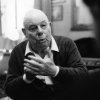
 As great as the movie is, the backstory is almost as fascinating. Released as WWII was brewing, it was one of the first things Goebbels seized when the Germans took France. The original negative was shipped to Berlin and presumed destroyed. However, it ended up in Russian archives and was re-discovered in the 1990’s. This was after Renoir (pictured left) had personally restored the film in the 1960’s from what was thought to be the best available copy. Unfortunately, he did not live to see this most recent restoration that brought the film back to it’s original glory. Renoir’s camera work is something to behold – subtle movements for extended shots. By the way, Jean Renoir is the son of the famous French Impressionist Pierre-Auguste Renoir. I believe they call that good genes.

 Silent film director Erich von Stroheim’s iconic turn as von Rauffenstein is truly movie magic. You will recognize von Stroheim as the man servant in Sunset Boulevard. Boeldieu is played by Pierre Fresnay, Marechal is played by Jean Gabin, and Rosenthal by Marcel Dalio. Marechal and Rosenthal have a remarkable segment at Elsa’s farm house. Elsa is played by the stunning Dita Parlo. This sequence provides a nice contrast to the POW portions of the film.

This work of art is now 75 years old. It is highly recommended that you see it at least once. Also, check out Renoir’s other masterpiece The Rules of the Game.

rather than the trailer, here is video of Jean Renoir himself introducing the first re-release:


TMI (5-27-12)

May 27, 2012

TMI (Today’s Movie Info)

5-27-12

 The Cinemark Theatre chain is running a Classic Film Series this summer.  One of the films in the series is the Alfred Hitchcock classic North By Northwest (from 1959)

The film stars Cary Grant, Eva Marie Saint and James Mason (as a bad guy).  With a little Hollywood magic (and Grant’s ever-youthful appearance), Grant’s mother is played by Jessie Royce Landis, who is actually only 7 years older than Grant. 

You’ll have to be quick to catch Hitchcock’s cameo in this one … it occurs during the opening credits at a bus stop.  You might also notice Edward Platt, who went on to TV fame as The Chief in “Get Smart“.  This was Hitchcock’s only movie for MGM.  The famous scenes taking place on Mt. Rushmore are actually filmed on a replica of the national monument.

Highly recommend catching this one on the big screen if you can …  both the crop duster chase scene and Mt Rushmore sequence are worth the price of admission.


WINGS (1927)

May 3, 2012

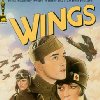
 Greetings again from the darkness. This film holds the prestigious position of forever being the answer to a favorite Academy Awards trivia question: Name the first Best Picture winner. Of course, there should be an asterisk attached as the film officially won Most Outstanding Production. There was no Best Picture award that first year. It was also the first and last Silent Film to win the award until The Artist won this year (2012).

Rarely have a film and director been so perfectly matched. William Wellman was known as “Wild Bill” thanks to his actual WWI flying experience and his penchant for fighting and partying in Hollywood. Wellman handled some of the stunt flights in the film and is also seen as the dying soldier near the end who shouts the “buzzards” line. Much of the film was shot at Kelly Field in San Antonio, and its popularity was certainly assisted by the patriotism of the time and the recent aviation excitement created by Charles Lindbergh‘s transatlantic flight.

The story is based on the WWI Army Air Corps and features some stunning aerial photography and combat flying missions, with an incredible-for-the-times 3500 soldiers, 65 pilots and 165 aircraft. The lead actors are Richard Arlen (David) and Charles “Buddy” Rogers (Jack). They are local rivals battling over the heart of the same woman played by Jobyna Ralston (Sylvia). It’s a pretty interesting love story as Jack thinks Sylvia loves him, Sylvia loves David and David knows it, and Mary loves Jack, and Jack has absolutely no clue.

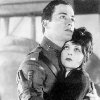
 Mary is played by the always outstanding Clara Bow (pictured left with Rogers). She truly lights up the film and screen in her scenes. Not only does she have the expressive eyes necessary for silent films, her physical presence is wonderful for such a tiny lady. Other interesting cast members include El Brendel as Herman Schwimpft. His German sounding name and somewhat effeminate manner are constant sources of comic relief. Hedda Hopper plays Jack’s mother. You might recognize her name as the founder of Hollywood gossip columns … she started out doing some acting.

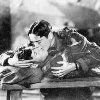
 Beyond the “Wild Bill” fun, there was also some romantic shenanigans on set. Richard Arlen and Jobyna Ralston ended up getting married after meeting during filming. Also, Clara Bow started an affair with a new actor named Gary Cooper. Yes, THAT Gary Cooper (pictured below, standing). It is startling to see such a young Cooper when he makes his first appearance. It’s a small, but vital role in the film. There has been an ongoing debate in the film world about the homosexual undertones between Jack and David. In the famous death scene, we get the first on screen man-on-man kiss on lips. Quite shocking for the times.  From a technical aspect, the Handschiegl Color Process was used for the flames and explosions – dramatic splashes of color in the aerial combat scenes. This was also Costume Designer Edith Head‘s first film. She went on to become the most famous Hollywood costume designer and worked on hundreds of films.

 The theatrical re-release of the film coincides with its 85th anniversary and celebrates 100 years of Paramount Pictures. The opening credits provide a time lapse view of the numerous Paramount logos through the years. There are many reasons to see this film: its ground-breaking action scenes, the history it addresses, its place in Hollywood lore, and of course, if you want to see the inspiration for Betty Boop (Clara Bow). What I won’t do is mention that the love story was copied by Michael Bay in the less-than-stellar Pearl Harbor film. Forget I even mentioned it.

*note: a bit more trivia … the film was released the same year Babe Ruth hit 60 home runs.  That’s the record Roger Maris would break 34 years later.  Also, this film is one of only three to ever win Best Picture without also receiving a Best Director nomination.  The other two films are Grand Hotel (Edmund Goulding, 1932) and Driving Miss Daisy (Bruce Beresford, 1989)

watch a one minute trailer:


THE GODFATHER II (1974) revisited

April 21, 2012

 Six weeks ago was The Godfather in a theatre setting. This time it was the exceptional sequel, which generated an equal amount of movie bliss. Experiencing these two classic movies on the big screen almost 40 years after release reinforces what great films they are … and how few truly great films get made. We are reminded that a powerful well-written story, world class cast, visionary director, brilliant photographer and stunning composer are all necessary components for movie greatness.

This sequel explores three time periods: the journey of 9 year old Vito to the U.S., his rise to power in Little Italy, and Corleone life after Vito’s death. Some find the cuts to varying timelines to be distracting. Personally, I find it fascinating and a very effective way to tell the entire story. Watching an almost mute 9 year old Vito land on Ellis Island and transform into a twenty-something community “leader” is one of the more powerful and unlikely events ever seen on screen. Mixing that with Al Pacino holding little back as a power-mongering Michael is downright frightening. If you doubt this, look at it from the perspective of Diane Keaton‘s May, or John Cazale‘s Fredo.

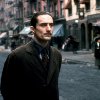
The film received 11 Oscar nominations and won 6, including Best Picture. Robert DeNiro won for his tremendous turn as young Vito, in a performance with very little English. This is early DeNiro … the Mean Streets, Taxi Driver era. DeNiro and Marlon Brando remain the only two actors to have won Oscars for playing the same character. DeNiro’s Supporting Actor competition came from two other cast members: Lee Strasberg as Hyman Roth (supposedly based on Meyer Lansky) and Michael V Gazzo as Pentangeli. Mr. Strasberg was the famed acting teacher whose prized pupils included none other than Al Pacino (who talked him into taking this role). Strasberg was also bequeathed 75% of the Marilyn Monroe estate and there was much scandal after his death when his widow auctioned off most of it.  Gazzo’s grizzled look and voice dominate his scenes and leave you feeling uneasy about what’s really going on with him.

 Here are a few other interesting points.  Most of this script was original for the film, though the background story of Vito was drawn from Mario Puzo‘s novel. Director Francis Ford Coppola considered casting Joe Pesci as the young Clemenza, but ultimately decided on Bruno Kirby. Dominic Chianese plays Hyman Roth’s right hand man Johnny Ola. Chianese has been recently seen in both The Sopranos and Boardwalk Empire. B-Movie mogul Roger Corman plays one of the Senators on the committee interrogating Michael and Pentangeli. Harry Dean Stanton plays one of the FBI bodyguards, and former heartthrob Troy Donahue plays Connie’s (Talia Shire) goofy boyfriend Merle. One of my favorite characters in the film is Don Fanucci, robustly played by Gastone Moschin. His strutting and preening always creeps me out and makes me laugh.

Besides being the first sequel to win a Best Picture Oscar, The Godfather II is simply one of the finest films ever made. At 200 minutes, it requires both a time and mental commitment, but along with The Godfather, Coppola and Puzo have provided us exemplary story telling through expert filmmaking … and a piece of movie history.

here is a link to my comments on the original: https://moviereviewsfromthedark.wordpress.com/2012/03/03/the-godfather-1972-revisited/

below is a link to the trailer, but be warned … it contains 3 plus minutes of actual footage.  If you have not seen the film, I would not recommend watching the trailer:


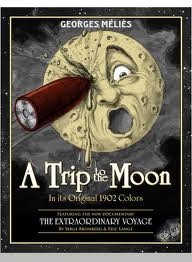
A TRIP TO THE MOON (La Voyage dans la Lune, 1902)

April 18, 2012

 Greetings again from the darkness.  If you have seen Hugo, you know that a central figure in the Martin Scorcese film is Georges Melies, the grumpy train station vendor who catches young Hugo stealing from him.  Frenchman Georges Melies was an early innovator in filmmaking and his most famous work was A Trip to the Moon (La Voyage dans la Lune) from 1902.  The film is still studied today because of it’s ground-breaking work in animation and special effects, and is considered the first science-fiction film.  The story goes that Melies went bankrupt after Thomas Edison and his technicians copied the film and distributed it in the U.S. before Melies could.  It is also thought that this started the process of film copyrighting, so that ownership of film rights could be determined.

There are many versions of varying length in existence, but I could not find a complete 16 minute version which features the final parade.  The version below has English narration added (albeit with a heavy French accent), and the famous moon landing is at about the 5:45 mark.