A HARD DAY’S NIGHT (1964) revisited

July 16, 2014

a hard days night Greetings again from the darkness. It’s the 50th anniversary and what a treat to see the re-mastered, restored film in a crowded theatre – many wearing their Beatles shirts. The quasi-documentary, cinema verite’ approach from director Richard Lester may not fit the traditional idea of a great movie, but at a minimum, it’s a fantastic pop culture artifact showing a world on the verge of change (and four of those partially responsible).

The Beatles first film shows them at the most innocent and fresh-faced we ever see them … it’s just a few months after their appearance on “the Ed Sullivan Show”. John Lennon is the most guarded, but his quick wit and distrust of the establishment are obvious. Paul McCartney is at his cutest and least arrogant, but still managing to pose on cue. George Harrison comes across most open and full of joy – before he became the most publicly withdrawn. Ringo Starr is self-deprecating and in full hang-dog mode.

For a stark contrast, watch the four lads a year later in HELP!, also directed by Mr. Lester. The luster of fame is clearly tarnished and they are quite aware of the power they wield. In contrast, during this shoot, we are almost “on set” as the boys are first experiencing Beatlemania! In addition to the Fab Four, British actor Wilfrid Brambill plays Paul’s Grandfather. The recurring gag of him being “very clean” is a play on Brambill’s long-running role as Albert Steptoe in “Steptoe & Son” where he is referred to as “a dirty old man“. Victor Spinetti plays the very anxious TV director wearing the infamous sweater. Mr. Spinetti also appeared in HELP! (1965) and The Magical Mystery Tour (1967). Richard Vernon played the grumpy old man sharing the train car with the boys. Mr. Vernon also appeared in Goldfinger that same year. Another James Bond link occurs when Ringo is invited to the Le Cercle Club … the same club James Bond first appears in Dr. No (1962). Lastly, Pattie Boyd is one of the giggly schoolgirls on the train and appears in 3 different scenes. 18 months later, she was married to George Harrison … and a few years later, she reiterated her attraction to lead guitarists by marrying Eric Clapton.

I was caught off guard by the frenetic pace of the film … it has been 3 decades since I last watched it. But mostly, I was stunned at the clean look of this restored version and was awed by the terrific sound, especially of the song restorations completed by Giles Martin, the son of Beatles record producer Sir George Martin … who was nominated for an Academy Award for his film score.

The film inspired the 1960’s TV show “The Monkees“, and of course, the soundtrack was a massive best seller and chart topper. “If I Fell” is one of my favorite Beatles songs and it’s a nice segment in the film, but the real climax is the performance of “She Loves You”, replete with terrific crowd shots. The impact and lasting impression of the film is every bit as recognizable as that stunning opening chord to the title track that opens the film.

watch the (new) trailer:


THE RAVEN (1963)

July 5, 2014

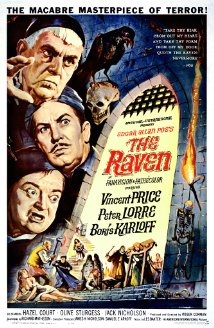
raven Greetings again from the darkness. It’s been more than 50 years since this one was released, so it seems a good time to offer up some thoughts and observations. Let’s start with the fact that you probably read Edgar Allen Poe’s poem “The Raven” in high school. Director Roger Corman and writer Richard Matheson take Poe’s work as a starting point in a most unique story of their own.

If you aren’t familiar with Roger Corman, he is one of the most prolific and entertaining “B” movie makers of all time. His writer here, Mr. Matheson, is best known for his work on numerous episodes of “The Twilight Zone“. Poe – Matheson – Corman would be enough, but we also get Vincent Price, Peter Lorre, Boris Karloff, Hazel Court and a young and not yet well known Jack Nicholson. Price is always a treat to watch (especially in horror films), Lorre appeared in 3 of the greatest movies of all-time (M, The Maltese Falcon, Casablanca), Karloff is the master of monster (and much more), Ms Court was one of the first stars of Hammer Films, and of course, Nicholson (fresh-faced here) went on to become one of the most successful actors in movie history.

Price, Karloff, Lorre and Nicholson offer up four of the most unique and recognizable voices ever heard in movies, and they each partake in the fun provided by Corman here. Yes, I said fun. This is almost slapstick comedy, and at a minimum, it’s a parody of the much darker series of Poe films. If you consider it as an influence of the 1960’s “Batman” TV series, you wouldn’t be wrong. Even the music (heavy on the tuba) has an air of comedy.

Watching Peter Lorre as a matador is pretty funny, as is Nicholson as the frenetic stagecoach driver.  Some of the back-and-forth with Lorre and Nicholson as father and son is clearly ad-libbed, but the classic comedic sequence occurs when Price and Karloff take their wizardry duel to the death and turn it into a special effects highlight reel.

This may be the only time you hear the phrase “precious viper” used to describe a woman, and if that, combined with all of the above reasons, isn’t enough to motivate you to seek this one out, then maybe you will never discover why so many adore the films of Roger Corman. Compared with films of today, this style is nevermore.

watch the trailer:


PARIS, TEXAS (1984) revisited

June 21, 2014

paris tx Greetings again from the darkness. It’s been 30 years. The movie hasn’t changed. I remember every scene. So that means it’s ME that has changed. While I really liked the movie on its 1984 release, it’s only now that I truly appreciate the brilliance of the script, the music, the direction, the photography and the acting … much less the wide range of emotions released in the smallest ways possible.

Director Wim Wenders has long been a favorite at Cannes Film Festival, and this one took home the prestigious Palme d’Or. Since then, the film has often been mentioned as one of the best movies of the 1980’s, and after this most recent screening (courtesy of the Dallas Film Society), I wholeheartedly concur.

Opening in a most unusual manner … the lead character comes stumbling out of the Texas dessert and doesn’t utter a word for the first 20-25 minutes … this film immediately strikes you as something unique –definitely not cookie cutter. Trying to outguess the script is a waste of time. It’s best to just watch it unfold in a believable and sometimes awkward way.

In a rare lead role, long time character actor Harry Dean Stanton plays Travis. We soon enough learn that Travis disappeared four years ago leaving behind a wife and young son. We also learn that his brother Walt (Dean Stockwell) and Walt’s wife Anne (Aurore Clement) have been taking care of the boy, and Hunter (Hunter Carson) considers them his parents (his mom ran off too).

Walt and Anne invite Travis to stay with them and re-connect with his son, but they are caught off guard when the two really click and they take off to find Jane, the wife/mother. Their charming (but less-than-professional) stakeout leads to the discovery that Jane is working in a sex shop, spending her days talking to a 2 way mirror with lonely men she can’t see. One of the most remarkable on screen soliloquies ever seen occurs on Travis’ final trip to see Jane (Natassja Kinski). He tells her a heartfelt story that plays out as an explanation, an apology, and a plan for moving forward. She slowly realizes it’s their story he is telling. It’s his way of making reparations and finally doing the right thing (as he sees it).

As with most classic films, the backstory offers some interesting tidbits and the players are fun to catch up with. This story was originally written by the great Sam Shepard. Mr. Shepard is a Pulitzer Prize winner, an award winning playwright, and well known actor (Oscar nominated for playing Chuck Yeager in The Right Stuff). Director Wenders then brought in L.M. “Kit” Carson to add and revise the script while on set. Carson’s son (with actress Karen Black) Hunter plays the boy in the film, and he delivers one of the best, least affected, child performances of all time. Kit went on to write the screenplay for The Texas Chainsaw Massacre 2 (1986) and had a significant acting role in Running on Empty (1988). His son Hunter is still a working actor today. Mr. Wenders was one of the German New Wave of directors along with Herzog and Fassbinder, and his Wings of Desire (1987) would make a terrific double feature with this one. Mr. Stockwell was a very successful child actor in the 1940’s and is best known for his work in Blue Velvet and TV’s “Quantum Leap“. Ms. Kinski is the daughter of Klaus Kinski and is fondly remembered for her roles in Tess (1979) and Cat People (1982), though she still works today as well.

Harry Dean Stanton is now 88 years old. He served in WWII and was present during the Battle of Okinawa. His acting career began in the 1950’s and he still works periodically today. In addition to nearly 200 acting credits, he has had a pretty nice career as a musician. His band built a large cult following. Some of his most popular acting roles have been in Cool Hand Luke, The Godfather II, Alien, Repo Man, Escape From New York and, of course, as the dad in Pretty in Pink.

The music in the film is provided by Ry Cooder, who is a tremendous slide guitarist and has worked with some of the all-time greats in the music business – The Rolling Stones, Van Morrison and Neil Young, among others. Cooder is a multi-Grammy winner and re-teamed with Wenders for the Oscar nominated Buena Vista Social Club a few years later. The music is an exceptional compliment to the movie, as is the camera work of Robby Muller, who also works frequently with Wenders.

This story of loss and loneliness is an easy one to overlook, but when a film holds up well for 30 years … and affects you differently depending on your own lot in life … its legacy is secure.

***NOTE: those of a certain age will get a kick out of the use of a Muse Air jet

watch the trailer:


LAURA (1944) revisited

April 27, 2014

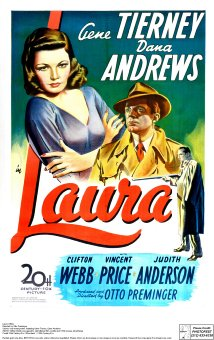
laura Greetings again from the darkness. Some movies from the 1940’s remain fun to watch for mostly nostalgia reasons. Others still hold up well today and can be enjoyed for the story, script, acting and production value. Director Otto Preminger’s Laura falls easily into the latter category. This quasi-film noir, murder mystery, creepy love story is based on the novel from Vera Caspary is probably more respected today than when it was released … 5 Oscar nominations, but not one for Best Picture.

To fully appreciate the film, it helps to know the tortured back story. This was always Otto Preminger’s baby, but Daryl Zanuck initially chose a different cast, a different director and a different ending. In the end, Preminger (Anatomy of a Murder) won all of his battles – directing Gene Tierney with the ending he wanted (thanks to Walter Winchell). TCM’s Robert Osborne correctly states that the film has one of the best opening lines: “I shall never forget the weekend Laura died“. The line is spoken by narrator Waldo Lydecker (great screen name) played by the elegant Clifton Webb.

Playing out as mostly a murder investigation led by the detective (Dana Andrews), we are treated to a stream of unusual story choices and only one scene at the police station … a terrific interrogation scene. Instead, we spend the entire movie on the turf of rich, high society types. There are at least four credible murder suspects and they are strung along by a mostly monotone detective, who only flashes personality on his date night with the dead girl’s portrait (well, that’s how it plays!) and when he is messing with a pocket baseball toy.

gene tierney Gene Tierney plays the titular Laura, and every time she appears on screen her startling beauty distracts us … just as it does the other characters in the film. Tierney was only 23 years old when this was filmed, and a couple years later she had a romance with young John F Kennedy (though she became a long time supporter of Richard Nixon). Her tragic personal story was the basis for Agatha Christie’s novel and movie The Mirror Crack’d. In the 1950’s a suicidal Tierney was treated with shock therapy in a sanatorium, and though she recovered, she struggled for the rest of her life. Her second husband was Houston oil man W Howard Lee, who had previously divorced actress Hedy Lamarr … another of the all-time screen beauties, who also turned down the lead role in Laura. Lucky guy.

The spirit of the movie comes courtesy of the magnificent performance of Clifton Webb as Waldo Lydecker. He is mesmerizing in his ability to take over every scene. This was Webb’s first “talkie” feature film – he left for the stage 15 years prior. The 30 year age difference between Waldo and Laura only works because Webb plays it as her society mentor, though it’s obvious he is obsessed.

Some of the best scenes and banter occurs with Webb and Vincent Price, who plays Laura’s fiancé. If you are only accustomed to Vincent Price in horror films, you will certainly get a kick out his odd role here as the virile, insecure fiancé. He also has some very good and uncomfortable scenes with the great Judith Anderson, who clearly lusts after the Price character.

The aforementioned portrait of Ms. Tierney was also used in 3 other films, and it’s interesting that Tierney and Andrews made 5 total films together. David Raskin’s haunting “Laura’s Theme” plays throughout the film in various fashions, and Joseph LaShelle won the film’s only Oscar – best black & white cinematography. This is certainly one of the best from the 1940’s and holds up very well today … enjoy the many facets of quality filmmaking.


**NOTE: None of the available online trailers are of acceptable quality, so I have decided not to post one


THE FOUNTAINHEAD (1949)

February 18, 2014

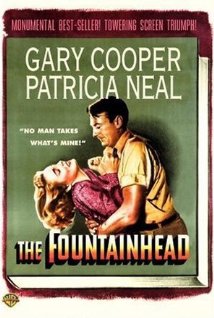
fountainhead Greetings again from the darkness. Russian-American writer/philosopher Ayn Rand is best known for her novels The Fountainhead and Atlas Shrugged. She is the founder of Objectivism (as opposed to collectivism) which has become the foundation for the Libertarian Party in the U.S. Both novels make for fascinating and thought-provoking reading, and numerous other writings and interviews featuring Ms. Rand will question your beliefs and today’s society. Unfortunately, her words and thoughts have just not translated well to the silver screen.

Ms. Rand was hired to adapt her own novel for this film version, and her stubbornness led to the two main weaknesses: the casting of Gary Cooper and the too long and too convoluted final courtroom speech. Cooper, a Hollywood legend and already a four time Oscar nominee by this time, was simply too old to play the idealistic architect Howard Roark. His stilted acting, such an advantage to High Noon a few years later, really bogged down many scenes in this one.

Newcomer Patricia Neal (22 years old) was cast and she brings much needed energy to the story, though her inexperience shows in a couple of crucial moments. Contrast her performance here with her Oscar winning performance in Hud (1963), where she was in complete command. Sadly, Ms. Neal had a series of strokes in the mid-1960’s and her recovery caused her to turn down the iconic role of Mrs. Robinson in The Graduate (1967).

Other support work in the movie is quite effective. Raymond Massey (so great in East of Eden) is terrific in the William Randolph Hearst-inspired role of powerful newspaper publisher, and Robert Douglas is expertly conniving as the self-centered villain and architecture critic. King Vidor, a 5 time Oscar nominee as director, does his best to overcome the challenges provided by Cooper and Ms. Rand’s script, and for the most part, the film is interesting and enjoyable enough to watch. It’s a bit frustrating to think what might have been.

Howard Roark’s final courtroom speech/closing was at the time the longest soliloquy yet seen on a movie screen. Supposedly, Mr. Cooper didn’t really understand it and his delivery makes that pretty easy to believe. Refusing to compromise on one’s beliefs and talent, and the theory that all we have are our convictions and integrity is simple enough to understand. The arguments ensue when the collectivists state that society depends on the creations of man, and these creations are owed to society, and the most talented of us should serve others. The film’s method of making this point probably won over very few people with it’s theme:  “To want nothing. To expect nothing. To depend on nothing.”

watch the trailer:

http://www.youtube.com/watch?v=swOxKu80JpU


Dr. Strangelove – 50 Year Anniversary

January 30, 2014

Dr Strangelove: How I Learned to Stop Worrying and Love the Bomb

Fifty years ago this week (January 29, 1964), director Stanley Kubrick‘s classic black comedy/satire was released … make that UNLEASHED into theatres.  It’s place as a legendary and classic film is quite secure.  I wrote about it not too long ago, and here is the link if you’d like to get my take:

DR. STRANGELOVE (1964)

Also, just for fun, here is a rare image from the infamous filmed, but cut, pie fight that occurred in the war room (Yes, that is George C Scott).  It was an over-the-top (even for this film) slapstick scene that was deemed too tasteless so soon after the assassination of President John Kennedy.

strangelove pie fight


THE LITTLE MERMAID (1989) revisited

January 24, 2014

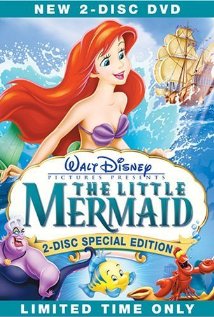
little mermaid Greetings again from the darkness. The first of three true classics from the “middle era” of Disney animation … along with Beauty and the Beast (1991) and The Lion King (1994) … this 1989 version of Hans Christian Anderson’s 1837 story brought musical theatre to an animated children’s fairy tale. It was also the 28th Disney film, and the final to utilize hand-painted cel animation.

The Blu-Ray release (a Christmas present from my son) to celebrate the film’s 25th anniversary is truly stunning in color, brightness, clarity and sound. An explosion of sight and sound occurs during the incredible cacophony of joy and cheer better known as the Best Song Oscar winner “Under the Sea”. The calypso style was a very creative choice by musical directors Alan Menken and Howard Ashman.

Of course, the star of the show is Ariel, the rebellious 16 year old mermaid who dreams of walking on the beach and dancing with the Prince. Ariel’s remarkable vocals (“Part of Your World”) are provided by Jodi Benson, who beautifully captures the innocence and longing necessary for the character. Samuel E Wright is the smooth voiced Jamaican crab Sebastian, who not only takes lead on “Under the Sea”, but also on romantic ballad “Kiss the Girl”. The other standout is Pat Carroll as Ursula the Sea Witch. She is the perfect villain vs Ariel, and is quite a commentary on the actions of those who are power hungry.

Written and directed by John Clements and Ron Musker, the film was a bit different for its time because of the depth of Ariel’s character. This was a typical teenager going against her strict parent and dreaming of a better life. Ariel has a mind of her own and is willing to chase her dreams … even if it’s a boy from the proverbial “other side of the tracks” and with a Faustian negotiation. From a technical perspective, the artwork is spectacular and movements are full and fluid (sorry for the pun). This came 5 years after Ron Howard’s live action Splash with Tom Hanks and Darryl Hannah. If you ever doubt the power that expert animation can possess, just compare the emotion and charm in these two mermaid films.

This latest Blu-Ray release has some very interesting special features. We are treated to interviews with the film’s animators as well as a peek inside the Disney Animation studios, now on its third generation of animators. Much reverence is provided to The Nine Old Men … the original group of animators hand picked by Walt Disney. The last of the nine men died in 2008, and their trainees are now mentoring the most excited current group that is kicking out some new classics like Frozen and Wreck-it Ralph. What’s that word … circle of life.

watch the “Under the Sea” segment (Best Song Oscar winner):

https://www.youtube.com/watch?v=NPQVrjnC1jo

http://www.youtube.com/watch?v=NPQVrjnC1jo


TENDER MERCIES (1983) revisited

January 22, 2014

tender mercies Greetings again from the darkness. What a cinematic treat to revisit this movie on the big screen some 30 years after its release. Standing in stark contrast to the superhero and graphic novel special effects extravaganzas of today, this little film takes a slow, simmering approach as it deals with real emotions of life.

Robert Duvall won his only (so far) Oscar (he’s been nominated 6 times) for playing Mac Sledge, a divorced former C&W singer/songwriter who spends each day trying to kill the pain by draining bottles of booze. The similarities to Jeff Bridges’ 2009 film Crazy Heart are unmistakable, but this film is much quieter with emotions being relayed through the eyes and body language of the key characters.

Mac’s gradual path to redemption comes courtesy of war-widow Rosa Lee, played exceedingly well by Tess Harper (her first feature film). Rosa Lee runs a gas station/hotel while raising her young boy named Sonny (Allan Hubbard in his only screen appearance). As the story develops, we meet Mac’s ex-wife Dixie, played by a bombastic Betty Buckley (the mom from TV’s “Eight is Enough”, a Tony winner, the helpful teacher in the original Carrie) as she lives a life of luxury and insecurity courtesy of a career singing Mac’s songs. Their daughter is played by Ellen Barkin in only her second screen appearance (Diner, 1982). Dixie’s manager offers us a chance to see the always superb Wilford Brimley with his drawling charm.

The story was written by the remarkable Horton Foote (a native Texan), who also won the Oscar for Best Original Screenplay. Mr. Foote also won an Oscar for adapting Harper Lee’s To Kill a Mockingbird for the screen, was nominated for The Trip to Bountiful, won the Pulitzer Prize in 1955, and was nicknamed the “American Chekov”. His works always captured the essence of what makes people tick, and how they deal with adversity. He passed away in 2009 at age 92.

Australian director Bruce Beresford was coming off the masterful Breaker Morant (nominated for his screenplay) and was surprised to be chosen to direct his first American film. He would later go on to direct Driving Miss Daisy, winner of the Best Picture Oscar. Mr. Beresford is now in his 7th decade of film work spanning his 1959 short film and his TV mini-series “Bonnie & Clyde” from 2013.

This is such a no-frills, down-to-earth presentation that it’s easy to be tricked into thinking it’s a simple story about simple people. Instead, these are complicated folks leading complicated lives in a seemingly quiet manner. Mostly they are re-assembling the pieces as best they can … some are better at it than others. The core of these people is captured in Mac’s line: “I don’t trust happiness. I never did. I never will“.

***NOTE: Wilford Brimley, a former Marine in the Korean War, spent time as personal bodyguard to billionaire Howard Hughes.

***NOTE: Not to be outdone in reference to billionaires, Ellen Barkin spent 7 years married to Ron Perelman, billionaire Chairman of Revlon.  She has since resumed her career.

watch the original trailer:

https://www.youtube.com/watch?v=YkRvzcektB0

http://www.youtube.com/watch?v=YkRvzcektB0


MEET ME IN ST LOUIS (1944) revisited

January 1, 2014

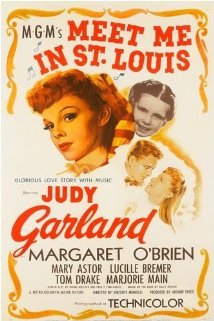
meet me Greetings again from the darkness. There are, even amongst otherwise intelligent movie lovers, those who proudly proclaim “I don’t like musicals“. It’s a somewhat understandable stance since so many of this genre are simply a group of songs linked together by a thin story with uninteresting characters. However, when done well, the musical can be a most enjoyable, emotional and entertaining ride. One of the best and most beloved is director Vincente Minnelli‘s Meet Me in St. Louis.

If you were making a musical in 1944, your dream cast would certainly include Judy Garland. She was 22 years old at the time, just a few years removed from her iconic role as Dorothy in The Wizard of Oz. Ms. Garland was desperately trying to break free of her “Oz” and “Andy Hardy” teenage ingénue image and transition to adult roles. In fact, she pushed back hard at MGM against being cast in this film. Because of this, she initially struggled with the character of Esther until finally grasping the tone that director Minnelli was after. The result is clearly one of her best performances, and maybe her most beautiful look ever on screen (probably due in part to the director’s attraction to her).

The story is broken into four sections … the four seasons leading up to the 1904 World’s Fair to be held in St. Louis. The Smith family lives in a charming upper middle class Victorian home that serves as the centerpiece for most scenes … especially the intricate, winding mahogany staircase, and the elaborate gaslight fixtures throughout. Mr. and Mrs Smith are played by Leon Ames and Mary Astor (known best for The Maltese Falcon). They are joined in the house by a son Lon (Henry H Daniels, Jr), four daughters (Rose – Lucille Bremer, Esther – Judy Garland, Agnes – Joan Carroll, Tootie – Margaret O’Brien), a spry grandfather (Harry Davenport), and wise-cracking housekeeper (Marjorie Main). The family dynamics are such that multiple sub-stories are constantly being juggled.

There are numerous pieces and tidbits associated with this film, so let’s discuss just a few. While audiences today may find 7 year old Margaret O’Brien’s performance as the youngest daughter Tootie to be a bit over the top, she won an Oscar that year as the Best Juvenile Actor (no longer awarded). Two sequences in particular stand out: the quite dark and harsh Halloween portion which accurately displays the dangerous activities of that era (making today’s trick or treat seem quite tame), and the song and dance routine performed in the parlor while wearing a nightgown. A few years later, Ms. O’Brien would star in the classic Little Women (1949). This is also the film where director Vincente Minnelli and Judy Garland first met. They were married the following year and of course had a daughter, Liza Minnelli. All three were Oscar winners: Judy in 1940 for Best Juvenile Actor, Vincente for directing Gigi (1958), and Liza for Best Actress in Cabaret (1972).

meet me2 Sally Benson’s series of short stories published in the “New Yorker” magazine inspired the film. The stories were based on Ms. Benson’s childhood in St. Louis and she consulted on the script and set. In the movie, the Smith house is located at 1935 Kensington. For filming, the house was built on the MGM backlot on what became known as St. Louis Street. The street was used for many films, and the same house was used for the original Cheaper By the Dozen (1950). Sadly, the street and houses fell into disrepair and was later destroyed and sold off by MGM (it’s now condos and office buildings).

Of course, this is a musical so the songs deserve mention. Many were original compositions for the film, including “The Trolley Song” (nominated for a Best Song Oscar, and one of the few songs ever to utilize the word clang multiple times) and “Have Yourself a Merry Little Christmas”, the latter showcasing Ms. Garland in peak singing voice. The film was a huge box office success and was nominated for four Oscars (no wins). The set design and costumes are extraordinary, and the story is quite affecting as it focuses on family and what makes a home so special. This is a wonderfully sentimental taste of Americana at the turn of the century.  And a bit of advice to all the gentlemen out there … should the object of your desire ever suggest the two of you dim the lights and watch this one together, immediately say YES with a smile!  It’s one of the best examples of how effective a musical can be in telling a story and connecting an audience to the characters … and it’s still pretty effective at connecting viewers to each other as well!

**NOTE:  TV buffs will notice a small, but important role for June Lockhart, who became a TV mainstay for 50 plus years.  She was best known for “Lassie” and “Lost in Space“, and still works today at age 88.

**NOTE: The beautiful curved brass bed in Judy Garland’s bedroom was also used in Gaslight, another classic film from 1944.

Rather than include the trailer for this film, below you will find the scene where Judy Garland sings “Have Yourself a Merry Little Christmas”.  Her voice is gorgeous and it may be her best ever vocal performance from a movie:

http://www.youtube.com/watch?v=5g4lY8Y3eoo

http://www.youtube.com/watch?v=5g4lY8Y3eoo


GASLIGHT (1944)

December 31, 2013

gaslight Greetings again from the darkness. Husbands were surely disliked in the 1940’s, at least by writers and filmmakers. There is no shortage of films depicting the villainous husband targeting the unsuspecting and defenseless wife. Too many to list here, but a couple years prior to this one we had Suspicion, and a couple years after, we had Notorious. The latter also features Ingrid Bergman who won her first Oscar for Gaslight, one of the more atmospheric of the psychological noir-thrillers.

Based on the Patrick Hamilton play, this one features terrific lead performances by Ms. Bergman and Charles Boyer, a role quite against type for France’s romantic leading man. Joseph Cotten delivers a solid (and nice) supporting role as the interested and inquisitive Scotland Yard detective, and making her screen debut is an 18 year old Angela Lansbury (yes this movie is now 70 years old).

Mr. Boyer is quite convincing and creepy as the despicable husband out to persuade his bride that she is slipping into insanity. The psychological abuse is painful to watch, and the art/set direction provides such perfect decor that we share the claustrophobia and entrapment with Bergman’s Paula. This audience connection allows for a most effective comeuppance or revenge scene that is simply delicious.

gaslight2 There was actually a mostly unsuccessful UK film version in 1940, but it doesn’t stand up to this expert production from director George Cukor. Mr. Cukor is the legendary director behind such classics as Little Women, The Philadelphia Story, and My Fair Lady. Gaslight received 7 Oscar nominations and in addition to Ms. Bergman’s win, it also took home the statue for Best Art Direction. The film, Cukor and Boyer all lost out to that year’s big winner Going My Way (Bing Crosby, Leo McCarey). Not many films have a psychology term named after them … here’s hoping you are never a victim of “gaslighting”.

**NOTE: the beautifully unique brass bed in the film is also featured as Judy Garland’s bed in the classic Meet Me in St. Louis

watch the trailer:

http://www.youtube.com/watch?v=ZiTjO9Pk4V4

http://www.youtube.com/watch?v=ZiTjO9Pk4V4