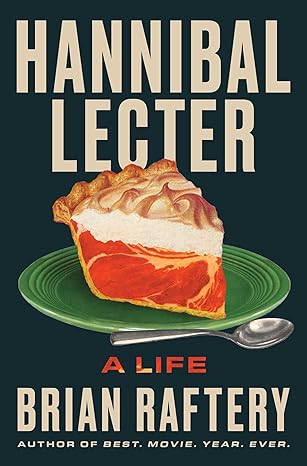
 Analyzed too closely, our fascination with serial killers could (and should) be considered disturbing. Novels, stage plays, movies, and TV series have long focused on the criminals who both frighten society and manage to long elude law enforcement. This is not referring to the demented appeal of scumbag shoot-the-CEO-in-the-back murderers with bushy eyebrows, but rather those whose intellect and psychological profiles allow them to stay one step ahead of those seeking justice – at least for a while. Included on the list would be such recognizable names as Jack the Ripper, Ed Gein, Ted Bundy, Jeffrey Dahmer, Aileen Wuornos, and the Zodiac Killer. Capitalizing on the public’s fascination led Thomas Harris to write “Red Dragon” in 1981, his first novel featuring Hannibal Lecter. Three more Lecter novels followed, and it’s Mr. Harris’ many Lecter works, and the projects influenced by them, that drove this detailed and expertly researched book from author Brian Raftery.
It’s tempting to call this a biography of Hannibal Lecter, a fictional character – despite his being referred to as “the late, great, Hannibal Lecter” during the most recent Presidential campaign (and a few times since). Yet, the biography label feels insufficient since Raftery also delves into Thomas Harris’ writing process, interviews with FBI agents, and serves up some behind-the-scenes details of the movie and TV projects of which ‘Hannibal the cannibal’ was a part. For many readers, including yours truly, gaining some insight into Harris is reward enough. The ever-reclusive bestselling author (more than 50 million books sold) is renowned not just for his outstanding storytelling, but also for his ability to avoid the spotlight and most anything resembling an interview (for decades).
Of course, the public fascination lies not with bestselling authors, but instead on serial killers. Harris’ work on Lecter has permitted us to get up close and (too) personal with this brilliant and dangerous character. It’s the mind games that draw us in … much more so than the grisly murders or cannibalism. This is what makes Raftery’s book so special. He guides us through the various incarnations of the enigmatic Hannibal Lecter. Harris’ four Lecter novels are “Red Dragon” (1981), “The Silence of the Lambs” (1988), “Hannibal” (1999), and the prequel “Hannibal Rising” (2006). Releases of the four novels spanned twenty-five years, fitting properly with Harris’ devotion to the character and his process. The novels fed the cinema with MANHUNTER (1986), THE SILENCE OF THE LAMBS (1991), HANNIBAL (2001), RED DRAGON (2002), HANNIBAL RISING (2007), and the TV series “Hannibal” (2013-15). Author Raftery divides the books/films into sections to facilitate our understanding of Lecter and how the projects came together.
Easily the most popular and widely seen version of Lecter is from the 1991 film version, THE SILENCE OF THE LAMBS. It won five Oscars: Best Picture, Best Director (Jonathan Demme), Best Adapted Screenplay (Ted Tally), Best Actress (Jodie Foster), and Best Actor (Sir Anthony Hopkins). Raftery gives the novel and the film its due, and includes quotes from Hopkins on his pride in portraying the character. For film lovers, Raftery also includes some juicy details around the early decisions on script, director, and casting. There are plenty of surprises throughout the book, yet this section probably contains the most. Raftery doesn’t shy away from the fading interest in Lecter in the later versions, however, the overall success rate and longevity is quite impressive.
Whether you are drawn to Hannibal Lecter through the Thomas Harris novels, the frightening on screen portrayal by Sir Anthony Hopkins, or a general interest in the criminal mind, Brian Raftery’s book will surely exceed expectations, while offering valued insight into one of the most intriguing literary villains of all-time.
Published by Simon & Schuster, available February 10, 2026
 Movie Reviews from the Dark
Excellent reviews as always. I don’t normally find any time for reading books nowadays but your review has inspired me to give this one a shot. I have always been a huge fan of Hannibal Lecter and consider him a fascinating character. I admired the ways in which he was portrayed by Anthony Hopkins in “The Silence of the Lambs”, which is one of my favourite films of all-time. Lecter truly is one of the greatest literary villains of all-time. I’m definitely curious to learn more about his backstory and how he became a force of nature in popular culture. As a huge fan of the character, I would definitely try and check out this book someday.
Here’s my thoughts on “The Silence of the Lambs”: