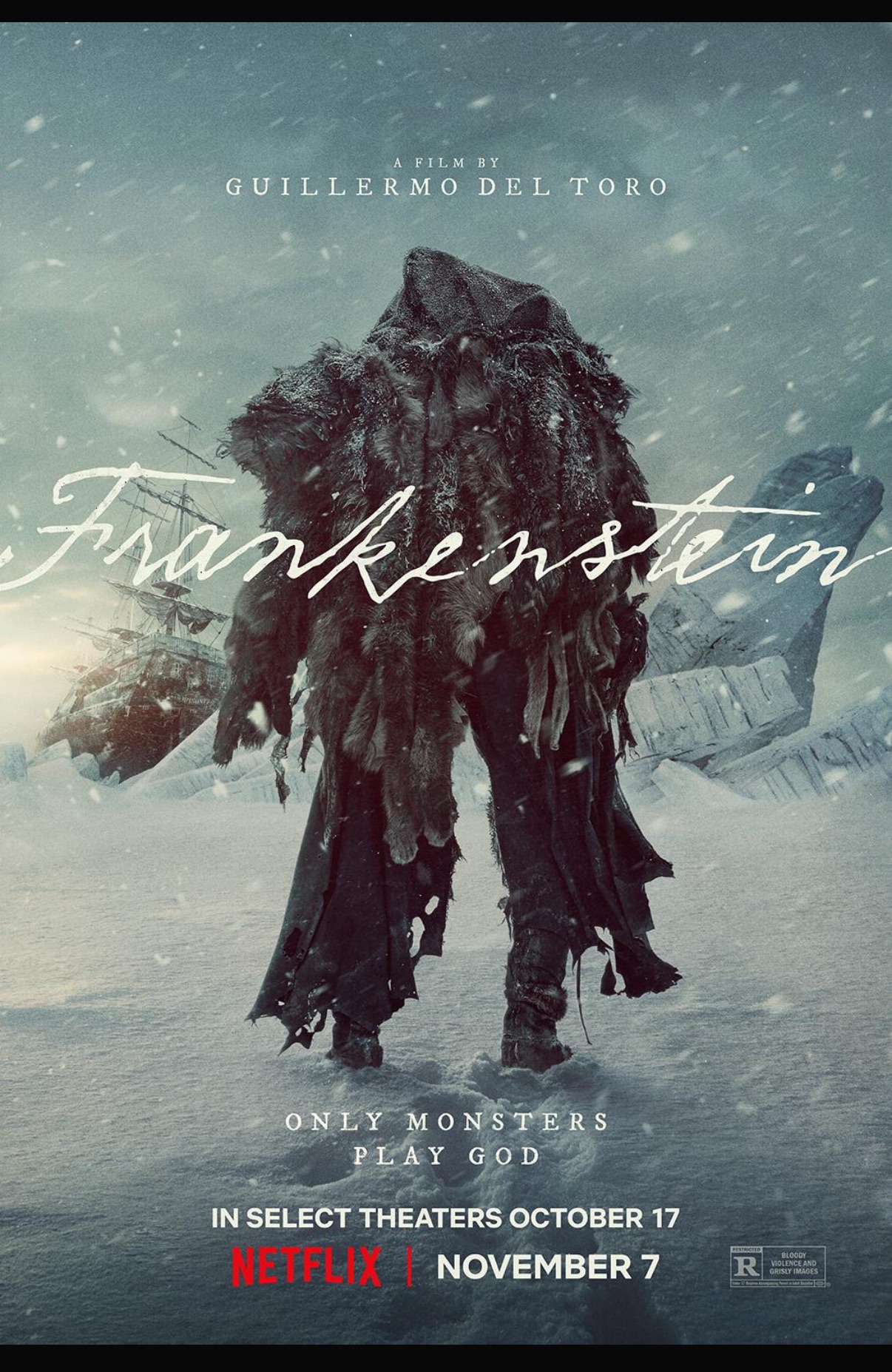
 Greetings again from the darkness. As a lifelong lover of cinema, I tend to latch on to the works of those who so obviously feel the same. Among those who have achieved some level of mainstream success are Martin Scorses, Quinton Tarantino, Steven Spielberg, and Christopher Nolan. Another filmmaker who definitely belongs in the group, and it may surprise some, is Guillermo del Toro (an Oscar winner for PINOCCHIO, 2022, and THE SHAPE OF WATER, 2017). Other gems in his oeuvre include CRIMSON PEAK (2015) and PAN’S LABRYNTH (2006). The esteemed director has long claimed that his “dream project” is a film version of Mary Shelley’s 1818 novel, “Frankenstein: Or, The Modern Prometheus”.
The dream is now a reality, and what a thing of beauty it is. The visuals here eclipse all expectations, and the only caution I would offer is that the tone and themes are a bit of a twist from traditional takes on the story … and we all know there have been many previous takes. All of this confirms what a remarkable source material Mary Shelley’s novel is. That’s not to say del Toro’s version is ‘new’, yet it’s certainly an oddity and an outlier to what we’ve come to expect from Frankenstein movies.
Setting the film in 1857 (nearly 40 years after the novel) affords del Toro some benefits of advancements, as well as audience familiarity to the times. It may seem strange, or even contrary, but to me, this film’s central theme is humanity – how we use it and how we sometimes work against it. An opening in the Arctic where creature (Jacob Elordi) and creator (Oscar Isaac) cross paths yet again – after chases that only become clear later in the film – and it’s horrifying and stunning. Pivotal to the sequence is Captain Anderson’s (Lars Mikkelsen, “House of Cards”, and brother of Mads) ship and crew.
Victor Frankenstein, the human God/creator, is played with enthusiastic ambition that often drifts into mania. He’s a man of science whose vision refuses to be contained. Even in success, his need to control override his accomplishments … meaning the creature is truly born into misery and pain, resulting in confusion and a need to find where and how he belongs. Is it possible for a laboratory experiment to be a tortured soul? Director del Toro clearly believes this … as did James Whale in those early versions. It’s in these moments where Elordi truly shines as the creature – it’s a terrific performance through prosthetics.
Two-time Oscar winner Christoph Waltz and Mia Goth (a dual role) are both terrific in supporting roles, and it’s best if nothing further is disclosed about their characters as each are key to the story. Beyond the fascinating, tragic, and heartbreaking story is a film with such stunning visuals that it stands alone as a work of art. Guillermo del Toro’s talented crew includes cinematographer Dan Laustsen, Production Designer Tamara Deverell, Oscar winning Set Decorator Shane Vieau, and two-time Oscar winning composer Alexandre Desplat, who delivers an incredible score (one certain to be nominated). Of course, as previously stated, this was the “dream project” of Guillermo del Toro, and he has delivered one for the ages … dreams really do come true!
 Movie Reviews from the Dark
Great review. I think you perfectly summed up my feelings on this movie. Frankenstein is a true work of art and one of my favourite films of the year. Guillermo Del Toro made a beautiful tribute to a celebrated monster. What I love most about this movie is how it imbues Frankenstein with unexpected humanity. It is a film made with so much compassion, care and passion. A dream project for Del Toro indeed. I hope to see it recognized at the upcoming Oscars.
Here’s my thoughts on the movie:
I agree with the point you make in your review about the romance/love story of Victor.
Mostly, I am in awe of the visuals that GDT continues to wow us with in his films.