DE PALMA (doc, 2016)

July 4, 2016

Oak Cliff Film Festival 2016
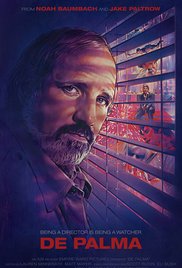
depalma Greetings again from the darkness. A self-inflicted career retrospective … that’s my most fitting description of this project from co-directors Noah Baumbach and Jake Paltrow. Rather than line-up a slew of third-party observers and collaborators, we get the famed director himself walking us film-by-film through his resume. That’s right, Brian De Palma discusses the De Palma film canon … and we movie lovers couldn’t ask for anything better.

Beginning with a clip of Vertigo, the doc leads with the Hitchcock influence, almost as a form of disclosure. It’s as if everyone associated is saying, Yes we admit it … Director De Palma has been heavily influenced and inspired by the works of Alfred Hitchcock. Now pay attention to what he’s done with his career – some really good, some not so good, some downright awful. “Underappreciated” might be the best label for De Palma. He was part of the “New Hollywood” with Spielberg, Scorcese, Coppola, and Lucas, yet they are worshipped, while De Palma is mostly ignored.

Mr. De Palma speaks directly to the camera and seems to thoroughly enjoy this opportunity to analyze (and at times defend) his career, providing a self guided reflective approach – a chronological retrospective that doesn’t shy away from his inability to put together a streak of successful films. This is direct talk (describing a particular bomb as “one of many disasters”) with no apologies from a filmmaker who has worked for five decades. He tells behind the scenes stories in a matter-of-fact manner, not always complimentary of himself, actors or the industry.

The stories and recollections are the highlight here. De Palma speaks highly of Wilford Leach (his mentor and professor at Sarah Lawrence), composer Bernard Hermann and Robert DeNiro, with less than flattering tales of Cliff Robertson (Obsession), Sean Penn (Casualties of War), and Oliver Stone (Scarface). It’s fascinating to hear De Palma explain the box office failure of his version of The Bonfire of the Vanities, address the scandal of Body Double, and describe in detail the simultaneous casting (with Spielberg) of Star Wars and Carrie. Even more eye-opening is his reminiscing on the back-and-forth with director Sidney Lumet as they played hot-potato with Scarface and Prince of the City.

Brian De Palma was Columbia University educated (math and physics), and has directed some of the most creative, colorful and controversial films – some of which never received their “due”. This may be mostly a film for those who want more inside-industry scoop, but it’s a man who takes pride in the fact that famed film critic Pauline Kael was a fan of his work, and that few directors have a more varied canon of film. His patented “holy mackerel” is on full display as he takes us on the journey of De Palma films, and it’s a reminder that “talking head” documentaries can still work … provided the talking head doing the talking is saying something worth listening to.

Here is a list of a few De Palma films over the years: Sisters (73), Phantom of the Paradise (74), Carrie (76), The Fury (78), Dressed to Kill (80), Blow Out (81), Scarface (83), Springsteen’s “Dancing in the Dark” video (84), Body Double (84), The Untouchables (87), Casualties of War (89), The Bonfire of the Vanities (90), Carlito’s Way (93), Mission: Impossible (96), Snake Eyes (98), The Black Dahlia (06).


MARCH OF THE LIVING (doc, 2016)

July 4, 2016

march of the living Greetings again from the darkness. Count me guilty as one of the movie lovers who have silently sworn off Holocaust movies. Actually, I’ve done so many times. Though neither Jewish nor German, revisiting these atrocities drains me of life force and has me questioning the human race … as if there aren’t plenty of current events already justifying such a reaction.

Director Jessica Sanders takes on the annual (since 1988) gathering of Holocaust survivors and Jewish teenagers as they turn what was once known as the March of Death (Auschwitz to Birkenau) into the March of the Living. It’s one of the most inspirational and life affirming presentations one could ask for. Many categorize the annual trek as a form of education, and while true, the label falls a bit a short. It’s also a legacy, a cultural phenomenon, and a reminder that the worst human beings are capable of unthinkable forms of evil, while the best possess a spirit that survives all.

Knowing this is the last generation of teenagers who will hear the stories directly from the concentration camp survivors adds a level of immediacy and poignancy. No history book can capture the soul-bearing pain as a survivor locates the stone at the Treblinka site which bears the family name Ostrowiec – her older sisters were killed there. Even when the teenagers react with such lines as “Dude, this is immense” (while viewing Birkenau), it’s obvious their normally cool façade is impacted by what they are seeing (including the mound of human ashes at Majdanek) and the personal stories being told.

Having the journey and film proceed to Israel reinforces the strength of a people, and leaves us with the film’s ultimate lesson … “not to hate, but to remember”.


LIFE, ANIMATED (2016, doc)

July 3, 2016

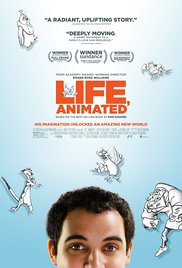
life animated Greetings again from the darkness. The magic of Disney takes on a whole new meaning for Ron and Cornelia Suskind, and their son Owen. Academy Award winning director Roger Ross Williams brings us the engaging story inspired by Ron’s best-selling book “Life, Animated: A Story of Sidekicks, Heroes and Autism”.

Ron, a well-respected journalist and writer, states … at age 3, our son Owen “disappeared”. Garbled talking and uneven walking took over their previously “normal” young son, and the doctor diagnosed “pervasive development disorder”. When the word “autism” was spoken, Ron and Cornelia realized their lives, and Owen’s, would never be the same.

Director Williams does an excellent job blending home movies, interviews and animation to give us a sense of what this family went through … and what an emotional wonder it was one evening when they realized that Owen was actually repeating the line “Just your voice” while watching The Little Mermaid. This led to “the first conversation we’ve ever had” as dad used an Aladdin puppet to talk with Owen.

It turns out that Owen had memorized ALL of the dialogue from that Disney classic, as well as all of the other Disney animated movies. What unfolds for the family is an ability to communicate through these movies, and with therapy, move Owen into a more mainstream lifestyle … speaking, reading, and writing. We get a peek at the professional therapy, as well as Owen leading his Disney club.

Much of the movie is structured to lead towards Owens independence at age 23 … a job and his own condo (in an assisted-living building). It’s interesting to hear the therapist discuss how the exaggerated features and emotions of the animated characters make it easier for Owen to interpret and understand – the stories and characters stay the same providing a sense of security and sameness for him.

Owen’s emotional range is on display with Emily (his first girlfriend) and his brother Walter (yep, can’t make this stuff up). It’s clear he understands the downside of independence (unpredictable life vs. scripted movies) while still leaning on his videos for the feel-good moments.

All parents have big dreams for what their kids might accomplish in life, but few parents are as thrilled and emotional as Ron and Cornelia when their son moves into his own place, and is later a featured speaker at a conference in France. Autism provides tremendous challenges for families and individuals, and if somehow animated Disney movies can provide life lessons and a forum for communication, then we should share in this family’s rejoicing. As they say … whatever works!

watch the trailer:


ROSEANNE FOR PRESIDENT! (2016, doc)

July 3, 2016

roseanne for prez Greetings again from the darkness. She was groundbreaking with her standup comedy and her top rated TV show (1988-97), and has always voiced her disdain towards the system that penalizes working class families. Roseanne Barr was a huge star with a talent for making people laugh, while also making a point. You likely know all of that, and probably don’t know that in 2012, she ran for President … of the United States … of America.

Director Eric Weinrib produced a couple of Michael Moore documentaries (Capitalism: A Love Story, Sicko), so it’s not surprising that he takes on the presentation of a comedic icon’s Presidential campaign … and includes interviews with Rosie O’Donnell, Michael Moore, and Tommy Smothers. We first see Roseanne smoking a joint while driving her car, and we soon learn her platform consists of: Legalizing marijuana, no more wars, and a bit of single-payer healthcare. Of course, this campaign (or this movie) isn’t so much about issues as it is the persona of Roseanne Barr.

She seems pretty “normal” while at home in Hawaii with her “long time boyfriend” John Argent. Things turn a bit surreal when we actually see the campaign in action as she competes against Dr. Jill Stein for the Green Party nomination. If you are unfamiliar with the Green Party, it is most noted for its 1968 candidate, Eldridge Cleaver. Roseanne’s campaign manager is Farheen Hakeem, who has almost as much screen time as the candidate herself. Why is that? Well, because Roseanne doesn’t much like to be around people, and prefers to give her speeches over Skype rather than in-person.

It’s here that we should note director Weinrib’s inclusion of Roseanne’s backstory, including her mental health issues stemming from being hit by a car while in high school. We are told she “woke up a different person”, and interviews with her brother, her sister, and her mother seem to confirm this.

Displaying her world class bitterness after losing the Green Party nomination, Roseanne rebounds by moving to the Peace and Freedom Party and naming Cindy Sheehan as her Vice Presidential running mate. We are informed she finished 6th nationally in the Presidential election, receiving more than 67,000 votes though limited to only being on the ballot in 3 states.

The campaign and the election are mere after-thoughts here, and the interest (if any exists) is derived from watching Roseanne the person/celebrity react to the moments as they come. The authenticity from her TV show is on display as her emotions prevent her from hiding her true thoughts – regardless of how brusque she might seem.

1990’s infamous rendition of The National Anthem at a Padres game is revisited, complete with the crotch grab and spit. So, when Roseanne states “They don’t recognize what I stand for or what I’ve done”, the filmmaker doesn’t let her off that easy. It’s a reminder of how sometimes one has to go along to get along, and that mere celebrity, emotion and sense of entitlement may not be enough to elicit change. Releasing the movie in the year of Donald Trump’s campaign makes the comparisons quite easy … even if the Donald has yet to join Roseanne’s now public profession of her love of pot.

watch the trailer: