Greetings again from the darkness. Do you often get accused of having a slightly demented sense of humor? Do you have secret crazy thoughts of seeking revenge on those who have wronged you? If so, writer/director Damian Szifron has a collection of short stories just for you!
Nominated for Best Foreign Language Oscar, Argentina’s entry is just now opening in the Dallas market where I live. To say Wild Talesis a wild ride would be quite an understatement. There are six short stories blended together, and while you may not recognize the theme immediately, it doesn’t take long before rage and retribution jump to the forefront in these seemingly typical slices of everyday life.
The best short stories make a quick grab for attention, and manage to convey character and setting from the beginning. The writing is crucial and can easily collapse in the hands of a less-proficient short story writer. But when it works, it’s fascinating to watch, and Mr. Szifron has a real talent for making us laugh in the midst of truly awful situations.
Not to give away any details, but the six stories involve: a remarkable “coincidence” on a flight, an unwelcome customer at a local diner, a close-quarters brawl at a bridge, the frustration of dealing with “the system”, misguided parental instincts in protecting their kid, and the most wheels-off wedding reception ever filmed.
If you are ever searching for an example of a dark comedy, this one will provide clarity. The seemingly unrelated stories are woven together through payback, though the price is often pretty high. Mr. Szifron’s stories remind us that life is not fair, but when it’s happening to someone else, we can still laugh about it.
Greetings again from the darkness. Imagine if Liam Neeson’s burned out Air Marshall from Non-Stopwas instead a one-time mob hit man who had seen better days. That seems to be the inspiration for director Jaume Collet-Serra’s film (yes, he directed Non-Stopas well). When a guy is a drunken mess with no family who speak to him and only one friend – his old mob boss – a nickname like The Gravedigger tends to conjure better days of yore.
Neeson plays Jimmy Conlon, the has-been hitman whose only remaining friend is boss Shawn Maguire (Ed Harris). These days, Conlon expends more effort emptying a glass than fulfilling a contract. Shawn respects their history and does all he can to protect his long-time friend who seems intent on boozing himself to death. As is customary in these “crime doesn’t pay” films, things get really messed up in the blink of an eye. Thanks to a wrong place at the wrong time moment, Conlon protects his own son (Joel Kinnaman) by shooting Maguire’s misguided son (Boyd Holbrook). Thus endeth the friendship.
The script is from Brad Ingelsby who wrote the original script for Out of the Furnace(2013), but most of it is pretty predictable. Still, with an excellent cast and some wildly creative camera work from cinematographer Martin Ruhe (Harry Brown, The American), this one offers plenty on the entertainment scale. The restaurant scene where Harris and Neeson face off is alone worth the price of admission.
As you might expect, there is plenty of gun play and swagger, but as the title suggests, mostly it’s a game of running and being chased … featuring a crazy car chase. Neeson has an extended public bathroom fight scene with Holt McCallany, and the detective played by Vincent D’Onofrio continues his decades long pursuit of Neeson’s character. Bruce McGill plays Harris’ right-hand man and Common is a steely new age hit man. Kinnaman’s wife is played by Genesis Rodriguez, and the film’s most bizarre scene features a grizzled Nick Nolte – you will find yourself asking “is that him or not?”
Mr. Collet-Serra has directed Unknown and Non-Stop, so Neeson is quite comfortable working with him, and you should certainly know what to expect going in. The friendship between two mobsters ends the way most do, and it’s another take on the blood family vs mob family loyalties. The Gravedigger may have one foot in his own grave, but he also has enough left for one wild night.
Greetings again from the darkness. The writings of Shakespeare are certainly timeless and it’s often quite fun to watch filmmakers or stage directors bring The Bard’s stories into a contemporary setting. A fine example is director Joss Whedon’s modern and quite enjoyable twist on Much Ado About Nothinga couple of years ago. Director Michael Almereyda had success with his modern day Hamlet in 2000, and here he re-teams with his Danish Prince from that one (Ethan Hawke) to bring one of Shakespeare’s lesser known “problem plays” to screen.
This modernization turns King Cymbeline into a Biker gang leader (Ed Harris) as he battles not the Romans, but rather a corrupt police force led by Vondre Curtis-Hall. As one would expect there is no shortage of deceit, violence and love of the “wrong” person. There are numerous sub-plots intertwined with the desire of the King and his Queen (Milla Jovovich) to marry her daughter (Dakota Johnson, 50 Shades of Gray) to his son (Anton Yelchin). Before your stomach turns, it should be pointed out that both kids are from previous marriages. It’s not surprising to discover that the daughter is really in love with someone of whom the Royal parents don’t approve – a brooding skateboarder (Penn Badgley).
The assembled cast is quite impressive. In addition to those previously mentioned, we also have Peter Gerety, Bill Pullman, Delroy Lindo (always great), John Leguizamo, Spencer Treat Clark (the kid from Gladiator) and Kevin Corrigan. The issue here is not the acting talent, but rather that some seem more comfortable with Shakespeare speak than others. Hawke, Yelchin and even Ms. Johnson seem to embrace the dialogue, while Leguizamo, Harris (in his shiny new leather jacket) and especially Badgley are fish out of water. And for some reason, Ms. Jovovich is mostly wasted despite adding much appreciated spirit to a couple of scenes.
Describing this as Shakespeare’s “lost masterpiece” is quite a stretch, but there is always some pleasure in hearing his words spoken. It’s just a shame when the project lacks energy and is lethargic in pacing … two elements that prevent us from ever connecting with any character. Still, any film that features a sky blue AMC Pacer can’t be all bad.
Greetings again from the darkness. It is initially a bit disorienting to settle in to watch a Western shot in South Africa by Danish filmmakers with a story based in 19th century America. However, any doubts are quickly forgotten thanks to terrific writing, powerful acting, and creative camera work set to a distinctive soundtrack.
Blood, dirt, politics, true loss and crackling gun play accompany what is, at its core, a story of vengeance … and of course, good vs evil. We open in 1871 America, seven years after Jon (Mads Mikkelsen) and his brother Peter (Mikael Persbrandt) left Denmark after fighting in the war. Today is the day that Jon’s wife (singer Nanna Oland Fabricius) and son (Toke Lars Bjarke) arrive, and the separation has been tough on all. The reunion is destroyed in the most awful manner imaginable thanks to a couple of drunken ex-cons sharing the stagecoach. Of course, salvation and vengeance would not be required if there were no turning point, and Jon’s natural reaction is what sparks the real fireworks in the story.
One of the bad guys on the wagon is the brother of powerful local gangster Delarue (Jeffrey Dean Morgan). We quickly learn he is not a rational man and cares little for anything other than making money and gaining revenge on his brother’s killer. Delarue stands for all the bullies of any era, while Jon and his brother Pete represent the huddled masses incited to action only through gross injustice. There are many details and elements that set this above the traditional western, and one of those is the presence of Madelaine (Eva Green) who was married to Delarue’s murdered brother, and was previously disfigured and muted by Native Americans.
It’s impossible not to notice the similarities and influences of John Ford, Sergio Leone and the classic High Noon(cowardly townspeople, morals corrupted under duress). Director Kristian Levring even superimposes the very familiar vistas of Monument Valley into some shots, and it’s done so well that our eyes simply accept the landscape. Mr. Levring also presents us a uniquely lit stagecoach in the moonlight scene that was beautiful to look at, despite the violent nature of what was happening. Composer Kasper Winding (brother to director Nicolas Winding Refn) adds a distinctive guitar that recalls the haunting effects of Ennio Morricone’s soundtrack to Leone’s classic Once Upon a Time in America… a very effective complement.
The lead actors are superb and well cast – though Jeffrey Dean Morgan goes 180 degrees against type as the evil-to-the-bone Delarue. Eva Green speaks volumes with her fiery eyes, and Mikael Persbrandt (who was so great in In A Better World) adds to the quiet-wild feel of the film. The bulk of the action falls to Mads Mikkelsen, who thanks to Casino Royale, The Hunt, and TV’s “Hannibal” has become one of the finest actors working today. His facial tics and emotional depth convey much with few words, and his character’s expert marksmanship with a Remington rifle is a welcome shift from the spraying automatic weaponry too common in film these days.
The politics of taking advantage of the unaware weak runs throughout the films, especially with the methodical “land grab” occurring so that the rich can capitalize on the “sticky oil” spoiling the water wells. You may not be a fan of Westerns, but there is much going on in this excellent script – and the visuals combined with expert acting should allow you to appreciate what expert filmmaking this is (especially given the low budget).
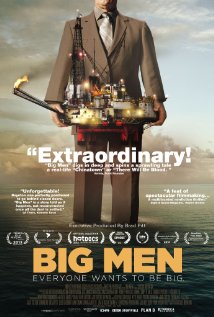
Greetings again from the darkness. The best we can hope for from a documentary is that it tells both sides to the story. But what happens when there are even more sides? Director Rachel Boynton expertly presents the perspective of numerous parties trying to secure their fair share (or more) of the first commercial oil field in Ghana … known as Jubilee Field. Her surprising and unprecedented access offers us a behind-the-scenes glimpse of what happens when business and politics mix during a clash of cultures.
Beginning with spot on quotes concerning greed and special interest – one from economist Milton Friedman and one from the 1948 movie The Treasure of the Sierra Madre– the movie spans the years of 2007 through 2011 as Dallas-based Kosmos Energy frantically maneuvers to develop this oil find while juggling the Ghana monarchy and government (two administrations), as well as the pressures from venture capitalists and investors Blackstone and Warburg Pincus.
Ms. Boynton’s access to closed-door meetings and negotiations is fascinating, as are her brief encounters with the local militant rebels (The Deadly Underdogs) on a mission to grab a share of the money – often by cutting the pipelines and starting fires (they want the contracts for clean-up). She interviews oilman Jim Musselman while he is President of Kosmos and he is negotiating with the Ghana government and King, and then again after he is ousted from the company by the Board of Directors who are demanding a quicker return on their investment.
The Ghana situation is contrasted to Nigeria, which is currently the 5th largest oil supplier to the United States. The billions in oil profits have not benefited the citizens of Nigeria, who continue to live in harsh poverty. The Ghana government gives every indication they don’t want this to be the case with Jubilee Field … even though they have had the same results with gold and cocoa. What we soon learn (though we already knew) is that every party involved, despite the words they speak, really have only their self-interest at the forefront.
When the election changes the players in Ghana, we see Kosmos scramble to maintain the agreements and their rights. Outside pressures and investigations add further turmoil and we begin to see that rational thought and fairness are rarely in play. There may be plenty to go around for everyone, but that matters little since everyone employs the “greed is good” approach. The culture clash is undeniable, but greed is the great equalizer.
We witness the May 2011 IPO for Kosmos Energy from the trading floor of the New York Stock Exchange, and it’s a reminder of what a strange world “big money” is on Wall Street, and maybe only the “big men” really understand. Boynton’s documentary does everything possible to enlighten the rest of us.
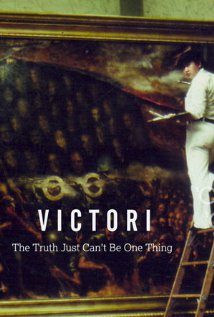
Greetings again from the darkness. Artists often don’t make for the best interviews. They usually best express themselves through their art – whether that’s music for the ears, words on a page, or paint on a canvas. So it’s understandable that director Michael Melamedoff thought it wise to focus attention on Ed Victori, the young, articulate, poised and educated son … rather than on the eccentric artist himself, Victor Victori. Unfortunately, this approach leaves us tired of Ed and longing for more Victor.
Victor emigrated to the U.S. from South Korea in 1972, and his first major project was a mural depicting all Presidents to that point in time. The mural is still displayed in the White House even today. Much of his career was spent traveling the country painting portraits … not just celebrities and industry leaders, but also the general public. Many of his stops were in shopping malls where his unusual speed allowed him to crank out enough portraits to make money and move on to the next stop.
Director Melamedoff picks up the story when Ed had been laid off from his corporate job in Finance, and has decided to become an art consultant representing his father’s work. We see the build up to the 2012 New York Art Expo, where Ed and his mother Maria do most of the marketing and set-up, while Victor continues to paint. The emphasis seems to be selling Victor’s immense body of work (more than 50,000 per Maria) with a concentration on Multiplism … a self-titled art movement that captures multiple faces and emotions of the same subject within a painting.
By far the most interesting moments come courtesy of the interviews and insight from Victor himself. He is a fascinating guy with the true artist’s disposition – enough ego to believe his work belongs alongside the greats, and enough insecurity to facetiously explain his lack of mass audience acceptance with “I’m sorry I didn’t paint pretty pictures”. That comment is in reference to the immensely popular works of Thomas Kinkade, whom Victor accuses of “cheating” through mass-produced reproductions that are nothing more than “pasting on canvas”. His frustrations are palpable. Victor also claims he pays no attention and is not influenced by other painters, but rather by the music of Beethoven … an unusual revelation by one who paints and sculpts.
While at the Expo, there are some quick exchanges with other artists who display a similar ego/insecurity/desperation blend. It’s during the Expo that Ed’s clinical and business-type approach is most obvious. He clashes with Maria, who just wants to sell enough of the work to make money, while Ed’s vision is to establish his father as a great artist, thereby establishing himself as a legitimate art consultant. The age old clash of commerce and art is on display, but all we really want is more time from Victor, so we can hear him explain why Andy Warhol is not a great artist, but he himself should be recognized as one.
Greetings again from the darkness. Childhood friends are the best. Sharing your inner most thoughts and goofy actions before the emotional self-defense shields of adult life kick in create some of the best memories we will make. That moment when those childhood friends try to force a romantic connection – and it fails miserably – is not just an awkward moment, but also a life-changing one. Liza (Zoe Worth) and Eli (Alden Ehrenreich) share just such a moment … and their friendship changes immediately, even though they don’t admit it for a few years.
The film bounces around from Liza and Eli’s high school days, to leaving for college, to a break from school, and finally 4 years later. They are the kind of friends who speak in code and have their own hand signals to communicate. Really, they are pretty normal except that for lack of mingling with other friends. And by pretty normal I mean they are actually kind of boring. You know the kind of boring where someone thinks they are way more interesting than they really are? That’s Liza and Eli.
On the bright side, we don’t get too many movies that play out like a hidden camera is following two friends. It feels like we are watching Liza and Eli come to grips with the first steps of adult life – and they don’t seem to like it all that much. Again, that’s pretty normal. This coming of age process includes family parties, quirky little road trips, sexual tension, tent camping to unwind, spontaneous dodge ball, carpooling (and more) with a school friend-turned-weed-dealer (Zachary Webber), dreams of a Labradoodle, and yes, even ukulele music (on more than one occasion).
There are some elements in this film from writer/director Melanie Shaw that remind me of the very fine indie gem Once (2006) and even the classic The Graduate(1967). We can certainly relate to Liza and Eli envisioning themselves as a modern day Bonnie and Clyde couple – minus the gunplay, and we have all felt that moment, and cracked that smile, when someone says … “I just wanted to look at you“.
Greetings again from the darkness. More Romantic-Drama than Romantic-Comedy, the story spans 12 years – a necessary change of structure from the 45 year saga of Cecilia Ahern’s novel and source material “Where Rainbows End”. It’s a familiar theme of boy-girl friendship muddled by quasi-romantic interludes of frustration, confusion, missed signals, and misplaced pride.
Rosie (Lily Collins) and Alex (Sam Clafin) have been friends since they were 5 years old, and their bond means they discuss everything from Alex’s weird dreams to leaving England together. Well, everything except what they really think of each other. On Rosie’s 18th birthday, a poorly executed, drunken spin atop a barstool, leads to the proverbial fork in the romantic road … and off to the dance go Rosie and Alex with other partners. One cringe-inducing condom mishap later and Alex is headed off to school in the U.S., while Rosie stays behind to tend to other responsibilities.
In the mode of One Day, or Four Weddings and A Funeral, we track the separate lives of Rosie and Alex. Though connected mostly through texts, the next dozen years bring more than enough opportunity for these two to right a wrong, but predictably bad timing is always their worst enemy. The adapted screenplay from Juliette Towhidi (Calendar Girls) and the direction of Christian Ditter allow us to really understand Rosie and care for her, while the supermodel dalliances of Alex keep him at arm’s length.
The film’s best scenes and most interesting sequences are those centered on Rosie. Lily Collins (Phil’s daughter) really steps up her game here and shows some promise for things to come in her career. Most enjoyable are her scenes with the more streetwise Ruby (played by Jaime Winston, daughter of the very cool Ray). The film’s weakest moments involve the attempts at slapstick humor. The two worst: a scene involving handcuffs and a headboard and an elementary school; and another scene with the group awkwardly scurrying through an airport. Both seem out of place with the almost pensive nature of so many other moments in the film.
In an attempt to lighten the mood and ensure the viewers are on track, numerous songs are utilized and act almost as a narrator for the dramatic turns. Most of these are a bit overbearing rather than serving as a complement to the story. Despite the shortcomings, the message of friendship and dreams is one worth delivering … even if the presentation may be a bit cheesy except for the most hopeless of romantics amongst us.
Greetings again from the darkness. Known for an endless stream of copycats and re-treads, the horror genre periodically surprises us with a dose of originality. Heck, we don’t even ask horror filmmakers for anything too revolutionary … just give us something we haven’t seen a few dozen times before. Writer/director David Robert Mitchell “gets it” and delivers a game of psycho-sexual-tag-you’re-it featuring the most sinister STD ever.
A definite departure from the all-too-common teen slasher films, the slow-drip terror of this one has more in common with dread and eventuality than scream-inducing terror and “made you jump” scares. When we first meet Jay (Maika Monroe), she is a typical pushing-twenty student who enjoys leisurely swims in her suburban backyard pool, hanging out with friends, and a healthy dating scene. Well, healthy until one evening of back seat passion with Hugh (Jake Weary) sets off the above-mentioned sinistry. See Jake has purposefully “passed on” some kind of affliction that attracts a death-seeking entity who slowly, but purposefully pursues its target. Supposedly the only options are to be killed or pass it on through more passion … the worst kind of “pay it forward”.
Jay is supported in her ongoing attempts to avoid the entity by her sister Kelly (Lili Sepe), her neighbor and classmate Greg (Daniel Zovatto), and Paul (Keir Gilchrist) her not-so-secret admirer who would do anything to protect her. The big catch is that only Jay can see the entity … making heroism quite elusive for her support group.
Lest there be any doubt of the dire situation, director Mitchell begins the movie with a very vivid example of the likely result in being “caught” by the entity, and adds the score from composer Disasterpeace … an ominous throwback techno-sound that would be distracting if not so fitting. This has all the makings of a breakout role for Maika Monroe, with similarities to Jamie Lee Curtis in the original Halloween movie (1978).
The low budget caused some obvious production limitations – in particular an awkward bounce from day to night and back again, and some iffy effects. However, the suburban Detroit setting provides a nice backdrop, and of special note are the Redford Theatre (est 1928) replete with its beautiful pipe organ, and the indoor swimming pool put to spectacular use in the film’s climax. As long as the audience is not expecting the typical teen slasher, this creative horror film should gain an audience while putting director David Robert Mitchell on the fast track to bigger budget films.
Greetings again from the darkness. If only drive-in theaters were still the weekend hang-out of choice for teenage boys, this latest from director Joe Lynch would be the perfect second feature after some horror or slasher designed to generate oohs and ahhs through gross-outs (elevators and grenades are not a good mix).
After beginning with its most unsettling scene – gang abuse of a female (fortunately via black screen and sound effects) – the rest of the film plays just like an ultra-violent, hyper-speed video game. The two main distinctions here are that all of the action takes place inside a loft apartment, and the lead character is played by Salma Hayek. Having appeared in Desperado and From Dusk Til Dawn, Ms. Hayek is no stranger to wild action sequences, but here she carries every carnage-filled scene … all while slinking around in a silk slip or her favorite yoga pants.
Gun, knives, swords, grenades, chemicals and various other implements of destruction are brandished by Hayek, masked killers, greedy hookers, a SWAT team, and Hayek’s ex-pimp/kidnapper. We even get a character called “The Sadist” (Togo Igawa) in one of the most straight-forward character names in movie history. There is even an attack dog named Bonzai that is well-trained in everything except the difference between a ball and a grenade. And therein lies the saving grace here … the movie has some absurd humor that prevents the ultimate tone of dread by such films as Saw. The humor isn’t so much clever as it is outrageous … and it helps offset the gruesome and blood-filled body count (at least 20 in the first 20 minutes!).
Director Joe Lynch is more comfortable with horror films than action films, but it’s clear he has a love with B-movies, and he is fortunate enough to have Salma Hayek front and center. The only way to watch this is with your brain shifted to neutral. The level of ridiculous is off the scale and includes too many “that makes no sense” moments to recap here. On top of all that, the action occurs around Christmas, and use of six traditional Christmas songs adds to the twisted humor that will probably keep you tuned in, despite your knowing better.
**NOTE: For those in the Dallas area, this will be playing at the Texas Theatre
 Greetings again from the darkness. Do you often get accused of having a slightly demented sense of humor? Do you have secret crazy thoughts of seeking revenge on those who have wronged you? If so, writer/director Damian Szifron has a collection of short stories just for you!


 Posted by David Ferguson






 Movie Reviews from the Dark