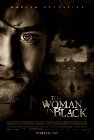
 Greetings again from the darkness. The quest for quality horror films is a never-ending project. Since low budget fright fests are the easiest way to make money in Hollywood, most take shortcuts that leave us feeling cheated. This remake of a 1989 British TV horror film actually has wonderful production design … the Gothic mansion is a sight to behold. Unfortunately, the shortcut here was a story that offers little substance, despite being based on Susan Hill‘s novel.
Daniel Radcliffe (yes, Harry Potter himself) plays a young, widowed solicitor named Arthur Kipps, who is still grief stricken, and now on the verge of losing his job. He is given one last chance to prove his mettle to the firm by going to a remote village to settle the affairs of recently deceased client. His young son (Misha Handley) and his nanny are to meet him in the village a few days later.
 The local townspeople clearly don’t want him there and are constantly trying to shoo him back to London. Of course, no one ever bothers to tell him why they are frightened and why they are so angry with him for going to the old house. This mansion is a work of art. It has the necessary creep factor to star in a real horror film. The furnishings and fixtures and decor are really the star of the movie. In fact, the DVD should include a segment on the antique mechanical toys. It’s not giving away anything to say that every time Radcliffe sees this mysterious woman in black, something bad happens in the village. The mystery is solved easily enough as we read along while Radcliffe organizes the letters.
The annoying thing about the film is that whenever we get a chill-inducing moment like a shadow in the background or a figure passing by a mirror, it is immediately followed up by a cheap parlor trick involving a sonic blast of music and an ear-piercing scream. It’s as if the director (James Watkins) is convinced movie goers are too ignorant to know when to be scared. His solution: provide clues to say “Scream now!” Ciaran Hinds and Janet McTeer add a touch of class to the film as Mr.and Mrs. Daily, who recently lost their son. Mr. Daily has found solace in the bottle, while Mrs. Daily teeters on the brink of insanity. My theory that no film featuring Mr. Hinds can be all bad is tested here, and Ms. McTeer was seen recently as the best thing about the Albert Nobbs film.
 On a positive note, this is a nice transition movie for Daniel Radcliffe. He has quite a career challenge as he tries to break loose of the Harry Potter clamp. He succeeds here with quite a different physical appearance, though he really has little to do but alternate between a distantly forlorn look and peering cautiously around dark corners. A couple of interesting notes: the boy playing his son is Radcliffe’s real life godson; and the actor who played Radcliffe’s role in the 1989 original is Adrian Rawlins, who played Harry Potter’s father in those movies.
By the way, how long until Daniel Radcliffe realizes he should just steer clear of train stations?
SEE THIS MOVIE IF: you are desperately seeking a horror film that isn’t a slasher … even if it’s not very good OR you are anxious to see Daniel Radcliffe first real step towards a film career outside of “Harry Potter” OR you just want to see a beautifully creepy haunted house
SKIP THIS MOVIE IF: you are expecting a classic horror story in the vein of Poe OR you have had your fill of cheap tricks designed with no purpose other than to cause viewers to jump
watch the trailer:


 Posted by David Ferguson



 Movie Reviews from the Dark